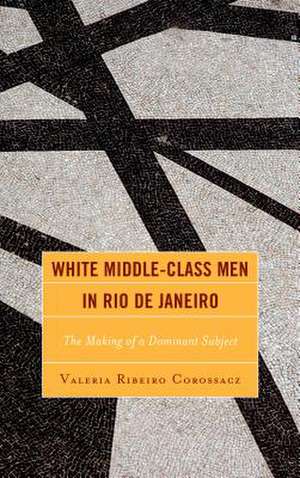
White Middle-Class Men in Rio de Janeiro: The Making of a Dominant Subject: Latin American Gender and Sexualities
Autor Valeria Ribeiro Corossaczen Limba Engleză Hardback – 6 dec 2017
Preț: 543.71 lei
Preț vechi: 610.91 lei
-11%
Puncte Express: 816
Carte tipărită la comandă
Livrare economică 21 noiembrie-05 decembrie
Livrare prin curier în România Termenul estimat este afișat lângă disponibilitate.
Transport gratuit pentru acest produs Plată online sau ramburs, în funcție de opțiunile comenzii.
Retur gratuit în 14 zile Comandă securizată și suport în română.
Specificații
ISBN-13: 9781498546423
ISBN-10: 1498546420
Pagini: 140
Dimensiuni: 150 x 232 x 14 mm
Greutate: 0.36 kg
Editura: Bloomsbury Publishing
Colecția Lexington Books
Seria Latin American Gender and Sexualities
Locul publicării:New York, United States
ISBN-10: 1498546420
Pagini: 140
Dimensiuni: 150 x 232 x 14 mm
Greutate: 0.36 kg
Editura: Bloomsbury Publishing
Colecția Lexington Books
Seria Latin American Gender and Sexualities
Locul publicării:New York, United States
Cuprins
Contents
Acknowledgements
Introduction: Looking at the Norm
Chapter 1: The Dominant Subject
Chapter 2: An Unusual Research Topic
Chapter 3: Unspoken Whiteness
Chapter 4: Learning Domination
Chapter 5: Race, Class and Gender
Conclusion
References
About the Author
Acknowledgements
Introduction: Looking at the Norm
Chapter 1: The Dominant Subject
Chapter 2: An Unusual Research Topic
Chapter 3: Unspoken Whiteness
Chapter 4: Learning Domination
Chapter 5: Race, Class and Gender
Conclusion
References
About the Author
Recenzii
Brazilian-Italian anthropologist Valeria Ribeiro Corssacz offers an interesting glimpse into white privilege in her book. . . . White Middle-Class Men in Rio de Janeiro: The Making of a Dominant Subject is a relatively short yet thorough read. It would especially appeal to students and academic professionals interested in anthropology, sociology, gender studies, ethnic studies, Latin American studies, Lusophone studies, or African diasporic studies. Corssacz' work. . . is written in a manner that students of all levels can grasp.
In a penetrating analysis that is at once timely and long overdue, Ribeiro Corossacz examines the self-perceptions of Brazil's most privileged citizens: middle-class white men living in the nation's most iconic city. "What makes a white man white?" she asks her interviewees-and is often met by a telling combination of silences and stories of domination. In highly readable prose, backed by thorough scholarship, Ribeiro Corossacz pursues what Laura Nader long ago called "studying up"-investigating the lives of those, who by virtue of their constructed identities, wield power and privilege in the durable hierarchies of global capitalism. Readers will discover here a valuable contribution not just to Latin American studies but to urgent theories of intersectionality.
White Middle-Class Men in Rio de Janeiro: The Making of a Dominant Subject by Valeria Ribeiro Corossacz is a beautifully written, rigorously researched, and groundbreaking ethnography of racial consciousness. This "ethnography of consciousness" is a significant empirical and theoretical contribution to a Critical Race Studies, Whiteness Studies, Latin American Studies, and Brazilian Studies. It is a standout and should be required reading for anyone interested in critical race theory.
Valeria Corossacz Ribeiro's book provides a much needed and powerful analysis of whiteness in Brazilian society. The stories of white Brazilian men and their relations with nonwhite domestic employees reveal white privilege unlike that discussed for the global North, illuminating an important aspect of the Brazilian racial system.
In a penetrating analysis that is at once timely and long overdue, Ribeiro Corossacz examines the self-perceptions of Brazil's most privileged citizens: middle-class white men living in the nation's most iconic city. "What makes a white man white?" she asks her interviewees-and is often met by a telling combination of silences and stories of domination. In highly readable prose, backed by thorough scholarship, Ribeiro Corossacz pursues what Laura Nader long ago called "studying up"-investigating the lives of those, who by virtue of their constructed identities, wield power and privilege in the durable hierarchies of global capitalism. Readers will discover here a valuable contribution not just to Latin American studies but to urgent theories of intersectionality.
White Middle-Class Men in Rio de Janeiro: The Making of a Dominant Subject by Valeria Ribeiro Corossacz is a beautifully written, rigorously researched, and groundbreaking ethnography of racial consciousness. This "ethnography of consciousness" is a significant empirical and theoretical contribution to a Critical Race Studies, Whiteness Studies, Latin American Studies, and Brazilian Studies. It is a standout and should be required reading for anyone interested in critical race theory.
Valeria Corossacz Ribeiro's book provides a much needed and powerful analysis of whiteness in Brazilian society. The stories of white Brazilian men and their relations with nonwhite domestic employees reveal white privilege unlike that discussed for the global North, illuminating an important aspect of the Brazilian racial system.