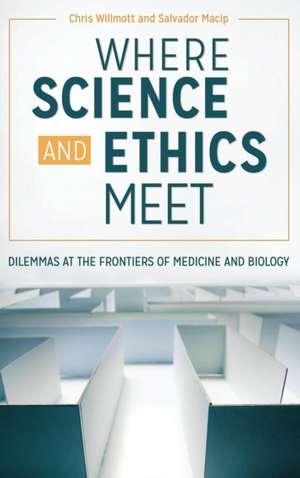
Where Science and Ethics Meet: Dilemmas at the Frontiers of Medicine and Biology
Autor Chris Willmott, Salvador Macipen Limba Engleză Hardback – 13 iun 2016
Recent biomedical discoveries promise considerable improvement in the quality of human life, but they also hold the potential to permanently alter society. Are the anticipated benefits worth the price we would have to pay for them? In Where Science and Ethics Meet: Dilemmas at the Frontiers of Medicine and Biology, a biochemist and a biomedical researcher who are highly experienced in explaining ethics for lay audiences present the most innovative advances in biomedicine and enable readers to develop their own opinions about the ethical and social consequences these technologies will bring.
Each controversial topic in modern medicine and ethics is introduced through a hypothetical case study that highlights thorny ethical issues before explaining the key aspects of the science and technology involved and addressing the associated ethical considerations in detail. The interdisciplinary treatment of the topics makes the book relevant to students of science, medicine, ethics, law, and sociology as well as health care professionals.
Preț: 301.43 lei
Preț vechi: 449.76 lei
-33%
Puncte Express: 452
Carte tipărită la comandă
Livrare economică 06-20 iunie
Specificații
ISBN-13: 9781440851346
ISBN-10: 1440851344
Pagini: 192
Dimensiuni: 156 x 235 x 13 mm
Greutate: 0.51 kg
Editura: Bloomsbury Publishing
Colecția Praeger
Locul publicării:New York, United States
ISBN-10: 1440851344
Pagini: 192
Dimensiuni: 156 x 235 x 13 mm
Greutate: 0.51 kg
Editura: Bloomsbury Publishing
Colecția Praeger
Locul publicării:New York, United States
V-ar putea interesa
-
 -44%Preț: 396.54 lei706.19 lei
 -
 The Ethics of Transplants: Why Careless Thought Costs LivesJanet Radcliffe Richards-10%Preț: 118.15 lei131.50 lei
 -
 Careless Thought Costs Lives: The Ethics of TransplantsJanet Radcliffe Richards-7%Preț: 112.55 lei120.75 lei
 -
 The Future of Bioethics: International DialoguesAkira Akabayashi-26%Preț: 775.59 lei1053.83 lei
 -
 -27%Preț: 545.71 lei748.82 lei
 -
 -28%Preț: 674.66 lei940.14 lei
 -
 -23%Preț: 671.19 lei875.85 lei
 -
 -18%Preț: 834.01 lei1015.04 lei
 -
 Ethics Field Guide: Applications to Rehabilitation PsychologyThomas R. Kerkhoff-28%Preț: 432.78 lei598.89 lei
 -
 -37%Preț: 381.97 lei602.05 lei
 -
 -31%Preț: 168.04 lei242.25 lei
 -
 Advance Directives in MedicineChris Hackler-37%Preț: 479.56 lei765.32 lei
 -
 -41%Preț: 356.35 lei602.25 lei
 -
 -17%Preț: 243.41 lei294.95 lei
 -
 Fatal Freedom: The Ethics and Politics of SuicideThomas Szasz-37%Preț: 380.57 lei602.36 lei
 -
 -5%Preț: 187.08 lei196.93 lei
 -
 Ethics in Speech and Language TherapyRichard Body-5%Preț: 442.25 lei465.52 lei
 -
 -31%Preț: 449.93 lei653.41 lei
 -
 PsychosurgeryMarc Lévêque-21%Preț: 595.04 lei749.56 lei
 -
 Biological Determinism, Free Will and Moral ResponsibilityChris WillmottPreț: 450.36 lei
 -
 Handbook of Global BioethicsHenk A.M.J. ten Have-18%Preț: 2987.34 lei3643.10 lei
Cuprins
Preface
Chapter 1 Designer Babies: Choosing Our Children
Chapter 2 Haven't I Seen You Before?
Chapter 3 Exchange Parts for Everybody
Chapter 4 How to Improve Yourself
Chapter 5 Who Wants to Live Forever?
Chapter 6 Big Brother Is Watching . . . Your Genome
Chapter 7 Something on Your Mind?
Chapter 8 Playing God
Chapter 9 Trust Me, I'm a Scientist!
Afterword
Notes
Index
Chapter 1 Designer Babies: Choosing Our Children
Chapter 2 Haven't I Seen You Before?
Chapter 3 Exchange Parts for Everybody
Chapter 4 How to Improve Yourself
Chapter 5 Who Wants to Live Forever?
Chapter 6 Big Brother Is Watching . . . Your Genome
Chapter 7 Something on Your Mind?
Chapter 8 Playing God
Chapter 9 Trust Me, I'm a Scientist!
Afterword
Notes
Index
Recenzii
I would highly recommend this book to someone thinking about studying ethics, or simply as an entertaining read. . . . [T]he issues discussed make for stimulating conversation, and for this very reason the book would be a welcome addition on my shelf.
This book is a fantastic introduction to the major ethical issues facing modern science. . . . This would be an ideal textbook for biomedical ethics courses, as it offers an easily digestible initiation into the current moral dilemmas that are and will be addressed by scientific researchers, health practitioners, and society for years to come. It cannot be more highly recommended for all readers-bench scientists, medical professionals, and general readers alike. Summing Up: Essential. All readers.
Overall, the book represents a valuable contribution to the ethics of new developments in medicine and biology. Despite the multiplicity of competing views regarding the moral standing of new biotechnologies and practices, Willmott and Macip fulfill their promise of providing epistemologically balanced tools to the reader. The authors begin each chapter by presenting an everyday story that exemplies the challenges, limits, and questions raised by the technology or practice. This approach catches the reader's attention from the outset. Finally, the dialogical style of presenting the story earns the reader's sympathy, certainly a useful tool to begin ethical reflection. . . . [The book] certainly represents a valuable tool for teaching ethics at the undergraduate level and for engaging a wider audience in the challenges arising from scientific and biotechnical developments.
This book is the best introduction to the topic that I have ever seen. . . . In a highly original way, it educates and engages readers in the profound issues and choices made possible by advances in biomedicine. . . .This is exactly the kind of book that can help readers think clearly about biomedical advances whose speed always seems to outstrip the capacity to analyze and weigh the ethical implications of the choices they pose.
Where Science and Ethics Meet calls attention to both the benefits and shortcomings of the human desire to 'play God,' and the various implications this has for modern society as a whole. The sheer speed and vigour with which scientific research has propelled itself forward is often so blinding that we tend to forget about the negative consequences of such novel developments. Wilmott and Macip present the issues in a balanced way, leaving it up to the reader to draw their own conclusions from the information given. . . . the book [is] ideal for those already beginning their studies into the subject, or simply those curious to venture into something new. . . . Wilmott and Macip write to inform their readers on an easily understandable level, and to stimulate questions within the next generation of budding bioethicists-objectives which they achieve with ease. Anyone unfamiliar with, or new to the subject area should definitely buy a copy, as it truly is a aluable tool in learning how to approach debate, and offers a much more practically applied approach to education in bioethics than many books.
This is a very engaging book and a perfect introduction to the minefield that is bioethics. . . . Both authors are lecturers at
Leicester University and this book reflects their experience in teaching and engaging students and, as such, offers ideal material for students from a range of disciplines-science, medicine, ethics, law, and sociology. . . . There is enough meat here to satisfy anyone who wants to be better informed and to think seriously about ethics at the frontier of medicine and biology. And for those who know it all already(!) this book would be a great resource to keep to hand for talks, discussions, and teaching.
This book is a fantastic introduction to the major ethical issues facing modern science. . . . This would be an ideal textbook for biomedical ethics courses, as it offers an easily digestible initiation into the current moral dilemmas that are and will be addressed by scientific researchers, health practitioners, and society for years to come. It cannot be more highly recommended for all readers-bench scientists, medical professionals, and general readers alike. Summing Up: Essential. All readers.
Overall, the book represents a valuable contribution to the ethics of new developments in medicine and biology. Despite the multiplicity of competing views regarding the moral standing of new biotechnologies and practices, Willmott and Macip fulfill their promise of providing epistemologically balanced tools to the reader. The authors begin each chapter by presenting an everyday story that exemplies the challenges, limits, and questions raised by the technology or practice. This approach catches the reader's attention from the outset. Finally, the dialogical style of presenting the story earns the reader's sympathy, certainly a useful tool to begin ethical reflection. . . . [The book] certainly represents a valuable tool for teaching ethics at the undergraduate level and for engaging a wider audience in the challenges arising from scientific and biotechnical developments.
This book is the best introduction to the topic that I have ever seen. . . . In a highly original way, it educates and engages readers in the profound issues and choices made possible by advances in biomedicine. . . .This is exactly the kind of book that can help readers think clearly about biomedical advances whose speed always seems to outstrip the capacity to analyze and weigh the ethical implications of the choices they pose.
Where Science and Ethics Meet calls attention to both the benefits and shortcomings of the human desire to 'play God,' and the various implications this has for modern society as a whole. The sheer speed and vigour with which scientific research has propelled itself forward is often so blinding that we tend to forget about the negative consequences of such novel developments. Wilmott and Macip present the issues in a balanced way, leaving it up to the reader to draw their own conclusions from the information given. . . . the book [is] ideal for those already beginning their studies into the subject, or simply those curious to venture into something new. . . . Wilmott and Macip write to inform their readers on an easily understandable level, and to stimulate questions within the next generation of budding bioethicists-objectives which they achieve with ease. Anyone unfamiliar with, or new to the subject area should definitely buy a copy, as it truly is a aluable tool in learning how to approach debate, and offers a much more practically applied approach to education in bioethics than many books.
This is a very engaging book and a perfect introduction to the minefield that is bioethics. . . . Both authors are lecturers at
Leicester University and this book reflects their experience in teaching and engaging students and, as such, offers ideal material for students from a range of disciplines-science, medicine, ethics, law, and sociology. . . . There is enough meat here to satisfy anyone who wants to be better informed and to think seriously about ethics at the frontier of medicine and biology. And for those who know it all already(!) this book would be a great resource to keep to hand for talks, discussions, and teaching.