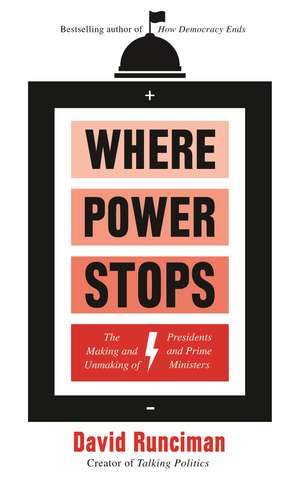
Where Power Stops
Autor David Runcimanen Limba Engleză Paperback – 26 mar 2020
Preț: 54.32 lei
Preț vechi: 68.41 lei
-21%
Puncte Express: 81
Preț estimativ în valută:
9.62€ • 11.17$ • 8.33£
9.62€ • 11.17$ • 8.33£
Carte disponibilă
Livrare economică 09-23 februarie
Livrare express 23-29 ianuarie pentru 32.85 lei
Preluare comenzi: 021 569.72.76
Specificații
ISBN-13: 9781788163347
ISBN-10: 1788163346
Pagini: 240
Dimensiuni: 132 x 198 x 20 mm
Greutate: 0.2 kg
Ediția:Main
Editura: Profile Books Ltd
Locul publicării:London, United Kingdom
ISBN-10: 1788163346
Pagini: 240
Dimensiuni: 132 x 198 x 20 mm
Greutate: 0.2 kg
Ediția:Main
Editura: Profile Books Ltd
Locul publicării:London, United Kingdom
Notă biografică
David Runciman is Professor of Politics at Cambridge University and the former Head of the Department of Politics and International Studies. He is the author of six previous books, including How Democracy Ends (Profile), Political Hypocrisy, The Confidence Trap and Politics (for the Ideas in Profile series). He writes regularly about politics for the London Review of Books and hosts the widely acclaimed weekly podcast Talking Politics.
Recenzii
Praise for How Democracy Ends:'Presented in pellucid prose free of the jargon of academic political science, How Democracy Ends is a strikingly readable and richly learned contribution to understanding the world today ... surely one of the most luminously intelligent books on politics to have been published for many years.'
Bracingly intelligent...a wonderful read
Full of intriguing new lines of thought
Refreshingly, rather than a knicker-twisting diatribe about Trump and Brexit, Runciman offers a thoughtful analysis about what popular democracy means, and its alternatives.
Clear-headed, compact and timely
An excellent book: it is well-written, evenly paced, accessible, non-academic in tone but very much so in rigour and thoughtfulness. It is sceptical but not pessimistic, and warnful but not alarmist ... It is heartily recommended for anyone who seeks to understand our current malaise and interested in this question of how democracy got to where it is today, and where it may go - if anywhere - next.
Refreshingly free of received and rehearsed wisdoms, Runciman doesn't tiptoe around sacred cows and invites us to take part in that most adult way of thinking: to examine contradictory ideas in tandem and ponder what the dissonance amounts to. . . . [H]e argues lucidly, persuasively, even exhilaratingly at times. The nightly news will never appear exactly the same again
Praise for The Confidence Trap: Runciman's book abounds with fresh insights, arresting paradoxes, and new ways of posing old problems
This rich and refreshing book will be of intense interest to anyone puzzled by the near paralysis that seems to afflict democratic government in a number of countries
As a corrective to the doom-and-gloomsters, this book makes some telling points, and he is a clear and forceful writer
Runciman is a good writer and brave pioneer. . . . The picture he sketches is agreeably bold
[An] ingenious account . . . Runciman concludes that democracy will probably survive, having made a delightfully stimulating, if counterintuitive case, that the unnerving tendency of democracies to stumble into crises is matched by their knack for getting out of them
What we get here is good history. The events at the seven junctures are presented in a way that is learned, concise and informative
Those who cannot remember history, George Santayana observed, are condemned to repeat it. Except he's wrong, according to David Runciman. In his admirable analysis, How Democracy Ends, he says the trouble is that we remember the least helpful bits of history, perpetually harking back to the 1930s to explain the aspects of modern politics we like least: Trump especially. Really we'd be better off comparing and contrasting ourselves with ancient Athens, the world's purest democracy.
well-written
Bracingly intelligent...a wonderful read
Full of intriguing new lines of thought
Refreshingly, rather than a knicker-twisting diatribe about Trump and Brexit, Runciman offers a thoughtful analysis about what popular democracy means, and its alternatives.
Clear-headed, compact and timely
An excellent book: it is well-written, evenly paced, accessible, non-academic in tone but very much so in rigour and thoughtfulness. It is sceptical but not pessimistic, and warnful but not alarmist ... It is heartily recommended for anyone who seeks to understand our current malaise and interested in this question of how democracy got to where it is today, and where it may go - if anywhere - next.
Refreshingly free of received and rehearsed wisdoms, Runciman doesn't tiptoe around sacred cows and invites us to take part in that most adult way of thinking: to examine contradictory ideas in tandem and ponder what the dissonance amounts to. . . . [H]e argues lucidly, persuasively, even exhilaratingly at times. The nightly news will never appear exactly the same again
Praise for The Confidence Trap: Runciman's book abounds with fresh insights, arresting paradoxes, and new ways of posing old problems
This rich and refreshing book will be of intense interest to anyone puzzled by the near paralysis that seems to afflict democratic government in a number of countries
As a corrective to the doom-and-gloomsters, this book makes some telling points, and he is a clear and forceful writer
Runciman is a good writer and brave pioneer. . . . The picture he sketches is agreeably bold
[An] ingenious account . . . Runciman concludes that democracy will probably survive, having made a delightfully stimulating, if counterintuitive case, that the unnerving tendency of democracies to stumble into crises is matched by their knack for getting out of them
What we get here is good history. The events at the seven junctures are presented in a way that is learned, concise and informative
Those who cannot remember history, George Santayana observed, are condemned to repeat it. Except he's wrong, according to David Runciman. In his admirable analysis, How Democracy Ends, he says the trouble is that we remember the least helpful bits of history, perpetually harking back to the 1930s to explain the aspects of modern politics we like least: Trump especially. Really we'd be better off comparing and contrasting ourselves with ancient Athens, the world's purest democracy.
well-written