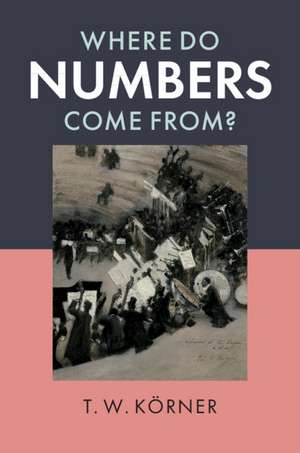
Where Do Numbers Come From?
Autor T. W. Körneren Limba Engleză Paperback – 24 oct 2019
Observăm că în formarea academică a unui matematician apare adesea un decalaj între utilizarea pragmatică a numerelor și înțelegerea structurii lor fundamentale. Where Do Numbers Come From? abordează direct această necesitate, oferind o construcție riguroasă a sistemelor numerice pe care se sprijină întreaga analiză matematică modernă. Autorul T W Körner pornește de la numerele naturale și cele de numărare, ghidând cititorul prin procesul de definire a numerelor raționale și negative, până la demonstrațiile complexe necesare pentru numerele reale. Structura cărții este una progresivă, împărțită în trei secțiuni majore. Prima parte analizează fracțiile și numerele raționale, a doua se întoarce la axiomele numerelor naturale prin prisma aritmeticii modulare, iar ultima parte consolidează construcția numerelor reale și complexe. Spre deosebire de lucrarea sa anterioară, Naive Decision Making, unde T W Körner se concentra pe aplicabilitatea matematicii în luarea deciziilor sub incertitudine, volumul de față este o incursiune în puritatea și rigoarea structurilor algebrice. Suntem de părere că această lucrare completează perspectiva oferită de Journey from Natural Numbers to Complex Numbers, adăugând o dimensiune istorică și o serie de explorări avansate despre polinoame și cuaternioni, elemente care lipsesc din tratatele introductive standard. Cele 255 de exerciții incluse sunt concepute nu doar pentru testare, ci pentru a încuraja o participare activă la procesul de 'descoperire' a numerelor, transformând o temă teoretică aridă într-o narațiune logică și accesibilă.
Preț: 331.32 lei
Carte disponibilă
Livrare economică 07-21 noiembrie
Livrare express 24-30 octombrie pentru 34.86 lei
Specificații
ISBN-10: 1108738389
Pagini: 274
Ilustrații: 1 b/w illus. 255 exercises
Dimensiuni: 152 x 229 x 16 mm
Greutate: 0.45 kg
Ediția:Nouă
Editura: Cambridge University Press
Locul publicării:Cambridge, United Kingdom
De ce să citești această carte
Această carte este esențială pentru studenții la matematică și pasionații care doresc să înțeleagă 'de ce' și 'cum' funcționează sistemele numerice, dincolo de simpla aplicare a unor reguli. Prin parcurgerea celor 255 de exerciții și a contextului istoric, cititorul câștigă o bază solidă în rigoarea matematică, trecând de la intuiție la construcții formale precum numerele complexe sau cuaternionii.
Descriere scurtă
Cuprins
Recenzii
'Körner begins with historical anecdotes that illustrate how numbers have been used. He then proceeds to develop number systems axiomatically with careful definitions, theorems and proofs. His characteristic humor, digressions and historical insights are present throughout, but this is a rigorous treatment that seems - in some measure - to follow Dedekind's original approach.' Bill Satze, MAA Reviews
'This is a comfortably paced introduction to the various notions of numbers … The relatively high level of abstraction of the second and third parts suggests that the ideal readership for this book is students who have taken at least some advanced undergraduate classes in mathematics. Classroom use would be possible in a philosophy of mathematics course …' M. Bona, Choice
'The text is peppered with quotes from classical (ancient civilizations), modern (nineteenth and early twentieth centuries), and contemporary mathematical texts; classical, modern and current approaches to most of the subjects covered are offered; and practical applications of most of the materials introduced are carefully explained. As a consequence, there is a constant dialogue between past and present from both a theoretical and a practical point of view, which makes this book interesting from a conceptual point of view and useful as an introductory working tool.' Capi Corrales-Rodriganez, Mathematical Reviews
'Fans of Körner's other books, like The Pleasures of Counting, will appreciate the conversational style of this book, which provides plenty of amusing footnotes, historical context, quotations and poems, while never relenting on the rigour of the mathematics.' Julia Collins, London Mathematical Society Newsletter
'Where Do Numbers Come From? certainly adds to the pleasure of mathematics as well as narrating a journey that surely every mathematician should undertake at some stage. As such, I enthusiastically recommend it to all Gazette readers.' Nick Lord, The Mathematical Gazette