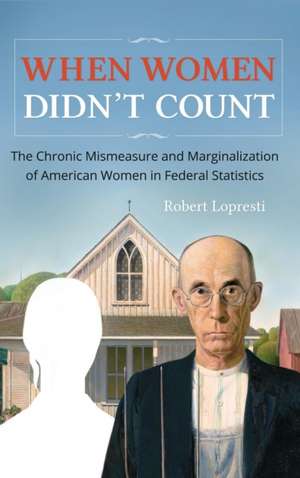
When Women Didn't Count: The Chronic Mismeasure and Marginalization of American Women in Federal Statistics
Autor Robert Loprestien Limba Engleză Hardback – 22 iun 2017
Much of women's history has been hidden and filtered through unrealistic expectations and assumptions. Because U.S. government data about women's lives and occupations has been significantly inaccurate, these misrepresentations in statistical information have shaped the reality of women's lives. They also affect men and society as a whole: these numbers influence our investments, our property values, our representation in Congress, and even how we see our place in society. This book documents how U.S. federal government statistics have served to reveal and conceal facts about women in the United States. It reaches back to the late 1800s, when the U.S. Census Bureau first listed women's occupations, and forward to the present, when the U.S. government relies on nonprofit groups for statistics on abortion.
Objective and accurate, When Women Didn't Count isn't focused on numbers and census results as much as on recognizing problems in data, exposing the hidden facets of government data, and using critical thinking when considering all seemingly authoritative sources. Readers will contemplate how the government decided that a "farmer's wife" could be a farmer, how the ongoing battle over abortion has been reflected in the numbers the government is allowed to keep and publish, the consequences of the Census Bureau "correcting" reports of women in unusual occupations in 1920, and why the official count of women-owned businesses dropped 20 percent in 1997.
Preț: 381.84 lei
Preț vechi: 606.28 lei
-37%
Puncte Express: 573
Preț estimativ în valută:
67.58€ • 78.98$ • 58.67£
67.58€ • 78.98$ • 58.67£
Carte tipărită la comandă
Livrare economică 19 februarie-05 martie
Preluare comenzi: 021 569.72.76
Specificații
ISBN-13: 9781440843686
ISBN-10: 1440843686
Pagini: 376
Dimensiuni: 156 x 235 mm
Greutate: 0.82 kg
Editura: Bloomsbury Publishing
Colecția Praeger
Locul publicării:New York, United States
ISBN-10: 1440843686
Pagini: 376
Dimensiuni: 156 x 235 mm
Greutate: 0.82 kg
Editura: Bloomsbury Publishing
Colecția Praeger
Locul publicării:New York, United States
Cuprins
Illustrations
Preface
Acknowledgments
Chronology
Part I Why Care about Government Statistics?
Chapter 1 Introduction
Chapter 2 Statistical System of the United States
Part II Demographics
Chapter 3 Population and Age
Chapter 4 Marriage, Divorce, and Cohabitation
Chapter 5 Motherhood
Chapter 6 Single Mothers
Part III Women at Home
Chapter 7 Heads of Household, Heads of Family
Chapter 8 Housewives, Homemakers, and Housekeepers
Part IV Concepts of Employment
Chapter 9 "Occupations Suitable for Women"
Chapter 10 "Gainful Employment"
Chapter 11 Income
Chapter 12 Unemployment during the Great Depression
Part V Women at Work
Chapter 13 The Bureau of Labor Statistics and the Women's Bureau
Chapter 14 Employment
Chapter 15 Women Factory Workers
Chapter 16 "Farm Females"
Chapter 17 Women Business Owners, Women-Owned Businesses
Part VI Women and Health
Chapter 18 Nonreproductive Health Issues
Chapter 19 Contraception
Chapter 20 Abortion
Part VII Women and the Law
Chapter 21 Women as Criminals
Chapter 22 Prostitution
Chapter 23 Women as Crime Victims
Chapter 24 Rape
Part VIII Women at War
Chapter 25 Rosie the Riveter: Civilian Women during the World Wars
Chapter 26 Women in the Military
Part IX Conclusion
Chapter 27 Conclusion
Notes
Bibliography
Index
Preface
Acknowledgments
Chronology
Part I Why Care about Government Statistics?
Chapter 1 Introduction
Chapter 2 Statistical System of the United States
Part II Demographics
Chapter 3 Population and Age
Chapter 4 Marriage, Divorce, and Cohabitation
Chapter 5 Motherhood
Chapter 6 Single Mothers
Part III Women at Home
Chapter 7 Heads of Household, Heads of Family
Chapter 8 Housewives, Homemakers, and Housekeepers
Part IV Concepts of Employment
Chapter 9 "Occupations Suitable for Women"
Chapter 10 "Gainful Employment"
Chapter 11 Income
Chapter 12 Unemployment during the Great Depression
Part V Women at Work
Chapter 13 The Bureau of Labor Statistics and the Women's Bureau
Chapter 14 Employment
Chapter 15 Women Factory Workers
Chapter 16 "Farm Females"
Chapter 17 Women Business Owners, Women-Owned Businesses
Part VI Women and Health
Chapter 18 Nonreproductive Health Issues
Chapter 19 Contraception
Chapter 20 Abortion
Part VII Women and the Law
Chapter 21 Women as Criminals
Chapter 22 Prostitution
Chapter 23 Women as Crime Victims
Chapter 24 Rape
Part VIII Women at War
Chapter 25 Rosie the Riveter: Civilian Women during the World Wars
Chapter 26 Women in the Military
Part IX Conclusion
Chapter 27 Conclusion
Notes
Bibliography
Index
Recenzii
The author seeks . . . to provide, and does so quite compellingly, an examination of why certain questions were asked, which in turn then generated those numbers, and the ways in which those questions changed over time, thus shaping the representation of women within this official historical record. . . . . [I]t is especially intriguing to see how the author clarifies the impact of changing occupations and new technologies and how they affected women at work, and the need to be able to provide data to effect social change. . . . Summing Up: Recommended. All levels/libraries.
Some questions have no accurate answers. This is especially true of government statistics on women, as Lopresti demonstrates this beautifully in When Women Didn't Count. . His treatise on the subject is enlightening. . . . This book is an important work that sheds light on the sexism that permeates our statistics, even as recently as the last decade.
In nearly every chapter consumers of federal statistics can find important lessons, many of which make it clear that the 'hardness' of numbers often is illusory. . . . In a captivating and often humorous way, Lopresti's documentation of the 'mismeasuring' of women in federal statistics provides a succinct history of women's changing role in American society.
Some questions have no accurate answers. This is especially true of government statistics on women, as Lopresti demonstrates this beautifully in When Women Didn't Count. . His treatise on the subject is enlightening. . . . This book is an important work that sheds light on the sexism that permeates our statistics, even as recently as the last decade.
In nearly every chapter consumers of federal statistics can find important lessons, many of which make it clear that the 'hardness' of numbers often is illusory. . . . In a captivating and often humorous way, Lopresti's documentation of the 'mismeasuring' of women in federal statistics provides a succinct history of women's changing role in American society.