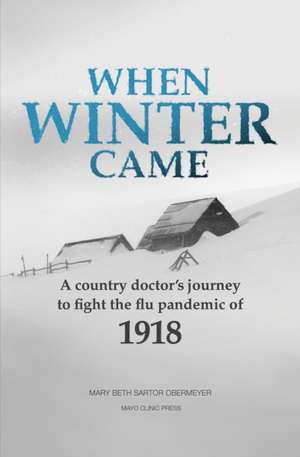
When Winter Came
Autor Mary Beth Sartor Obermeyeren Limba Engleză Paperback – 17 ian 2023
Recomandăm acest volum ca o lucrare de referință profesională și istorică pentru cei interesați de evoluția medicinei comunitare și de managementul crizelor sanitare în zonele rurale. When Winter Came nu este doar o biografie, ci o analiză documentată a modului în care un singur medic a reușit să mențină o rată de mortalitate surprinzător de scăzută — doar cinci decese la peste o mie de cazuri — în timpul pandemiei de gripă spaniolă din 1918. Structura narațiunii, construită de Mary Beth Sartor Obermeyer pe baza memoriilor bunicului său, oferă o perspectivă rară asupra logisticii medicale de acum un secol, de la utilizarea măștilor și a izolării, până la vizitele efectuate în condiții climatice extreme. Considerăm că relevanța acestui text pentru curriculumul de istoria medicinei rezidă în descrierea parteneriatului dintre practica locală și instituții de prestigiu. Cartea extinde cadrul propus de 1918 de David Cornish MD cu date noi din experiența directă a medicului de familie, oferind un contrast necesar față de perspectiva militară sau urbană asupra pandemiei. În timp ce Dancer in the Garden de Siegfried Kra explorează „epoca de aur” a medicinei prin prisma carierei academice și a specializării, lucrarea de față se concentrează pe rigoarea și sacrificiul medicinei generale. Tonul este unul precis, ancorat în fapte, evitând dramatizarea excesivă în favoarea detaliilor tehnice despre triaj și îngrijirea pacienților în comunități izolate precum Titonka, Iowa. Este o examinare onestă a presiunii exercitate asupra personalului medical, scrisă cu rigoarea unui jurnalist și empatia unui descendent.
Preț: 137.16 lei
Carte disponibilă
Livrare economică 31 octombrie-14 noiembrie
Specificații
ISBN-10: 1945564156
Pagini: 352
Dimensiuni: 152 x 226 x 20 mm
Greutate: 0.68 kg
Editura: Mayo Clinic Press
De ce să citești această carte
Subliniem valoarea acestei cărți pentru studenții la medicină și istorici, oferind o lecție practică despre reziliență și etică profesională. Cititorul câștigă o înțelegere profundă a rădăcinilor protocoalelor sanitare actuale, văzute prin ochii unui pionier care a colaborat cu Mayo Clinic pentru a ridica standardele de îngrijire rurală. Este o dovadă concretă a modului în care empatia și rigoarea științifică pot salva comunități întregi în perioade de criză globală.
Despre autor
Mary Beth Sartor Obermeyer este o jurnalistă americană și autoarea a trei volume anterioare, cunoscută pentru capacitatea de a transforma arhivele de familie în narațiuni istorice riguroase. Fiind nepoata Dr. Pierre Sartor și fiica Dr. Guido Sartor, aceasta a crescut într-un mediu medical, ceea ce îi conferă o perspectivă avizată asupra profesiei. Pentru When Winter Came, ea a petrecut ani de zile cercetând contextul istoric al pandemiei din 1918, completând jurnalul bunicului său cu date din arhivele Mayo Clinic și ale societăților medicale din Iowa, oferind astfel o lucrare ce îmbină biografia cu istoria socială.
Notă biografică
A dancer, a musician, a journalist and an author, Beth Obermeyer used her journalism degree and a lifetime of dance and music to seed three careers: dance/soloist, Minnesota Dance Theatre, 1973-1983; her company, TA DA! Special Events/Public Relations, 1978-1990; and author, three books, published by North Star Press, 2011-2012. The third book, THE DAYS OF SONG AND LILACS, was a finalist, one of three from twelve states, Midwest Book Awards.
Her first book, THE BIGGEST DANCE, was a Summer Read Pick, St. Paul Pioneer Press and featured in The Quarterly of the Minnesota Historical Society, 2013. Beth's fourth manuscript, WHEN WINTER CAME, is about finding her grandfather's medical journal of the winter of 1918-1919, the great flu pandemic.
Beth graduated from Iowa State University with a degree in Technical Journalism. While writing her first three books she studied at St. Catherine University, St. Paul, for two semesters, and at the Loft Literary Center, Minneapolis, for two years. She was a Professional in Residence at Iowa State University at the Greenlee School of Journalism, for one week. While on the faculty of the Minnesota Dance Theatre, Beth soloed with Garrison Keillor on "Prairie Home Companion"; with the Minnesota Orchestra in "The Tap Concerto," a twenty-minute piece in four movements, Morton Gould composer; with Gregory Hines, to promote his film, "Tap;" and with Christopher Plummer in Minnesota Orchestra's British Series. In 1979 she organized 1,801 tap dancers to open the Hennepin Center for the Arts.
Beth has done seminars to business and professional groups, including Public Relations Society of America. Her journalism degree is from Iowa State University, Ames, Iowa, where she was a member of Kappa Alpha Theta, social sorority, and Theta Sigma Phi, journalism honorary.
Beth is a native of Mason City, Iowa, the setting of her third book and has lived in Minneapolis, Minnesota, for the past fifty years. In Spring 2019 she will become a citizen of Luxembourg, a dual citizenship. Luxembourg is a setting for her fourth manuscript, WHEN WINTER CAME, along with Chicago, Illinois, and Bancroft and Titonka, Iowa.
Descriere
Maintain isolation – practice good hygiene – wear a mask – be kind. We all know these methods of fighting COVID-19, but this prescription comes from the 1918 experience of Dr. Pierre Sartor, who battled the worldwide influenza pandemic in his small town of Titonka, Iowa.
Dr. Sartor wrote an inspiring first-person account of how he treated more than 1,000 patients – and by his reckoning, lost only five – which lay forgotten in a lockbox of family artifacts until it was discovered decades later by his granddaughter, Beth Obermeyer, a journalist and author of three previous books. Beth knew her grandfather through her teenage years and grew up absorbing family stories. Based upon Dr. Sartor’s memoir and her years of research, she vividly reconstructs his life from childhood in Luxembourg, where he overcame a debilitating hearing problem, to medical school in Chicago, courtship and marriage.
A pioneer in the geographic as well as the medical sense, Dr. Sartor left his flourishing urban practice and settled his young family in rural Iowa where, he said, “I am needed.” Those words took on special resonance when Dr. Sartor moved to another Iowa town in the early months of 1918, amid the gathering storm of the influenza pandemic. He had barely settled into the community of Titonka, when, as he wrote, the disease “spread like wildfire on wild prairie land.”
Dr. Sartor traveled for hours and miles to serve his patients, but he did not go alone. His steady, reliable companion was Guido Sartor, his son, who drove a horse-drawn sleigh as well as the family’s Model T Ford so Dr. Sartor could reach his patients. Twelve years old at the time, Guido, in his knickers and mask, was an able assistant on many trips – including one February day when he drove through a blizzard – a searing journey whose denouement would occur more than 30 years later. In the meantime, Guido, inspired by his father, became a physician. The author is Guido’s daughter. Growing up in a medical family, Beth writes with insight and candor of the strain that well-intentioned caregivers can place upon the people they love most.
Humor was a saving grace for Dr. Sartor. Beth takes us along when young Guido gets their car stuck fast in mud … and when, Pierre, exhausted, was roused from bed by a ringing telephone. He answered all the patient’s questions but then could not forbear asking, “Why, why do you always call me at night?” Whereupon the patient helpfully explained, “But, doctor, you’re so busy during the day!”
Why was Dr. Sartor successful – so accomplished, in fact, that he was named General Practitioner of the Year by the Iowa State Medical Society? Among many factors, Dr. Sartor established a close collaboration with Mayo Clinic, about 130 miles away, starting a decade before the pandemic and continuing throughout his career. Referring patients and sharing best practices, Dr. Sartor personifies the respectful relationships that Mayo establishes with community-based physicians throughout the country.
Beth’s story is rooted in a certain time and place. Yet it speaks across generations to the qualities that make a compassionate, skilled physician – a compelling example of doing the best of things in the worst of times. Because, when winter comes, we all want a doctor like Pierre Sartor.