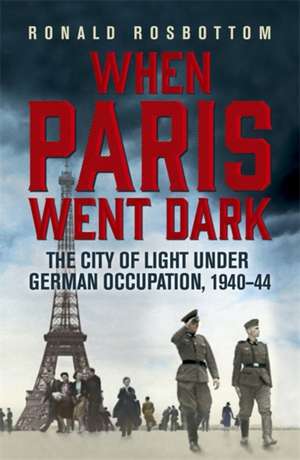
When Paris Went Dark: The City of Light Under German Occupation, 1940-44
Autor Ronald Rosbottomen Limba Engleză Paperback – 2015
When Paris Went Dark tells the extraordinary story of Germany's capture and Occupation of Paris, Hitler's relationship with the City of Light, and its citizens' attempts at living in an environment that was almost untouched by war, but which had become uncanny overnight. Beginning with the Phoney War and Hitler's first visit to the city, acclaimed literary historian and critic Ronald Rosbottom takes us through the German Army's almost unopposed seizure of Paris, its bureaucratic re-organization of that city, with the aid of collaborationist Frenchmen, and the daily adjustments Parisians had to make to this new oppressive presence.
Using memoirs, interviews and published eye-witness accounts, Rosbottom expertly weaves a narrative of daily life for both the Occupier and the Occupied. He shows its effects on the Parisian celebrity circles of Pablo Picasso, Simone de Beauvoir, Colette, Jean Cocteau, and Jean-Paul Sartre, and on the ordinary citizens of its twenty arrondissements. But Paris is the protagonist of this story, and Rosbottom provides us with a template for seeing the City of Light as more than a place of pleasure and beauty.
Preț: 73.74 lei
Preț vechi: 99.64 lei
-26%
Puncte Express: 111
Carte disponibilă
Livrare economică 09-23 noiembrie
Livrare express 23-29 octombrie pentru 51.21 lei
Livrare prin curier în România Termenul estimat este afișat lângă disponibilitate.
Transport gratuit de la 400.00 lei Plată online sau ramburs, în funcție de opțiunile comenzii.
Retur gratuit în 14 zile Comandă securizată și suport în română.
Specificații
ISBN-13: 9781848547391
ISBN-10: 1848547390
Pagini: 480
Dimensiuni: 133 x 200 x 24 mm
Greutate: 0.33 kg
Editura: John Murray Press
Colecția John Murray
Locul publicării:London, United Kingdom
ISBN-10: 1848547390
Pagini: 480
Dimensiuni: 133 x 200 x 24 mm
Greutate: 0.33 kg
Editura: John Murray Press
Colecția John Murray
Locul publicării:London, United Kingdom
V-ar putea interesa
Recenzii
A sombre, but riveting read, a stark reminder of the divisive nightmare of occupation
Exposes the manifold instances of French cowardice and duplicity while not exaggerating rare moments of heroism
An admirable background study
[Rosbottom's] lively writing, wide research and obvious affection for the city makes for a fascinating read
When Paris Went Dark recounts, through countless compelling stories, how Nazi occupation drained the light from Paris and how many of its residents resisted in ways large and small. This is a rich work of history, a brilliant recounting of how hope can still flourish in the rituals of daily life
A riveting account of one of the most resonant hostage-takings in history: the 1,500 days when a swastika flew from the Eiffel Tower . . . an intimate, sweeping narrative, astute in its insight and chilling in its rich detail
Ron Rosbottom has recreated the Parisian world during the dark days of the German occupation like no previous writer I know. His secret is two-fold: first, exhaustive research that allows him to recover what we might call the importance of the ordinary; and second, a shrewd grasp of how memory works
His book's main strength is the sense it gives of how ordinary Parisians coped, but it is also excellent on youth culture, the divisions that marked the Jewish community's response to persecution, the toxic aftermath of liberation, and the mythologies that quickly arose around the war years
Exposes the manifold instances of French cowardice and duplicity while not exaggerating rare moments of heroism
An admirable background study
[Rosbottom's] lively writing, wide research and obvious affection for the city makes for a fascinating read
When Paris Went Dark recounts, through countless compelling stories, how Nazi occupation drained the light from Paris and how many of its residents resisted in ways large and small. This is a rich work of history, a brilliant recounting of how hope can still flourish in the rituals of daily life
A riveting account of one of the most resonant hostage-takings in history: the 1,500 days when a swastika flew from the Eiffel Tower . . . an intimate, sweeping narrative, astute in its insight and chilling in its rich detail
Ron Rosbottom has recreated the Parisian world during the dark days of the German occupation like no previous writer I know. His secret is two-fold: first, exhaustive research that allows him to recover what we might call the importance of the ordinary; and second, a shrewd grasp of how memory works
His book's main strength is the sense it gives of how ordinary Parisians coped, but it is also excellent on youth culture, the divisions that marked the Jewish community's response to persecution, the toxic aftermath of liberation, and the mythologies that quickly arose around the war years