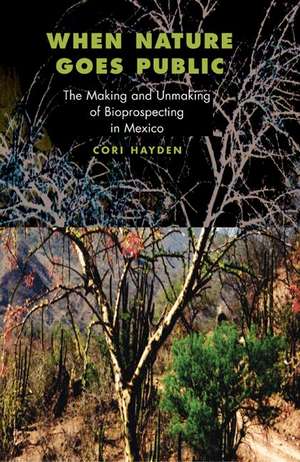
When Nature Goes Public
Autor Cori Haydenen Limba Engleză Paperback – 16 noi 2003
Cori Hayden tracks bioprospecting's contentious new promise--and the contradictory activities generated in its name. Focusing on a contract involving Mexico's National Autonomous University, Hayden examines the practices through which researchers, plant vendors, rural collectors, indigenous cooperatives, and other actors put prospecting to work. By paying unique attention to scientific research, she provides a key to understanding which people and plants are included in the promise of "selling biodiversity to save it"--and which are not. And she considers the consequences of linking scientific research and rural "enfranchisement" to the logics of intellectual property. Roving across UN protocols, botanical collecting histories, Mexican nationalist agendas, neoliberal property regimes, and North-South relations, When Nature Goes Public charts the myriad, emergent publics that drive and contest the global market in biodiversity and its futures.
Preț: 357.02 lei
Puncte Express: 536
Carte tipărită la comandă
Livrare economică 23 noiembrie-07 decembrie
Livrare prin curier în România Termenul estimat este afișat lângă disponibilitate.
Transport gratuit de la 400.00 lei Plată online sau ramburs, în funcție de opțiunile comenzii.
Retur gratuit în 14 zile Comandă securizată și suport în română.
Specificații
ISBN-13: 9780691095578
ISBN-10: 0691095574
Pagini: 304
Ilustrații: 6 halftones. 3 line illus.
Dimensiuni: 152 x 229 x 19 mm
Greutate: 0.5 kg
Ediția:New.
Editura: Princeton University Press
Locul publicării:Princeton, United States
ISBN-10: 0691095574
Pagini: 304
Ilustrații: 6 halftones. 3 line illus.
Dimensiuni: 152 x 229 x 19 mm
Greutate: 0.5 kg
Ediția:New.
Editura: Princeton University Press
Locul publicării:Princeton, United States
Notă biografică
Cori Hayden is Assistant Professor of Anthropology at the University of California, Berkeley and Research Fellow in Social Anthropology at the University of Cambridge.
Descriere
Focusing on a contract involving Mexico's National Autonomous University, this book examines the practices through which researchers, plant vendors, indigenous cooperatives, and other actors put prospecting to work. It considers the consequences of linking scientific research and rural 'enfranchisement' to the logics of intellectual property.