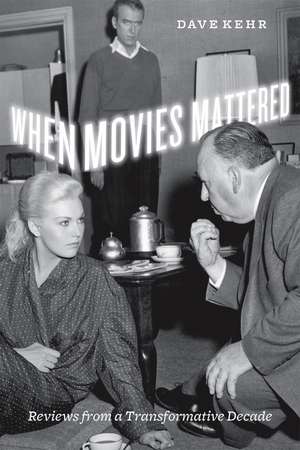
When Movies Mattered: Reviews from a Transformative Decade
Autor Dave Kehren Limba Engleză Paperback – 15 apr 2011
Acest volum sub formă de monografie critică, When Movies Mattered, ne invită la o incursiune intelectuală într-o decadă transformatoare pentru cinematografia mondială. Departe de a fi o simplă colecție de recenzii, lucrarea semnată de Dave Kehr funcționează ca o hartă stilistică a anilor '70 și '80, perioadă în care filmul era privit nu doar ca divertisment, ci ca un obiect de studiu profund. Apreciem modul în care autorul reușește să mențină un echilibru fin între rigoarea analitică a teoriei de tip „auteur” și accesibilitatea unui text scris pentru publicul larg al publicațiilor Chicago Reader sau Chicago Tribune.
Structura volumului este organizată meticulos pentru a reflecta tranziția cinematografică. Prima parte, „The Best”, reunește analize ale unor puncte de cotitură precum Days of Heaven al lui Terrence Malick sau F for Fake de Orson Welles. Secțiunea a doua explorează „Amurgul Hollywood-ului Clasic” și ascensiunea „Noului Hollywood”, oferind perspective incisive asupra unor regizori precum John Carpenter sau Martin Scorsese. Colecționarii care au apreciat Movies That Mattered vor găsi aici aceeași calitate a observației și aceeași erudiție care l-au consacrat pe Kehr drept unul dintre cei mai importanți critici americani. De asemenea, cei familiarizați cu stilul din The Age of Movies: Selected Writings of Pauline Kael vor recunoaște în Kehr o voce complementară, poate mai puțin impulsivă, dar extrem de tăioasă în examinarea mecanismelor vizuale.
Considerăm că forța acestui volum rezidă în capacitatea lui Kehr de a descifra „semnătura” unui regizor în detalii tehnice aparent banale. Este o experiență de lectură care transformă vizionarea unui film dintr-un act pasiv într-o explorare activă a sensului și esteticii.
Preț: 232.32 lei
Carte tipărită la comandă
Livrare economică 01-15 decembrie
Specificații
ISBN-10: 0226429415
Pagini: 304
Dimensiuni: 152 x 229 x 30 mm
Greutate: 0.42 kg
Ediția:New.
Editura: University of Chicago Press
Colecția University of Chicago Press
V-ar putea interesa
-
 Scorsese by EbertRoger EbertPreț: 121.18 lei
 -
 Something Like an AutobiographyAkira KurosawaPreț: 86.84 lei
 -
 Suddenly Something ClickedWalter MurchPreț: 238.88 lei
 -
 Loach on LoachGraham FullerPreț: 139.17 lei
 -
 -22%Preț: 128.11 lei163.73 lei
 -
 The Great MoviesRoger Ebert-17%Preț: 116.24 lei139.70 lei
 -
 Mark Kermode's Surround SoundMark Kermode-39%Preț: 83.67 lei137.93 lei
 -
 Cinema SpeculationQuentin Tarantino-25%Preț: 59.78 lei79.93 lei
 -
 Chris Marker: Early Film WritingsChris MarkerPreț: 122.99 lei
 -
 50 Film Ideas You Really Need to KnowHelen O’Hara-28%Preț: 50.70 lei70.25 lei
 -
 -16%Preț: 105.79 lei125.32 lei
 -
 The Age of Movies: Selected Writings of Pauline KaelPauline KaelPreț: 184.85 lei
 -
 The Press Gang: Writings on Cinema from New York Press 1991 - 2011Godfrey Cheshire-14%Preț: 156.90 lei181.72 lei
 -
 How to Watch a MovieDavid Thomson-20%Preț: 74.47 lei92.60 lei
 -
 Colours of Wes AndersonHannah Strong-16%Preț: 105.85 lei126.05 lei
 -
 Re-viewing Hitchcock: New Critical PerspectivesRobert E. Kapsis-13%Preț: 239.65 lei274.71 lei
 -
 Signs and Meaning in the CinemaPeter Wollen-24%Preț: 186.06 lei244.80 lei
 -
 In Dreams Begin Responsibilities: A Jonathan Rosenbaum ReaderJonathan RosenbaumPreț: 245.85 lei
De ce să citești această carte
Recomandăm această carte oricărui cinefil care dorește să înțeleagă de ce anumite filme au rămas relevante peste decenii. Veți câștiga nu doar o listă de recomandări valoroase, ci și un set de instrumente critice pentru a analiza stilul regizoral. Este lectura ideală pentru cei care vor să exploreze istoria cinema-ului prin ochii unui critic care a trăit și a documentat în timp real transformările spectaculoase ale industriei americane și internaționale.
Despre autor
Dave Kehr este unul dintre cei mai respectați critici de film americani, cunoscut pentru activitatea sa îndelungată la Chicago Reader, Chicago Tribune și, ulterior, New York Times. Format în spiritul criticii cinematografice de tip „auteur”, Kehr s-a distins prin stilul său lucid și capacitatea de a identifica trăsăturile vizuale distinctive ale regizorilor. În prezent, acesta ocupă funcția de curator în cadrul departamentului de film de la Museum of Modern Art (MoMA) din New York, continuându-și misiunea de conservare și promovare a culturii cinematografice.
Descriere scurtă
When Movies Mattered presents a wide-ranging and illuminating selection of Kehr’s criticism from the Reader—most of which is reprinted here for the first time—including insightful discussions of film history and his controversial Top Ten lists. Long heralded by his peers for both his deep knowledge and incisive style, Kehr developed his approach to writing about film from the auteur criticism popular in the ’70s. Though Kehr’s criticism has never lost its intellectual edge, it’s still easily accessible to anyone who truly cares about movies. Never watered down and always razor sharp, it goes beyond wry observations to an acute examination of the particular stylistic qualities that define the work of individual directors and determine the meaning of individual films.
From current releases to important revivals, from classical Hollywood to foreign fare, Kehr has kept us spellbound with his insightful critical commentaries. When Movies Mattered will secure his place among our very best writers about all things cinematic.
Notă biografică
Cuprins
Part 1: The Best
1974: Le Petit théâtre de Jean Renoir (Jean Renoir)
1976: Family Plot (Alfred Hitchcock)
1977: F for Fake (Orson Welles)
1978: Days of Heaven (Terrence Malick)
1979: 10 (Blake Edwards)
1981: Melvin and Howard (Jonathan Demme)
1982: The Aviator’s Wife (Eric Rohmer)
1983: Francisca (Manoel de Oliveira)
Part 2: The End of Classical Hollywood
Classical Hollywood
The Man Who Would Be King (John Huston)
Fedora (Billy Wilder)
Escape From Alcatraz (Don Siegel)
The Human Factor (Otto Preminger)
New Hollywood
The Driver (Walter Hill)
Halloween (John Carpenter)
Reds (Warren Beatty)
Sudden Impact (Clint Eastwood)
New Directions in Comedy
Victor/Victoria (Blake Edwards)
Risky Business (Paul Brickman)
Lost in America (Albert Brooks)
After Hours (Martin Scorsese)
Mavericks and Outsiders
Dawn of the Dead (George Romero)
The Big Red One (Samuel Fuller)
Love Streams (John Cassavetes)
Trouble in Mind (Alan Rudolph)
Part 3: Other Visions
Old Masters
Blaise Pascal (Roberto Rossellini)
A Piece of Pleasure (Claude Chabrol)
That Obscure Object of Desire (Luis Buñuel)
Perceval (Eric Rohmer)
Godard
Numéro deux
Every Man for Himself
Passion
Detective
New Masters
Jonah Who Will be 25 in the Year 2000 (Alain Tanner)
The Memory of Justice (Marcel Ophuls)
Allegro non troppo (Bruno Bozzetto)
The American Friend (Wim Wenders)
Loulou (Maurice Pialat)
Eijanaika (Shohei Imamura)
Coup de torchon (Bertrand Tavernier)
City of Pirates (Raul Ruiz)
Part 4: Revivals and Retrospectives
The Story of the Last Chrysanthemums (Kenji Mizoguchi)
The Flowers of St. Francis (Roberto Rossellini)
Born in Germany, Raised in Hollywood: The Film Art of Fritz Lang
Record of a Tenement Gentleman (Yasujiro Ozu)
Peeping Tom (Michael Powell)
Othello (Orson Welles)
Crisis, Compulsion, and Creation: Raoul Walsh’s Cinema of the Individual
A Love That Caresses the Soul: Films by Carl Theodor Dreyer
When a Woman Ascends the Stairs (Mikio Naruse)
Le Silence de la mer and Bob le Flambeur (Jean-Pierre Melville)
The Leopard (Luchino Visconti)
Hitch’s Riddle: On Five Rereleased Films
Once Upon a Time in the West (Sergio Leone)
French Cancan (Jean Renoir)
Appendix: Top Ten Lists, 1974–86