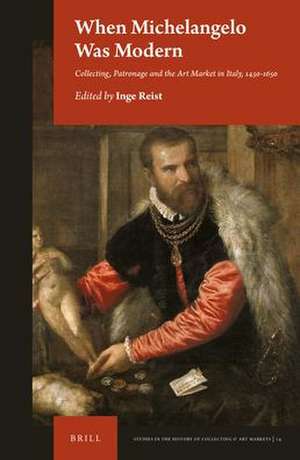
When Michelangelo Was Modern
en Limba Engleză Hardback – 23 iun 2022
This book evolved from a symposium “When Michelangelo was Modern: The Art Market and Collecting in Italy, 1450–1650,” organized by the Center for the History of Collecting, that was held at The Frick Collection on April 12 and 13, 2019. Both the book and the symposium were made possible through the generous support of the Robert H. Smith Family Foundation.
The book is published in association with The Frick Collection.
Preț: 534.92 lei
Preț vechi: 660.39 lei
-19%
Puncte Express: 802
Carte tipărită la comandă
Livrare economică 28 noiembrie-12 decembrie
Livrare prin curier în România Termenul estimat este afișat lângă disponibilitate.
Transport gratuit pentru acest produs Plată online sau ramburs, în funcție de opțiunile comenzii.
Retur gratuit în 14 zile Comandă securizată și suport în română.
Specificații
ISBN-13: 9789004460423
ISBN-10: 900446042X
Pagini: 258
Dimensiuni: 163 x 238 x 20 mm
Greutate: 0.67 kg
Editura: Brill
ISBN-10: 900446042X
Pagini: 258
Dimensiuni: 163 x 238 x 20 mm
Greutate: 0.67 kg
Editura: Brill
Notă biografică
Inge Reist (Ph. D. Columbia University 1984) was the Founding Director of the Center for the History of Collecting, The Frick Collection. Her edited and authored publications focus on Italian Renaissance and Baroque Art and the History of Art Collecting.
Cuprins
List of Figures
Contributors
Introduction: Shaping the Splendor of Italian Renaissance Art through Collecting and Patronage
Inge Reist
1 Merchant-Banker, Diplomat, Courtier or Agent? Intermediaries and Collecting Art in the Renaissance Courts
Leah R. Clark
2 Birth in Venice: The Origins of Art Collecting in the Serenissima
Frederick Ilchman
3 Courtesans as Collectors and Tastemakers in Renaissance Italy
Chriscinda Henry
4 Fractured Politics, Seamless Art: Family Patronage in Bologna at the Turn of the Cinquecento
Saida Bondini
5 “Our Insatiable Desire for All Things Antique”: Isabella d’Este as Patron and Collector
Stephen K. Scher
6 Cleaning Out the Workshop: How Preparatory Drawings Became Collector’s Treasure in Renaissance and Baroque Italy
John Marciari
7 Modern Michelangelos? Copies, Fakes, and New Economies of Taste in the Early Seicento
Hannah Joy Friedman
8 Trading Caravaggio: Giovan Angelo Altemp, Prospero Orsi, and the Roman Art Market of Caravaggesque Painting
Fausto Nicolai
9 From the Art Market to St. Peter’s: The Cases of Nicolas Poussin and Valentin de Boulogne
Patrizia Cavazzini
10 Artists as Critics, and Critics as Artists: Collaboration and Inclination in Giulio Mancini’s Taste Formation
Frances Gage