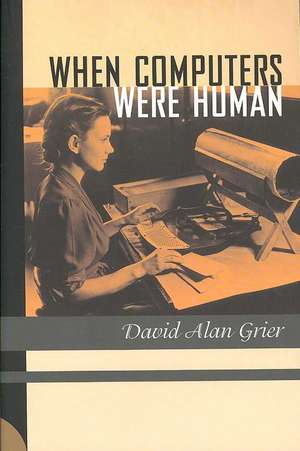
When Computers Were Human
Autor David Alan Grieren Limba Engleză Paperback – 16 sep 2007
Autorul David Alan Grier, profesor și cercetător recunoscut pentru studiile sale asupra intersecției dintre tehnologie și societate, propune în When Computers Were Human o istorie socială a științei care recuperează o identitate pierdută. Analiza sa fundamentează ideea că, înainte de era digitală, „computerul” era un angajat specializat, adesea o femeie cu studii matematice avansate, a cărei muncă migăloasă a susținut marile descoperiri astronomice și inginerești ale ultimelor două secole. Subliniem modul în care Grier transformă o istorie tehnică într-o narațiune profund umană, pornind de la experiența propriei sale bunici. Reținem structura cronologică riguroasă: volumul debutează cu efortul a trei astronomi francezi din 1758 de a calcula orbita cometei Halley și se încheie patru cicluri mai târziu, odată cu apariția procesării electronice prin UNIVAC. Pe parcurs, explorăm proiectele masive de calcul din timpul Revoluției Franceze și birourile gigantice ale Works Progress Administration din perioada Marii Depresiuni. Stilul este precis, dar evocator, evitând jargonul excesiv în favoarea unei perspective asupra condițiilor de muncă și a aspirațiilor acestor „calculatori” umane. Cititorii familiarizați cu Calculation and Computation in the Pre-electronic Era de Aristotle Tympas vor aprecia modul în care Grier aduce în prim-plan factorul uman și social, acolo unde alte lucrări se concentrează strict pe evoluția mecanismelor. În contextul operei sale, această carte continuă explorarea comunităților tehnice începută în The Company We Keep, însă face un pas înapoi în timp pentru a explica geneza diviziunii muncii în cercetare. Recomandăm acest volum celor care doresc să înțeleagă nu doar cum au evoluat mașinile, ci și cine a ocupat locul acestora în structura științei moderne.
Preț: 405.37 lei
Carte tipărită la comandă
Livrare economică 27 noiembrie-11 decembrie
Specificații
ISBN-10: 0691133824
Pagini: 424
Ilustrații: 1, black & white illustrations
Dimensiuni: 156 x 234 x 23 mm
Greutate: 0.64 kg
Editura: Princeton University Press
Locul publicării:Princeton, United States
V-ar putea interesa
-
 Preț: 294.38 lei
 -
 The Innocent AssassinsBjörn KurténPreț: 482.97 lei
 -
 Phanerozoic Sea–Level Changes (Paper)Anthony HallamPreț: 412.28 lei
 -
 Outpost on Apollo′s MoonEric Burgess-23%Preț: 664.76 lei863.32 lei
 -
 -23%Preț: 542.79 lei704.92 lei
 -
 To Engineer Is HumanHenry PetroskiPreț: 105.45 lei
 -
 Introduction to Atmospheric ChemistryDaniel J. Jacob-19%Preț: 565.62 lei698.30 lei
 -
 Preț: 267.89 lei
 -
 The Descent of Man, and Selection in Relation to SexCharles DarwinPreț: 386.42 lei
 -
 Princeton Guide to Advanced PhysicsAlan C. Tribble-19%Preț: 487.36 lei601.68 lei
 -
 Quantum Mechanics and Its Emergent MacrophysicsGeoffrey L Sewell-23%Preț: 853.35 lei1108.25 lei
 -
 Sex and EvolutionGeorge Christopher WilliamsPreț: 496.76 lei
 -
 Population Ecology of IndividualsAdam Lomnicki-19%Preț: 545.88 lei673.91 lei
 -
 Biologists and the Promise of American LifePhilip J. PaulyPreț: 378.41 lei
 -
 What Science Is and How It WorksGregory N. DerryPreț: 380.23 lei
 -
 The Company We Keep: Based on Linux Kernel 2.6.34David Alan Grier-20%Preț: 116.25 lei145.31 lei
 -
 Preț: 112.61 lei
 -
 Mortuary Science: A SourcebookJohn F. Szabo-34%Preț: 444.48 lei672.92 lei
 -
 Crowdsourcing For DummiesDavid Alan GrierPreț: 141.08 lei
 -
 Barack Like MeDavid Alan GrierPreț: 105.41 lei
 -
 Chemie und GeisteswissenschaftenJürgen Mittelstrass-9%Preț: 772.76 lei849.18 lei
 -
 Allgemeine GeologieDieter Richter-9%Preț: 774.27 lei850.85 lei
 -
 Pathophysiologie, Pathobiochemie, klinische ChemieEckhart Buddecke-9%Preț: 1059.75 lei1164.56 lei
De ce să citești această carte
Această carte este esențială pentru cei interesați de istoria științei și de rolul adesea ignorat al femeilor în matematică. Cititorul va câștiga o perspectivă inedită asupra modului în care munca intelectuală a fost organizată industrial înainte de microcipuri. Este o lectură fundamentală pentru a înțelege că revoluția digitală nu a început cu tranzistorul, ci cu oameni dedicați care au transformat calculul într-o profesie.
Despre autor
David Alan Grier este un autor și cercetător proeminent, cunoscut pentru analizele sale privind istoria calculului și impactul tehnologiei asupra comunităților umane. Cu o pregătire academică solidă, el a documentat tranziția de la munca manuală la cea automatizată în numeroase articole și volume. Printre lucrările sale se numără The Company We Keep și Crowdsourcing For Dummies, titluri care reflectă interesul său constant pentru modul în care grupurile de oameni colaborează pentru a rezolva probleme tehnice complexe. În When Computers Were Human, Grier îmbină rigoarea cercetării istorice cu elemente biografice, oferind o voce celor care au pus bazele erei informaționale.