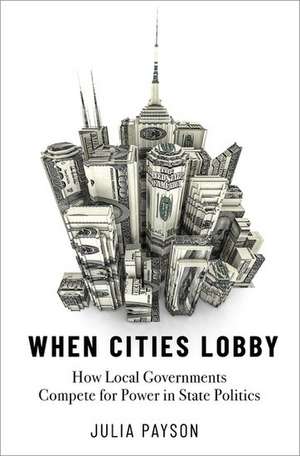
When Cities Lobby: How Local Governments Compete for Power in State Politics
Autor Julia Paysonen Limba Engleză Paperback – 31 mar 2022
Preț: 196.11 lei
Preț vechi: 234.85 lei
-16%
Puncte Express: 294
Carte disponibilă
Livrare economică 06-11 noiembrie
Livrare prin curier în România Termenul estimat este afișat lângă disponibilitate.
Transport gratuit de la 400.00 lei Plată online sau ramburs, în funcție de opțiunile comenzii.
Retur gratuit în 14 zile Comandă securizată și suport în română.
Specificații
ISBN-13: 9780197615270
ISBN-10: 0197615279
Pagini: 208
Dimensiuni: 236 x 156 x 14 mm
Greutate: 0.3 kg
Editura: Oxford University Press
Colecția OUP USA
Locul publicării:New York, United States
ISBN-10: 0197615279
Pagini: 208
Dimensiuni: 236 x 156 x 14 mm
Greutate: 0.3 kg
Editura: Oxford University Press
Colecția OUP USA
Locul publicării:New York, United States
Recenzii
The book offers political science, public policy, and public administration students an informative outlook on the process of resource allocation and power struggles in the American case study, and its consequences on political decision making. Hence, the target audience for this book is both practitioners and academicians.
Payson's book provides the critical first step in launching future studies on the role of lobbying in shaping local politics, city-state relationships, the political power of cities in the face of growing partisan polarization.
When Cities Lobby is a stunning account of an underappreciated side of power and influence in American politics—one in which the lobbyists are governments themselves. In this meticulously-researched, beautifully-written book, Payson pulls back the curtain on how common it is for city governments to lobby their states, why they do it, and how it makes a difference. This is a must-read for anyone interested in how American government works.
American cities, counties, and other local governments are intricately dependent on their state governments for their very existence. Yet as Payson shows in this important and ambitious book, they do not wait around passively for handouts from their states. Rather, U.S. local governments collectively spend hundreds of millions of dollars each year lobbying their state governments. Employing an expansive new dataset and careful statistical analyses, Payson shows that while intergovernmental lobbying can help address representational gaps, it comes with an all-too-familiar bias by advantaging wealthier jurisdictions. A must-read for scholars of city politics and policy, interest groups and lobbying, and American federalism.
In a federal system, cities are at the mercy of state governments which shape and constrain local policies and revenues. Julia Payson reveals that many cities rely on lobbying to ensure that they do not remain powerless in this system. With sophisticated methods, novel data, and clear writing, Payson skillfully maps the landscape of intergovernmental lobbying. She convincingly demonstrates that cities see important returns to their efforts, but unequally so. As is so often the case in the American political system, the wealthiest communities reap the most rewards.
The book is essential for all scholars studying urban politics and government, intergovernmental relations, and lobbying.
Payson's book provides the critical first step in launching future studies on the role of lobbying in shaping local politics, city-state relationships, the political power of cities in the face of growing partisan polarization.
When Cities Lobby is a stunning account of an underappreciated side of power and influence in American politics—one in which the lobbyists are governments themselves. In this meticulously-researched, beautifully-written book, Payson pulls back the curtain on how common it is for city governments to lobby their states, why they do it, and how it makes a difference. This is a must-read for anyone interested in how American government works.
American cities, counties, and other local governments are intricately dependent on their state governments for their very existence. Yet as Payson shows in this important and ambitious book, they do not wait around passively for handouts from their states. Rather, U.S. local governments collectively spend hundreds of millions of dollars each year lobbying their state governments. Employing an expansive new dataset and careful statistical analyses, Payson shows that while intergovernmental lobbying can help address representational gaps, it comes with an all-too-familiar bias by advantaging wealthier jurisdictions. A must-read for scholars of city politics and policy, interest groups and lobbying, and American federalism.
In a federal system, cities are at the mercy of state governments which shape and constrain local policies and revenues. Julia Payson reveals that many cities rely on lobbying to ensure that they do not remain powerless in this system. With sophisticated methods, novel data, and clear writing, Payson skillfully maps the landscape of intergovernmental lobbying. She convincingly demonstrates that cities see important returns to their efforts, but unequally so. As is so often the case in the American political system, the wealthiest communities reap the most rewards.
The book is essential for all scholars studying urban politics and government, intergovernmental relations, and lobbying.
Notă biografică
Julia Payson is an Assistant Professor of Politics at New York University.