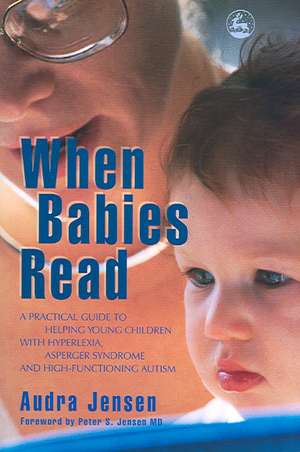
When Babies Read: A Practical Guide to Helping Young Children with Hyperlexia, Asperger Syndrome and High-Functioning Autism
Cuvânt înainte de Peter Steen Jensen Autor Audra Jensenen Limba Engleză Paperback – 8 aug 2005
The author stresses the importance of diagnosis of the condition for successful implementation of effective teaching strategies and encouragement of more typical childhood development. As well as useful advice, this guide provides a comprehensive reading curriculum specially designed for young, challenged children to help promote their reading ability.
With practical suggestions on how to modify teaching and therapy programmes to suit a child's individual learning style, this practical guide will prove invaluable for parents of children with autism and hyperlexia.
Preț: 129.97 lei
Preț vechi: 163.48 lei
-20%
Puncte Express: 195
Carte indisponibilă temporar
Doresc să fiu notificat când acest titlu va fi disponibil:
Se trimite...
Specificații
ISBN-13: 9781843108030
ISBN-10: 1843108038
Pagini: 192
Ilustrații: Illustrations
Dimensiuni: 150 x 228 x 12 mm
Greutate: 0.29 kg
Ediția:American Paperb.
Editura: JESSICA KINGSLEY PUBLISHERS
Colecția Jessica Kingsley Publishers
Locul publicării:London, United Kingdom
ISBN-10: 1843108038
Pagini: 192
Ilustrații: Illustrations
Dimensiuni: 150 x 228 x 12 mm
Greutate: 0.29 kg
Ediția:American Paperb.
Editura: JESSICA KINGSLEY PUBLISHERS
Colecția Jessica Kingsley Publishers
Locul publicării:London, United Kingdom
Recenzii
A variety of methods for connecting a child's knowledge of words with their meanings is demonstrated, as are numerous useful resources like social stories... Many of these examples, especially rewards, are useful for all children with ASD. This book, probably the first of its kind, is strongly recommended for all public libraries and academic libraries with autism or education collections.
This book is interesting in that it focuses primarily upon hyperlexia- the ability to read at a level beyond age- related norms with associated deficits in verbal communication skills. Many parents and practitioners familiar with autistic spectrum disorder will recognize aspects of this presentation without necessarily knowing this specific label and a discussion of this area is welcome. This is an energetic and practical guide outlining principles and activities that have evidently contributed enormously to the quality of life experienced by the author's son and family.
The book is extremely well written, easy to read and understand and is a moving and insightful account of the difficulties families can face when blessed with a challenging child. A great read (I personally couldn't put it down) for all those interested in either comprehensive learning programmes or just requiring a deeper understanding of Hyperlexia, Asperger Syndrome and Autism.
This book is interesting in that it focuses primarily upon hyperlexia- the ability to read at a level beyond age- related norms with associated deficits in verbal communication skills. Many parents and practitioners familiar with autistic spectrum disorder will recognize aspects of this presentation without necessarily knowing this specific label and a discussion of this area is welcome. This is an energetic and practical guide outlining principles and activities that have evidently contributed enormously to the quality of life experienced by the author's son and family.
The book is extremely well written, easy to read and understand and is a moving and insightful account of the difficulties families can face when blessed with a challenging child. A great read (I personally couldn't put it down) for all those interested in either comprehensive learning programmes or just requiring a deeper understanding of Hyperlexia, Asperger Syndrome and Autism.
Cuprins
Foreword. Preface. Acknowledgements. 1. Something About Him. 2. The Walking Paradox. Definitions. Why Does Hyperlexia Fit? Diagram of Hyperlexia. To Diagnose or Not to Diagnose? That is the question. 3. The Case for Teaching Reading. Create a Hyperlexic? Early Brain Development. Making the Case. Teaching Guidelines. What Method? 4. Teaching Babies to Read. Preparation. Level One: Match Word. Level Two: Pointing. Level Three: Match Object. Level Four: Reading. Level Five: Generalization. The Genelect Program. Set One: Familiar names and high-frequency words. Set Two: Facilitating Words. Set Three: First letters. Set Four: First Phonic Words ă (CVC). Set Five: Common high-frequency words. Set Six: Individual interest words. Set Seven: More phonics words Ä• Ä Å Å (CVC). Set Eight: Phonics vowel change (CVC). Set Nine: More high-frequency words. Set Ten: Phonics long vowel (CVC-e). Set Eleven: Phonics blends. Set Twelve: More long vowels. Phonemic Conventions. Sight and High-frequency Words. 5. Line of Attack. Home. Outside Therapies. School. Other Environments. Strategies. 6. Learning Early Social Expectations. Reminder Book. Situation Book. Incentive Chart.. 7. Navigating the School System Placement. When You Have to Fight. Process Guidelines. 8. Customizing Behavior Therapy. Pro-Active Responses. Foundation Skills. Social Skills. Academic Skills. 9. Customizing Language Therapy. Receptive Language. Expressive Language. Wh- Questions. Intraverbals. Grammar. Social Language. 10. Theory of Mind. Picture Inferencing. What Comes Next? Guess/Don't Guess. Verbal Inferencing. Thought Bubbles. Role Playing with Figures. 11. Ten Commandments. Appendix A: Special Education La in the United States. Special Education Law Terms. The Special Education Process. Legal Documentation. Appendix B: Some Useful Organizations in the UK. Appendix C: Glossary and Diagnostic Criteria. Glossary. DSM-IV (1994) Diagnostic Criteria. Other Disorders. References. Index.