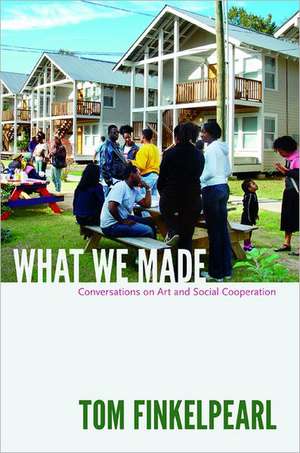
What We Made
Autor Tom Finkelpearlen Limba Engleză Paperback – 15 ian 2013
Această monografie de referință, publicată de Duke University Press, explorează teritoriul fertil unde arta contemporană întâlnește activismul social. Găsim în What We Made o analiză profundă a modului în care experiențele estetice co-autorate și participative redefinesc rolul artistului în societate. Tom Finkelpearl nu se limitează la o descriere teoretică, ci propune un cadru de înțelegere bazat pe cooperarea socială, integrând 91 de ilustrații care oferă o dimensiune vizuală esențială proiectelor discutate. Ne-a atras atenția structura dialogică a cărții, organizată în jurul a cincisprezece conversații revelatoare. Autorul angajează în dezbatere nu doar artiști, ci și istorici de artă precum Grant Kester sau Claire Bishop, abordând provocările scrierii critice despre un mediu atât de fluid. Colecționarii și cercetătorii care au apreciat Art : Process : Change de Loraine Leeson vor găsi aici aceeași rigoare în examinarea practicilor situate social, însă What We Made extinde perspectiva către politici sociale, urbanism și spiritualitate. Progresia capitolelor ne poartă de la spațiul public și relația cu muzeele, până la studii de caz concrete, cum este celebrul Project Row Houses din Houston. Textul explorează granița fină dintre educație și artă, oferind voce și „participanților experți” — acei colaboratori adesea ignorați ai procesului creativ. Prin utilizarea pragmatismului ca instrument critic, Tom Finkelpearl reușește să ofere criterii de evaluare pentru o formă de artă a cărei principală valoare rezidă în întâlnirea umană și dialog.
Preț: 238.32 lei
Carte disponibilă
Livrare economică 07-21 noiembrie
Livrare express 24-30 octombrie pentru 93.21 lei
Specificații
ISBN-10: 0822352893
Pagini: 416
Ilustrații: 91 illustrations
Dimensiuni: 154 x 236 x 27 mm
Greutate: 0.57 kg
Editura: Duke University Press
V-ar putea interesa
-
 TogetherRichard SennettPreț: 91.86 lei
 -
 Preț: 167.79 lei
 -
 Curating the Commons: Socially Engaged Public ArtKatia ArfaraPreț: 348.08 lei
 -
 What Art DoesBrian Eno-19%Preț: 86.26 lei106.99 lei
 -
 Co-ArtEllen Mara De Wachter-21%Preț: 163.43 lei207.67 lei
 -
 Make Art or Die TryingStuart Semple-16%Preț: 136.67 lei162.22 lei
 -
 The One and the ManyGrant H KesterPreț: 268.59 lei
 -
 -24%Preț: 94.94 lei125.31 lei
 -
 A Studious Use: Designing From The UndercommonsGiovanni Marmont-18%Preț: 135.71 lei166.13 lei
 -
 For FreedomsHank Thomas-13%Preț: 345.89 lei395.39 lei
 -
 Propositions for Museum EducationAnita SinnerPreț: 426.31 lei
 -
 Artificial HellsClaire BishopPreț: 162.29 lei
 -
 Towards the Ethical Art MuseumGareth HarrisPreț: 161.52 lei
 -
 Preț: 314.32 lei
 -
 The Social Organization of Arts: A Theoretical CompendiumVolker KirchbergPreț: 364.32 lei
 -
 What about Activism?Steven Henry MadoffPreț: 156.09 lei
 -
 Residencies ReflectedIrmeli Kokko-16%Preț: 139.38 lei166.07 lei
 -
 -19%Preț: 215.16 lei265.26 lei
 -
 24-HOUR INTERVIEWCharles Moore-18%Preț: 120.73 lei146.39 lei
 -
 No Straight Road Takes You ThereRebecca SolnitPreț: 93.02 lei
De ce să citești această carte
Recomandăm această carte profesioniștilor din muzee, artiștilor vizuali și studenților la istoria artei care doresc să înțeleagă mecanismele artei participative. Cititorul câștigă o perspectivă rară asupra modului în care cooperarea poate deveni un act estetic valid. Este un instrument esențial pentru oricine crede în puterea artei de a genera schimbare socială reală prin dialog și parteneriat comunitar.
Cuprins
1. Introduction
The Art of Social Cooperation: An American Framework 1
2. Cooperation Goes Public
Consequences of a Gesture and 100 Victoria/10,000 Tears 51
Interview: Daniel Joseph Martinez, artist, and Gregg M. Horowitz, philosophy professor
Chicago Urban Ecology Action Group 76
Follow-Up Interview: Naomi Beckwith, participant
3. Museum, Education, Cooperation
Memory of Surfaces 90
Interview: Ernesto Pujol, artist, and David Henry, museum educator
4. Overview
Temporary Coaltions, Mobilized Communities, and Dialogue as Art 114
Interview: Grant Kester, art historian
5. Social Vision and a Cooperative Community
Project Row Houses 132
Interview: Rick Lowe, artist, and Mark Stern, professor of social history and urban studies
6. Participation, Planning, and a Cooperative Film
Blot Out the Sun 152
Interview: Harrell Fletcher, artist, and Ethan Seltzer, professor of urban studies and planning
Ride Out the Sun 174
Follow-up Interview: Jay Dykeman, collaborator
7. Education Art
Catedra Arte del Conducta 179
Interview: Tania Bruguera, artist
Catedra de Conducta
Follow-up Interview: Claire Bishop, art historian
8. A Political Alphabet 219
Interview: Wendy Ewald, artist, and Sondra Farganis, political scientist
9. Crossing Borders
Transnational Community-Based Production, Cooperative Art, and Informal Trade Networks 240
Interview: Pedro Lasch, artist, and Teddy Cruz, architect
10. Spirituality and Cooperation
Unburning Freedom Hall and The Packer School Project 269
Interview: Brett Cook, artist, and Mierle Laderman Ukeles, artist
The Seer Project 301
Interview: Lee Mingwei, artist
11. Interactive Internet Communication
White Glove Tracking 313
Interview: Evan Roth, artist
White Glove Tracking 335
Follow-up Interview: Jonah Peretti, contagious media pioneer
Conclusion: Pragmatism and Social Cooperation 343
Notes 363
Bibliography 373
Index 381
Recenzii
"In between histories, current art practices, and theories lies the conundrum: how to describe relational and public art and the many intentions of those involved. Tom Finkelpearl gives us perspectives from artists' on-the-ground experiences and a welcome revisiting of Dewey, contextualized by a sweeping introduction that alone is worth the price of the book."Suzanne Lacy, author of Leaving Art: Writings on Performance, Politics, and Publics, 1974-2007
"In between histories, current art practices, and theories lies the conundrum: how to describe relational and public art and the many intentions of those involved? Tom Finkelpearl gives us perspectives from artists on-the-ground experiences and a welcome revisiting of Dewey, contextualized by a sweeping introduction that alone is worth the price of the book."Suzanne Lacy, author of Leaving Art: Writings on Performance, Politics, and Publics, 1974-2007
"This work attempts to unpack contemporary artistic practices along new aesthetic criteria: sociopolitical, transnational, spiritual, and, in particular with regard to the Internet, given its notions of networked collaboration and new definitions of authorship. These conversations by key practitioners and thinkers are a snapshot of thinking around the emergence of social and collaborative art, which seeks to improve society and address social issues... Finkelpearl ably situates collaborative and participatory art within the chronology of American art history. This book will be at home in university libraries and can function well as a course text in the field of public-art studies.".--Toro Castaño, Library Journal, February 25th 2013
"What We Made is a dialogic thick description of cooperative art practices from the point of view of practitioners and many insightful interlocutors. It will be an extremely valuable resource for artists, art historians, and museum professionals." - Rebecca Zorach, author of The Passionate Triangle "In between histories, current art practices, and theories lies the conundrum: how to describe relational and public art and the many intentions of those involved. Tom Finkelpearl gives us perspectives from artists' on-the-ground experiences and a welcome revisiting of Dewey, contextualized by a sweeping introduction that alone is worth the price of the book." - Suzanne Lacy, author of Leaving Art: Writings on Performance, Politics, and Publics, 1974-2007 "In between histories, current art practices, and theories lies the conundrum: how to describe relational and public art and the many intentions of those involved? Tom Finkelpearl gives us perspectives from artists' on-the-ground experiences and a welcome revisiting of Dewey, contextualized by a sweeping introduction that alone is worth the price of the book." - Suzanne Lacy, author of Leaving Art: Writings on Performance, Politics, and Publics, 1974-2007 "This work attempts to unpack contemporary artistic practices along new aesthetic criteria: sociopolitical, transnational, spiritual, and, in particular with regard to the Internet, given its notions of networked collaboration and new definitions of authorship. These conversations by key practitioners and thinkers are a snapshot of thinking around the emergence of social and collaborative art, which seeks to improve society and address social issues... Finkelpearl ably situates collaborative and participatory art within the chronology of American art history. This book will be at home in university libraries and can function well as a course text in the field of public-art studies.".--Toro Castano, Library Journal, February 25th 2013