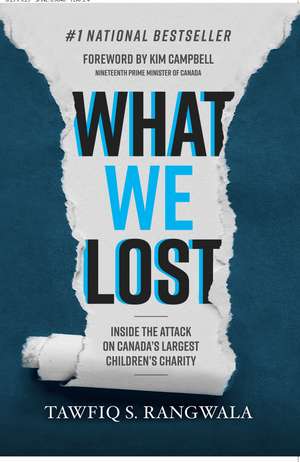
What WE Lost: Inside the Attack on Canada's Largest Children's Charity
Autor Tawfiq S. Rangwala Cuvânt înainte de Right Honourable Kim Campbell, Prime Ministeren Limba Engleză Hardback – 5 mai 2022
In its 25 years, the international development charity and youth empowerment movement impacted lives the world over. Innovation was at its core: while most charities focus on making the world a better place for our children, WE Charity focused on making better children for our world.
Founded by the ubiquitous Kielburger brothers, WE Charity operated more like a Silicon Valley start-up than a traditional NGO. From creating stadium-filling events with A-list celebrity ambassadors to building schools, infrastructure, a hospital and even a university at lightning speed, the organization was always full-throttle. Its for-profit partner, ME to WE, filled shelves with socially-conscious products that allowed consumers to track the impact of their spending, invited young people and families to visit and work in communities WE Charity supported and channelled proceeds back into the charity to make it self-sustaining.
Unique and disruptive, WE generated energy, engagement, and accolades. But it also bred misunderstanding and, in some quarters, resentment. With a long history of propelling youth to act in support of myriad causes—making “doing good doable,” the slogan went—WE Charity was the ideal candidate to administer the Canada Student Services Grant (CSSG) program. The program, if it had happened, involved matching students within non-profits in a summer in which Covid had stolen most job opportunities.
And then, WE Charity in Canada was gone. It didn’t crumble. It crashed.
Unwittingly caught in the crosshairs of a partisan fight that reflects the increasing “Americanization” of Canadian politics, WE Charity was forced to shutter its doors in Canada.
Once a media darling with politicians of all stripes clamouring to appear at its events, the charity was suddenly a pariah accused (falsely) of a litany of wrongdoings: political cronyism; governance failures; heavy-handed decision-making by executives; lining the pockets of the founders; manipulating children; mistreating donors; racism and international corruption. Many were shocked. Detractors were delighted. Led by fringe commentators, the media quickly piled on. Allies who spoke out were castigated and forced to take cover. But while most Canadians have heard of the so-called “WE Charity Scandal”—at times forming strong views—few are able to recount the true facts. Misperceptions and confusion have ruled the day. And many of the most important voices—including those of educators and young people—have gone unreported and unheard. In this book, former WE board member and lawyer Tawfiq Rangwala unpacks the evidence and provides the critical context around the headline-grabbing controversies that have shaped the narrative.
Drawing on the factual record, his personal experiences inside the organization, and extensive interviews with supporters and critics, Rangwala cuts through the fog and explains what really happened, why it happened, and who should be held to account. The world needs to have a balanced perspective on what this International charity has achieved while coming to terms with how the two founders handled the controversy in front of the cameras during testimony.
Along the way, we learn what has been lost and the personal cost to Canadians and people around the world.
More than just a story of the rise and fall of an iconic global charity, this is a cautionary tale of the collateral damage that can be levelled by unchecked partisan politics, social media pundits, and sensationalist headlines.
In the end, Canadians are left to ponder whether the real “scandal” is the demise of WE Charity and the values of fair play and due process that most of us hold dear.
Preț: 305.89 lei
Puncte Express: 459
Carte tipărită la comandă
Livrare economică 04-10 decembrie
Livrare prin curier în România Termenul estimat este afișat lângă disponibilitate.
Transport gratuit de la 400.00 lei Plată online sau ramburs, în funcție de opțiunile comenzii.
Retur gratuit în 14 zile Comandă securizată și suport în română.
Specificații
ISBN-13: 9780888903204
ISBN-10: 0888903200
Pagini: 448
Dimensiuni: 156 x 235 x 25 mm
Greutate: 0 kg
Editura: Optimum Publishing International
Colecția Optimum Publishing International
Locul publicării:Toronto, Canada
ISBN-10: 0888903200
Pagini: 448
Dimensiuni: 156 x 235 x 25 mm
Greutate: 0 kg
Editura: Optimum Publishing International
Colecția Optimum Publishing International
Locul publicării:Toronto, Canada
Recenzii
Reading What WE Lost was an incredibly educational experience—it should be part of civics classes everywhere. While it was painful to absorb the stories of loss in each chapter and to come to terms with the societal costs that resulted from so much misinformation, thanks to Tawfiq Rangwala’s extraordinary work, the truth is revealed.”
“My father believed in both fighting for justice and in the power of youth to be agents for positive social change. So I was saddened by the way in which political partisanship and unchecked media tore down WE Charity, which embodies those ideals. Tawfiq Rangwala tells the untold story behind the controversy that engulfed WE in a moving and powerful way. This beautifully written book serves as a cautionary tale for all those who care about fair play and will open your eyes to a profound injustice that should not happen again.I recommend you purchase the book or download my narration of the book. "Available on Amazon or directly from the publisher
https://www.betterboardsbettercommunities.com/blog/Good-Governance-and-Risk-ManagementWhat You Could Lose: Understanding Good Governance and Risk ManagementGovernance As Leadership LeadershipMay 16, 2022This is a tale of great achievement and great loss. A tale of innovation and jealousy. A tale of conflicts of interest, governance issues, and risk management. We do not recommend many books at Better Boards. Better Communities. But we do recommend to you What we lost: Inside the attack on Canada’s largest children's charity by Tawfiq Rangwala. You can click on the title to order.Here is my ever so brief review:Through deep analysis and insightful reporting, Rangwala presents a thrilling if a disturbing review of the “WE Scandal", disgracing all parties concerned, but especially our politicians and media, looking for short-term clicks at the expense of thousands of young people. Shame indeed.But here are my lessons for all of us:-Be wary of single-source contracts, ensuring that it is indeed sole and that necessary policies and protocols have been followed in issuing them, if possible.-Be prepared for crisis communication, not just releasing positive stories to the press.-Collaborate and support related agencies to ensure broader impact and diffused support.-Anticipate risk. This story provides an object and abject lesson.-And most importantly, review your governance policies – conflict of interest, governance vs. operations, board members as agency volunteers, boards, and their foundations. You get the idea. Regardless of your size, location or focus, this title and story warrants your attention.
Mark BourrieTawfiq Rangwala has written a well-researched, solid account of the destruction of the WE movement in Canada. It’s remarkably clearly written. Rangwala is a lawyer who could have gone too deeply into the weeds of corporate and legal jargon, but What WE Lost is compelling and very readable. People should read this book. It is the only complete analysis of what happened to WE and its founders. Some of it is heartbreaking: the vicious online threats, the creepy stalking of the Kielburger brothers and their young families, especially after Brian Lilley published the home address of one of them in the Toronto Sun, and, always looming, the ruin of the life’s work of two Canadian heroes.One was a sort of child star who had grown up sane, healthy and still enthusiastic, the other a Rhodes Scholar who could have made a lot of money on Bay Street but decided instead to develop sustaining fundraising systems for charities. Craig Kielburger was the idealist. Marc was the brother who tried to ensure the fruits of that idealism had sustainable funding, not from donations pried from people through TV ads or by fundraisers on street corners, but from ethical businesses that turned a profit. Canadian media insisted WE’s structure – a for-profit side feeding money to a charity – was somehow strange and sleazy, when the most basic research would have shown it wasn’t. The Salvation Army’s stores – a retail outlet that is likely familiar to Canadaland’s underpaid employees – raises money for the Salvation Army’s work with the homeless, prisoners, addicts and others in need. Journalists were so incurious on the WE story that they missed the fact that it was a media issue that generated this law.......https://fairpress.ca/what-we-lost-a-review/
“My father believed in both fighting for justice and in the power of youth to be agents for positive social change. So I was saddened by the way in which political partisanship and unchecked media tore down WE Charity, which embodies those ideals. Tawfiq Rangwala tells the untold story behind the controversy that engulfed WE in a moving and powerful way. This beautifully written book serves as a cautionary tale for all those who care about fair play and will open your eyes to a profound injustice that should not happen again.I recommend you purchase the book or download my narration of the book. "Available on Amazon or directly from the publisher
https://www.betterboardsbettercommunities.com/blog/Good-Governance-and-Risk-ManagementWhat You Could Lose: Understanding Good Governance and Risk ManagementGovernance As Leadership LeadershipMay 16, 2022This is a tale of great achievement and great loss. A tale of innovation and jealousy. A tale of conflicts of interest, governance issues, and risk management. We do not recommend many books at Better Boards. Better Communities. But we do recommend to you What we lost: Inside the attack on Canada’s largest children's charity by Tawfiq Rangwala. You can click on the title to order.Here is my ever so brief review:Through deep analysis and insightful reporting, Rangwala presents a thrilling if a disturbing review of the “WE Scandal", disgracing all parties concerned, but especially our politicians and media, looking for short-term clicks at the expense of thousands of young people. Shame indeed.But here are my lessons for all of us:-Be wary of single-source contracts, ensuring that it is indeed sole and that necessary policies and protocols have been followed in issuing them, if possible.-Be prepared for crisis communication, not just releasing positive stories to the press.-Collaborate and support related agencies to ensure broader impact and diffused support.-Anticipate risk. This story provides an object and abject lesson.-And most importantly, review your governance policies – conflict of interest, governance vs. operations, board members as agency volunteers, boards, and their foundations. You get the idea. Regardless of your size, location or focus, this title and story warrants your attention.
Mark BourrieTawfiq Rangwala has written a well-researched, solid account of the destruction of the WE movement in Canada. It’s remarkably clearly written. Rangwala is a lawyer who could have gone too deeply into the weeds of corporate and legal jargon, but What WE Lost is compelling and very readable. People should read this book. It is the only complete analysis of what happened to WE and its founders. Some of it is heartbreaking: the vicious online threats, the creepy stalking of the Kielburger brothers and their young families, especially after Brian Lilley published the home address of one of them in the Toronto Sun, and, always looming, the ruin of the life’s work of two Canadian heroes.One was a sort of child star who had grown up sane, healthy and still enthusiastic, the other a Rhodes Scholar who could have made a lot of money on Bay Street but decided instead to develop sustaining fundraising systems for charities. Craig Kielburger was the idealist. Marc was the brother who tried to ensure the fruits of that idealism had sustainable funding, not from donations pried from people through TV ads or by fundraisers on street corners, but from ethical businesses that turned a profit. Canadian media insisted WE’s structure – a for-profit side feeding money to a charity – was somehow strange and sleazy, when the most basic research would have shown it wasn’t. The Salvation Army’s stores – a retail outlet that is likely familiar to Canadaland’s underpaid employees – raises money for the Salvation Army’s work with the homeless, prisoners, addicts and others in need. Journalists were so incurious on the WE story that they missed the fact that it was a media issue that generated this law.......https://fairpress.ca/what-we-lost-a-review/