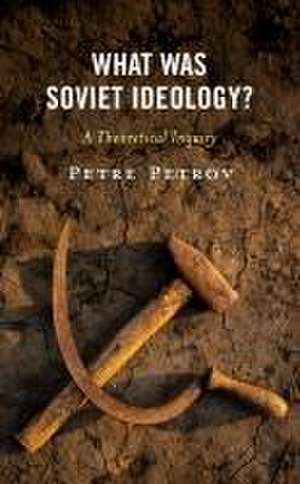
What Was Soviet Ideology?: A Theoretical Inquiry
Autor Petre Petroven Limba Engleză Hardback – 30 oct 2023
Preț: 552.80 lei
Preț vechi: 820.38 lei
-33%
Puncte Express: 829
Carte tipărită la comandă
Livrare economică 11-25 noiembrie
Livrare prin curier în România Termenul estimat este afișat lângă disponibilitate.
Transport gratuit pentru acest produs Plată online sau ramburs, în funcție de opțiunile comenzii.
Retur gratuit în 14 zile Comandă securizată și suport în română.
Specificații
ISBN-13: 9781666937374
ISBN-10: 1666937371
Pagini: 282
Dimensiuni: 160 x 230 x 22 mm
Greutate: 0.58 kg
Editura: Bloomsbury Publishing
Colecția Lexington Books
Locul publicării:New York, United States
ISBN-10: 1666937371
Pagini: 282
Dimensiuni: 160 x 230 x 22 mm
Greutate: 0.58 kg
Editura: Bloomsbury Publishing
Colecția Lexington Books
Locul publicării:New York, United States
Cuprins
Introduction
Chapter 1: What Makes Ideology Ideological?
Chapter 2: The Three Logics of Ideology
Chapter 3: The Ontological Truth of Ideology
Chapter 4: The Production of Ideology
Chapter 5: The Show of Civilization
Chapter 6: The Economy of Tokens
Conclusion
Bibliography
Index
About the Author
Chapter 1: What Makes Ideology Ideological?
Chapter 2: The Three Logics of Ideology
Chapter 3: The Ontological Truth of Ideology
Chapter 4: The Production of Ideology
Chapter 5: The Show of Civilization
Chapter 6: The Economy of Tokens
Conclusion
Bibliography
Index
About the Author
Recenzii
Petrov's innovative and challenging study offers theoretical definition and shape to the murky notion of Soviet ideology, interrogating what ideology is, how the term has been used to talk about Soviet culture and ideas, and how ideological concepts emerged from-and also created-the forms of both theoretical and everyday socialism. The opening chapters offer the reader models for theorizing ideology rooted in insights from Marxist-Leninist texts, on the one hand, and frameworks offered by Althusser, Epstein, Foucault, and others, including dialogue with literary texts. Ideology is the logic of ideas, Petrov shows, but it is also the process by which ideas both emerge from life and take form in life, how they are both "production and show." In the later chapters, Petrov investigates the content of ideological production. He studies values like nauchnost' (scientific character) and zhizennost' (vitality) that, when taken together, form the total character of Soviet ideology. This study will be attractive to scholars looking for a chiefly theoretical analysis of the Soviet project, both how it was produced and performed and how scholars have chosen to speak about its legacy. Highly recommended. Graduate students and faculty.