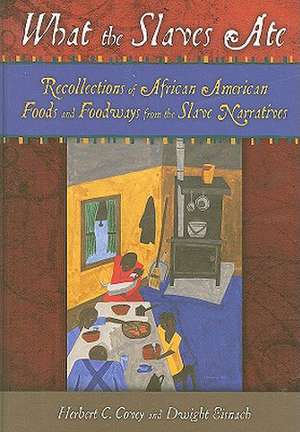
What the Slaves Ate: Recollections of African American Foods and Foodways from the Slave Narratives
Autor Herbert C. Covey, Dwight Eisnachen Limba Engleză Hardback – 20 mai 2009
While a number of scholars have discussed slaves and their foods, slave foodways remains a relatively unexplored topic. The authors' findings also augment existing knowledge about slave nutrition while documenting new information about slave diets.
Preț: 314.26 lei
Preț vechi: 555.23 lei
-43%
Puncte Express: 471
Carte tipărită la comandă
Livrare economică 07-21 decembrie
Livrare prin curier în România Termenul estimat este afișat lângă disponibilitate.
Transport gratuit de la 400.00 lei Plată online sau ramburs, în funcție de opțiunile comenzii.
Retur gratuit în 14 zile Comandă securizată și suport în română.
Specificații
ISBN-13: 9780313374975
ISBN-10: 031337497X
Pagini: 328
Ilustrații: 10 bw illus
Dimensiuni: 186 x 258 x 26 mm
Greutate: 0.84 kg
Editura: Bloomsbury Publishing
Colecția Greenwood
Locul publicării:New York, United States
ISBN-10: 031337497X
Pagini: 328
Ilustrații: 10 bw illus
Dimensiuni: 186 x 258 x 26 mm
Greutate: 0.84 kg
Editura: Bloomsbury Publishing
Colecția Greenwood
Locul publicării:New York, United States
V-ar putea interesa
-
 -27%Preț: 935.25 lei1281.16 lei
 -
 -18%Preț: 791.35 lei965.07 lei
 -
 Preț: 172.85 lei
 -
 Psychology of HabitsRobin Mazzariello-27%Preț: 612.52 lei835.54 lei
 -
 -27%Preț: 1635.92 lei2229.04 lei
 -
 -27%Preț: 1160.24 lei1582.34 lei
 -
 China and the New MaoistsProfessor Kerry Brown-22%Preț: 115.15 lei146.98 lei
Cuprins
Preface
Acknowledgments
1. The WPA Narratives and Slave Diets
2. Slave Nutrition
3. African Roots and Food Traditions
4. Slave Cooking and Meals
5. Vegetables
6. Meat
7. Wild Game and Fish
8. Dairy
9. Grains, Cereals, and Baked Goods
10. Fruits, Nuts, and Coffee
11. Celebrations, Special Occasions, and the War
12. Closing Observations
APPENDICES: FOODS IDENTIFIED IN THE WPA NARRATIVES
Appendix A: Vegetables
Appendix B: Meats
Appendix C: Wild Game: Birds
Appendix D: Wild Game: Fish/Shellfish
Appendix E: Wild Game: Reptiles and Amphibians
Appendix F: Wild Game: Mammals
Appendix G: Dairy
Appendix H: Grains
Appendix I: Baked Goods
Appendix J: Fruit
Appendix K: Nuts
Appendix L: Sugar/Molasses/Spices
Appendix M: Beverages
Appendix N: General or Unclear
Bibliography
Index
Acknowledgments
1. The WPA Narratives and Slave Diets
2. Slave Nutrition
3. African Roots and Food Traditions
4. Slave Cooking and Meals
5. Vegetables
6. Meat
7. Wild Game and Fish
8. Dairy
9. Grains, Cereals, and Baked Goods
10. Fruits, Nuts, and Coffee
11. Celebrations, Special Occasions, and the War
12. Closing Observations
APPENDICES: FOODS IDENTIFIED IN THE WPA NARRATIVES
Appendix A: Vegetables
Appendix B: Meats
Appendix C: Wild Game: Birds
Appendix D: Wild Game: Fish/Shellfish
Appendix E: Wild Game: Reptiles and Amphibians
Appendix F: Wild Game: Mammals
Appendix G: Dairy
Appendix H: Grains
Appendix I: Baked Goods
Appendix J: Fruit
Appendix K: Nuts
Appendix L: Sugar/Molasses/Spices
Appendix M: Beverages
Appendix N: General or Unclear
Bibliography
Index
Recenzii
This fascinating anthropological documentary excavates 1930s WPA-funded interviews to find the testimony of former slaves on the subject of food's role in daily life. In 12 absorbing, essay-style chapters, Covey (African American Slave Medicine) and independent scholar Eisnach explore how food was used to reinforce power relationships, how slave recipes gradually entered plantation kitchens, and how the Civil War changed entrenched traditions. Fourteen appendixes, categorized by food type, list specific ingredients mentioned by interview subjects and indicate the subject's home state, a record that facilitates awareness of regional customs.'
This book is among the first to explore the diet and cooking behaviors of American slaves through the use of first-person narratives as opposed to archaeological evidence such as slave ship logs, plantation rationing logs and manuals on the treatment of slaves. Covey, an author and Vice Chair of the Colorado State Juvenile Parole Board, has teamed with
Eisnach, and independent scholar and editor, to collect oral histories handed down from generation to generation and compiled by a WPA narrative project. The authors discuss African traditions and roots that influenced food consumption and break down the slaves' diet according to food category.
.contribute greatly to our knowledge of African-American diet and cuisine, a subject often clouded by myth, misinformation and ignorance. .This book helps us understand the use of food as a control mechanism, through rationing, denial and timing of the supply as well as the effect of these issues on nutrition and health. Researchers tell the story of how the people they enslaved repurposed what was available to create new cuisines, often supplementing meager supplies by farming, fishing and hunting. Many recipes are included, and appendices list more than 300 foods or dishes found as researchers examined all 2,200 narratives recorded by the WPA.
Highly recommended for high school, community college, college and public libraries.
This book is among the first to explore the diet and cooking behaviors of American slaves through the use of first-person narratives as opposed to archaeological evidence such as slave ship logs, plantation rationing logs and manuals on the treatment of slaves. Covey, an author and Vice Chair of the Colorado State Juvenile Parole Board, has teamed with
Eisnach, and independent scholar and editor, to collect oral histories handed down from generation to generation and compiled by a WPA narrative project. The authors discuss African traditions and roots that influenced food consumption and break down the slaves' diet according to food category.
.contribute greatly to our knowledge of African-American diet and cuisine, a subject often clouded by myth, misinformation and ignorance. .This book helps us understand the use of food as a control mechanism, through rationing, denial and timing of the supply as well as the effect of these issues on nutrition and health. Researchers tell the story of how the people they enslaved repurposed what was available to create new cuisines, often supplementing meager supplies by farming, fishing and hunting. Many recipes are included, and appendices list more than 300 foods or dishes found as researchers examined all 2,200 narratives recorded by the WPA.
Highly recommended for high school, community college, college and public libraries.