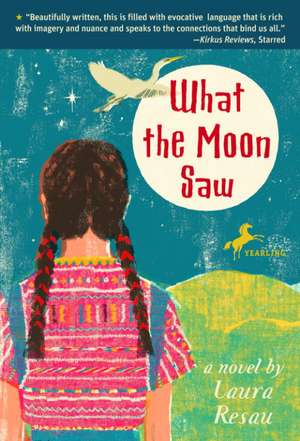
What the Moon Saw
Autor Laura Resauen Limba Engleză Paperback – 31 mar 2008 – vârsta de la 8 până la 12 ani
Vezi toate premiile Carte premiată
Colorado Book Award (2007)
has felt anything but clear. One day a letter comes from Mexico, written in Spanish: Dear Clara, We invite you to our house for the summer. We will wait for you on the day of the full moon, in June, at the Oaxaca airport. Love, your grandparents.
Fourteen-year-old Clara has never met her father's parents. She knows he snuck over the border from Mexico as a teenager, but beyond that, she knows almost nothing about his childhood. When she agrees to go, she's stunned by her grandparents' life: they live in simple shacks in the mountains of southern Mexico, where most people speak not only Spanish, but an indigenous language, Mixteco.
The village of Yucuyoo holds other surprises, too-- like the spirit waterfall, which is heard but never seen. And Pedro, an intriguing young goatherder who wants to help Clara find the waterfall. Hearing her grandmother’s adventurous tales of growing up as a healer awakens Clara to the magic in Yucuyoo, and in her own soul. What The Moon Saw is an enchanting story of discovering your true self in the most unexpected place.
From the Hardcover edition.
Preț: 48.87 lei
Puncte Express: 73
Preț estimativ în valută:
8.65€ • 10.05$ • 7.49£
8.65€ • 10.05$ • 7.49£
Carte disponibilă
Livrare economică 09-23 februarie
Preluare comenzi: 021 569.72.76
Specificații
ISBN-13: 9780440239574
ISBN-10: 0440239575
Pagini: 257
Dimensiuni: 140 x 192 x 16 mm
Greutate: 0.18 kg
Ediția:Reprint
Editura: Yearling Books
ISBN-10: 0440239575
Pagini: 257
Dimensiuni: 140 x 192 x 16 mm
Greutate: 0.18 kg
Ediția:Reprint
Editura: Yearling Books
V-ar putea interesa
-
 Oops, Pounce, Quick, Run!Mike TwohyPreț: 105.77 lei
 -
 The Indigo NotebookLaura ResauPreț: 74.89 lei
 -
 The Queen of WaterLaura ResauPreț: 72.08 lei
 -
 Yang the Youngest and His Terrible EarLensey NamiokaPreț: 45.33 lei
 -
 Jackson Jones and the Puddle of ThornsMary QuattlebaumPreț: 35.84 lei
 -
 Yang the Third and Her Impossible FamilyLensey NamiokaPreț: 40.77 lei
 -
 Soft RainCornelia CornelissenPreț: 40.39 lei
 -
 The Watsons Go to Birmingham - 1963Christopher Paul CurtisPreț: 47.91 lei
 -
 The Beef Princess of Practical CountyMichelle HoutsPreț: 43.36 lei
 -
 The Dark-ThirtyPatricia MckissackPreț: 57.86 lei
 -
 -26%Preț: 51.36 lei69.65 lei
 -
 The Darkness WithinKelly HashwayPreț: 128.33 lei
 -
 In der Heimat der BlumenAnnelies Umlauf-LamatschPreț: 100.33 lei
Recenzii
“Filled with evocative language that is rich in imagery and nuance and speaks to the connections that bind us all. Add a thrilling adventure and all the makings of an enticing read are here.”–Kirkus Reviews, Starred
“Readers . . . will find themselves swept up in this powerful, magical story, and they’ll feel, along with Clara, ‘the spiderweb’s threads, connecting me to people miles and years away’.”–Booklist, Starred
“Readers . . . will find themselves swept up in this powerful, magical story, and they’ll feel, along with Clara, ‘the spiderweb’s threads, connecting me to people miles and years away’.”–Booklist, Starred
Notă biografică
What The Moon Saw is Laura Resau's first novel. The author lives in Colorado.
From the Hardcover edition.
From the Hardcover edition.
Extras
1
Clara
Moonlight is what started everything, what led me to the edge one May night. Yes, I know I sound like a lunatic, but it’s fitting since Luna is my last name. Clara Luna. Clara Lunatic is what some boys at school call me. I turn red and roll my eyes when they say it, but Mom says this is the way eighth-grade boys flirt. I wish they knew what my name means in Spanish: Clear Moon. I didn’t feel like a clear moon on the day my adventure began, though. More like a fuzzy moon, just a faint light through clouds.
It was the afternoon of my neighborhood’s spring fair, and I was supposed to meet my best friend, Samantha, at one o’clock at the snowball stand, but she was late as usual. I was sweating and waiting in line for a raspberry snow cone when I noticed a miniature Walnut Hill set up on the table next to me. It was an exact replica of my neighborhood—every single house was there! There were little plastic people everywhere—smiling kids with helmets riding bikes on my street, women gardening, couples jogging, a teenager mowing the lawn, people barbecuing on their decks. It was kind of cool, but kind of creepy.
I found my family’s house, and sure enough, the shutters were dark green, and the aluminum siding was tan, just like ours. For some reason I shivered, even though the sun was blazing and sweat was dripping down my neck. In the backyard of our house, under a tree, stood a girl who looked about my age, fourteen. Her skin was lighter than mine and her hair was only down to her shoulders, but still, looking at her gave me goose bumps. Of course, her hair was painted on, so I couldn’t tell if she had the same streak of pumpkin orange underneath where I’d tested blond highlights the month before. She did have the same chubby cheeks, and the same way of standing awkwardly, as though she didn’t know what to do with her hands.
I paid for the snow cone and stayed staring at the tiny neighborhood, licking the syrupy ice.
“Pretty neato, huh?” said one of the mothers at the table behind a sign that read walnut hill neighborhood association. “You see your own house there, hon?”
I pretended not to hear her, and she turned away to talk with another mother about a shoe sale at the mall. Then I did something crazy. I didn’t know why, but I reached over and tried to pick up the plastic girl. She was glued down, and didn’t budge. I reached my other hand over and held down the turf grass as I yanked her up. She came up, but only after half my snow cone had fallen into my miniature yard.
The mother glanced back at me as slush dripped off the tree, making a red puddle where the girl used to be.
Her mouth dropped open, and before she could say anything, I turned and ran.
Samantha walked up to me at the bike racks just as I was fumbling with my bike lock. I could tell she’d spent hours in the bathroom perfecting her makeup, which was probably what made her so late. She begged me to stay and hang out with her for a while. I did, but I made sure we stayed far away from the miniature neighborhood. The rest of the afternoon I didn’t talk much. I felt like a hazy moon, all fogged up with questions that Samantha wouldn’t understand. I’m more than just a plastic doll, aren’t I? Who am I, really? Who did I come from?
On Dad’s side, I had no idea. All I knew was that before I was born, Dad crossed the Mexican border into Arizona, illegally—probably the only time in his life he’d broken a law. He hiked through the desert for three days and two nights, thirsty all the time, careful to stay hidden from the border police. In the cool darkness of night he walked, and during the blazing days he rested in the shade of cacti. Over the next years he picked tomatoes in the Southwest, and apples in the Northwest, and then made his way to the East Coast, where he mowed lawns and fell in love with his En-glish tutor—my mother. He married her and started his own landscaping business. Then I was born and then my little brother, Hector, and we all moved to Walnut Hill, suburban Maryland.
For all my fourteen years I’d never thought much about Mexico—at least not until those questions began taking over my mind like tangled weeds.
The night after I freed the plastic girl, I couldn’t sleep. The moonlight through my window made me restless. I picked up the girl from my nightstand and felt her hard and smooth in my hand. I couldn’t stop fiddling with her, the way I could never help wiggling a loose tooth with my tongue.
After a long time, I slipped the doll into the pocket of my nightgown and crept downstairs, opened the sliding glass doors, and balanced there on the metal edge in my bare feet. The air felt damp and warm for a May night. The grass smelled especially strong, and the trees seemed to be watching me.
I took the first step onto the cold concrete of the pa- tio. There was the hum of the air-conditioning fan, and beyond that, songs of crickets and maybe frogs.
Another few steps. My feet touched the wet blades of grass. This shocked me, woke me up. I walked across a wide stretch of lawn, and the ground squished beneath me like a sponge. I didn’t know where I was headed or why I was headed there.
Once I stepped past the edge of our yard, the grass didn’t feel any different, but I did. On and on I went. Across the Morgans’ lawn, along the Taylors’ fence into the Sweeneys’ yard, around their plastic-lined pond and down their driveway. I cut across the cul-de-sac, through more yards and streets. No cars moving. No people. Purple-blue shadows draped everything. I realized I was making a beeline for the patch of forest that marked the end of Walnut Hill.
I crossed the border between the last trimmed lawn and the tangle of wild grasses. I walked farther and farther into the shadows, weaving in and out of tree trunks, letting my hands run along their rough bark.
I missed this feeling. Until the year before, Samantha and I used to play in these woods together after school. Sometimes we were priestesses who could talk with animals in the Otherworld. Sometimes gypsy dancers living in treetops in the Black Forest. Sometimes scientists collecting insects in the Amazon. I’d always thought it was a magical place during the daytime, but in the moonlight it was more than magi-cal; it was a different world.
From the Hardcover edition.
Clara
Moonlight is what started everything, what led me to the edge one May night. Yes, I know I sound like a lunatic, but it’s fitting since Luna is my last name. Clara Luna. Clara Lunatic is what some boys at school call me. I turn red and roll my eyes when they say it, but Mom says this is the way eighth-grade boys flirt. I wish they knew what my name means in Spanish: Clear Moon. I didn’t feel like a clear moon on the day my adventure began, though. More like a fuzzy moon, just a faint light through clouds.
It was the afternoon of my neighborhood’s spring fair, and I was supposed to meet my best friend, Samantha, at one o’clock at the snowball stand, but she was late as usual. I was sweating and waiting in line for a raspberry snow cone when I noticed a miniature Walnut Hill set up on the table next to me. It was an exact replica of my neighborhood—every single house was there! There were little plastic people everywhere—smiling kids with helmets riding bikes on my street, women gardening, couples jogging, a teenager mowing the lawn, people barbecuing on their decks. It was kind of cool, but kind of creepy.
I found my family’s house, and sure enough, the shutters were dark green, and the aluminum siding was tan, just like ours. For some reason I shivered, even though the sun was blazing and sweat was dripping down my neck. In the backyard of our house, under a tree, stood a girl who looked about my age, fourteen. Her skin was lighter than mine and her hair was only down to her shoulders, but still, looking at her gave me goose bumps. Of course, her hair was painted on, so I couldn’t tell if she had the same streak of pumpkin orange underneath where I’d tested blond highlights the month before. She did have the same chubby cheeks, and the same way of standing awkwardly, as though she didn’t know what to do with her hands.
I paid for the snow cone and stayed staring at the tiny neighborhood, licking the syrupy ice.
“Pretty neato, huh?” said one of the mothers at the table behind a sign that read walnut hill neighborhood association. “You see your own house there, hon?”
I pretended not to hear her, and she turned away to talk with another mother about a shoe sale at the mall. Then I did something crazy. I didn’t know why, but I reached over and tried to pick up the plastic girl. She was glued down, and didn’t budge. I reached my other hand over and held down the turf grass as I yanked her up. She came up, but only after half my snow cone had fallen into my miniature yard.
The mother glanced back at me as slush dripped off the tree, making a red puddle where the girl used to be.
Her mouth dropped open, and before she could say anything, I turned and ran.
Samantha walked up to me at the bike racks just as I was fumbling with my bike lock. I could tell she’d spent hours in the bathroom perfecting her makeup, which was probably what made her so late. She begged me to stay and hang out with her for a while. I did, but I made sure we stayed far away from the miniature neighborhood. The rest of the afternoon I didn’t talk much. I felt like a hazy moon, all fogged up with questions that Samantha wouldn’t understand. I’m more than just a plastic doll, aren’t I? Who am I, really? Who did I come from?
On Dad’s side, I had no idea. All I knew was that before I was born, Dad crossed the Mexican border into Arizona, illegally—probably the only time in his life he’d broken a law. He hiked through the desert for three days and two nights, thirsty all the time, careful to stay hidden from the border police. In the cool darkness of night he walked, and during the blazing days he rested in the shade of cacti. Over the next years he picked tomatoes in the Southwest, and apples in the Northwest, and then made his way to the East Coast, where he mowed lawns and fell in love with his En-glish tutor—my mother. He married her and started his own landscaping business. Then I was born and then my little brother, Hector, and we all moved to Walnut Hill, suburban Maryland.
For all my fourteen years I’d never thought much about Mexico—at least not until those questions began taking over my mind like tangled weeds.
The night after I freed the plastic girl, I couldn’t sleep. The moonlight through my window made me restless. I picked up the girl from my nightstand and felt her hard and smooth in my hand. I couldn’t stop fiddling with her, the way I could never help wiggling a loose tooth with my tongue.
After a long time, I slipped the doll into the pocket of my nightgown and crept downstairs, opened the sliding glass doors, and balanced there on the metal edge in my bare feet. The air felt damp and warm for a May night. The grass smelled especially strong, and the trees seemed to be watching me.
I took the first step onto the cold concrete of the pa- tio. There was the hum of the air-conditioning fan, and beyond that, songs of crickets and maybe frogs.
Another few steps. My feet touched the wet blades of grass. This shocked me, woke me up. I walked across a wide stretch of lawn, and the ground squished beneath me like a sponge. I didn’t know where I was headed or why I was headed there.
Once I stepped past the edge of our yard, the grass didn’t feel any different, but I did. On and on I went. Across the Morgans’ lawn, along the Taylors’ fence into the Sweeneys’ yard, around their plastic-lined pond and down their driveway. I cut across the cul-de-sac, through more yards and streets. No cars moving. No people. Purple-blue shadows draped everything. I realized I was making a beeline for the patch of forest that marked the end of Walnut Hill.
I crossed the border between the last trimmed lawn and the tangle of wild grasses. I walked farther and farther into the shadows, weaving in and out of tree trunks, letting my hands run along their rough bark.
I missed this feeling. Until the year before, Samantha and I used to play in these woods together after school. Sometimes we were priestesses who could talk with animals in the Otherworld. Sometimes gypsy dancers living in treetops in the Black Forest. Sometimes scientists collecting insects in the Amazon. I’d always thought it was a magical place during the daytime, but in the moonlight it was more than magi-cal; it was a different world.
From the Hardcover edition.
Descriere
Clara Luna's name means" clear moon" in Spanish, but lately, her head has felt anything but clear. "What The Moon Saw" is an enchanting story of discovering one's true self in the most unexpected place.
Premii
- Colorado Book Award Winner, 2007