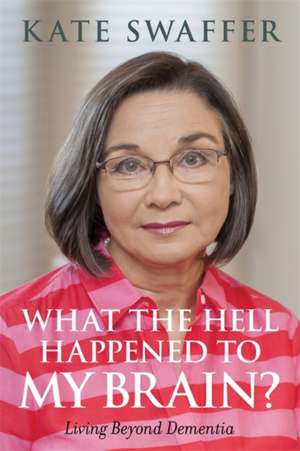
What the hell happened to my brain?: Living Beyond Dementia
Autor Kate Swaffer Cuvânt înainte de Dr Shibley Rahman, Glenn Rees, Richard Tayloren Limba Engleză Paperback – 21 ian 2016
Kate describes vividly her experiences of living with dementia, exploring the effects of memory difficulties, loss of independence, leaving long-term employment, the impact on her teenage sons, and the enormous impact of the dementia diagnosis on her sense of self. Never shying away from difficult issues, she tackles head-on stigma, inadequacies in care and support, and the media's role in perpetuating myths about dementia, suggesting ways in which we can include and empower people with the diagnosis. She also reflects on the ways in which her writing and dementia advocacy work have taken her on a process of self-discovery and enabled her to develop a new and meaningful personal identity.
Kate's powerful words will challenge misconceptions about dementia, and open our eyes to new ways of supporting people with the diagnosis. A must read for people with dementia and their families as well as for professionals and carers.
Preț: 125.43 lei
Preț vechi: 155.72 lei
-19%
Puncte Express: 188
Carte disponibilă
Livrare economică 10-24 septembrie
Livrare express 26 august-01 septembrie pentru 58.72 lei
Livrare prin curier în România Termenul estimat este afișat lângă disponibilitate.
Transport gratuit de la 400.00 lei Plată online sau ramburs, în funcție de opțiunile comenzii.
Retur gratuit în 14 zile Comandă securizată și suport în română.
Specificații
ISBN-13: 9781849056083
ISBN-10: 1849056080
Pagini: 392
Dimensiuni: 140 x 214 x 30 mm
Greutate: 0.4 kg
Editura: JESSICA KINGSLEY PUBLISHERS
Colecția Jessica Kingsley Publishers
Locul publicării:London, United Kingdom
ISBN-10: 1849056080
Pagini: 392
Dimensiuni: 140 x 214 x 30 mm
Greutate: 0.4 kg
Editura: JESSICA KINGSLEY PUBLISHERS
Colecția Jessica Kingsley Publishers
Locul publicării:London, United Kingdom
V-ar putea interesa
-
 Coping with Chronic IllnessH Norman WrightPreț: 117.52 lei
 -
 Preț: 129.30 lei
 -
 You Can Choose To Be HappyTom G StevensPreț: 128.06 lei
 -
 Tracy's Story - The Other Side of the CoinTracy Lynn ArmstrongPreț: 126.56 lei
 -
 10 Minutes/10 YearsFrederic BrandtPreț: 117.96 lei
 -
 AHCCM. D. Fred PescatorePreț: 68.59 lei
 -
 Preț: 146.14 lei
 -
 Living and Working with CancerBeki P. LangaPreț: 99.52 lei
 -
 Pathological Demand Avoidance Syndrome - My Daughter is Not NaughtyJane Alison Sherwin-20%Preț: 117.68 lei146.33 lei
 -
 Nothing about us, without us!: 20 years of dementia advocacyChristine Bryden-19%Preț: 149.46 lei184.34 lei
 -
 -20%Preț: 123.10 lei154.05 lei
 -
 Life on the Autism Spectrum - A Guide for Girls and WomenKaren McKibbin-21%Preț: 114.31 lei144.32 lei
 -
 -20%Preț: 125.23 lei155.61 lei
 -
 All In My MindJennifer BuschPreț: 106.26 lei
 -
 Living Your Best With Early-Stage Alzheimer'sLisa Snyder-5%Preț: 249.06 lei262.17 lei
 -
 A Stem Cell Transplant MS Recovery StorySandi SelviPreț: 99.88 lei
Recenzii
Before being diagnosed with younger onset dementia, Kate Swaffer loved to study, to learn, to be of service to others. Now living with dementia, she has not changed in these respects whatsoever. Her wonderfully illuminating book should be required reading for people and families living with dementia.
The scope of Kate's book is beyond that which anyone else with dementia has attempted. She reflects upon loneliness, guilt, driving, aged care, writing and advocacy.
Janet Baylis, Manager of our Dementia Knowledge Centre, says, 'There are few books written by people with dementia. This is one that I would strongly recommend to anyone with a recent diagnosis who is searching for answers about living well with their condition.'
Keith Oliver, a Society ambassador who has Alzheimer's, says the book covers areas that he hasn't seen written about in such personal and emotive ways elsewhere. He adds, 'The structure of short, crisp chapters works extremely well and gives the author the opportunity to structure her thinking and experience in a clear way.'
Laura Venables, who works on the Society's Engagement and Participation programme, was fascinated by Kate's account of 'prescribed disengagement'. This is how Kate describes the advice she says she was given - but ignored - to withdraw from her life and work after she was diagnosed. Laura says, 'Kate challenges the assumptions that are continuously brought out to define living with dementia. 'She openly illustrates her experiences of striving to continue life as she lived it the day before she was diagnosed, and of all the opportunities that she has become involved with since diagnosis - it's exciting stuff!'
The scope of Kate's book is beyond that which anyone else with dementia has attempted. She reflects upon loneliness, guilt, driving, aged care, writing and advocacy.
Janet Baylis, Manager of our Dementia Knowledge Centre, says, 'There are few books written by people with dementia. This is one that I would strongly recommend to anyone with a recent diagnosis who is searching for answers about living well with their condition.'
Keith Oliver, a Society ambassador who has Alzheimer's, says the book covers areas that he hasn't seen written about in such personal and emotive ways elsewhere. He adds, 'The structure of short, crisp chapters works extremely well and gives the author the opportunity to structure her thinking and experience in a clear way.'
Laura Venables, who works on the Society's Engagement and Participation programme, was fascinated by Kate's account of 'prescribed disengagement'. This is how Kate describes the advice she says she was given - but ignored - to withdraw from her life and work after she was diagnosed. Laura says, 'Kate challenges the assumptions that are continuously brought out to define living with dementia. 'She openly illustrates her experiences of striving to continue life as she lived it the day before she was diagnosed, and of all the opportunities that she has become involved with since diagnosis - it's exciting stuff!'
Cuprins
Disclaimer. Foreword by Dr Richard Taylor. Foreword by Glenn Rees, AM. Foreword by Dr Shibley Rahman. Dedication. Acknowledgements. Author's Note. Introduction. 1. Why Me, Why This, Why Now? 2. The Early Days. 3. So, What the Hell Did Happen to My Brain? 4. Illness, Sadness and Positivity. 5. The Dementia Train and Not Sweating the Small Stuff. 6. Thank You, Richard Taylor. 7. Reactions to Dementia: Yours, Mine, Others'. 8. The Burden of Disbelief. 9. Being Diagnosed with Younger Onset Dementia. 10. Children of People with Younger Onset Dementia. 11. Early vs Delayed Diagnosis. 12. Dementia, Grief and Loss: It's Very Complicated. 13. The Emotional Toll of Letting Go. 14. Myths of Dementia. 15. Loneliness and Dementia. 16. Prescribed Disengagement®. 17. Dementia as a DisAbility. 18. Stigma and Dementia. 19. The Language of Dementia. 20. Dementia and Word Finding. 21. Employment and Dementia. 22. Driving and Dementia. 23. Family Care Partners or BUBs (Back-Up Brains). 24. Care Partners Speaking Out Publicly About People with Dementia. 25. Guilt. 26. Who's Got the 'Challenging Behaviours'? 27. Dementia and Common Sense. 28. Interventions for Dementia. 29. Blogging and Writing as Interventions for Dementia. 30. Advocacy as an Intervention for Dementia. 31. Volunteering as an Intervention for Dementia. 32. Dementia-friendly/Accessible Communities. 33. Human Rights in Dementia and Aged Care. 34. There is Big Money in Dementia. 35. Nothing About us, Without Us... 36. Love, Gifts, Dementia and Dying. 37. A Final Word on Resilience and Memory. 38. Proof that People with Dementia Can Live Beyond and Diagnosis of Dementia. Dementia: A Brief Summary. Resources. References.