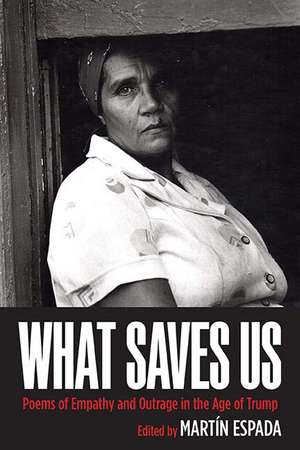
What Saves Us: Poems of Empathy and Outrage in the Age of Trump
Editat de Martín Espada Contribuţii de Julia Alvarez, Doug Anderson, Naomi Ayala, Benjamin Balthaser, Sean Bates, Jan Beatty, Tara Betts, Richard Blanco, Rafael Campo, Cyrus Cassells, Hayan Charara, Chen Chen, Brian Clements, Jim Daniels, Kwame Dawes, Chard deNiord, Cynthia Dewi Oka, Dante DiStefano, Kathy Engle, George Evans, Tarfia Faizullah, Dr. Carolyn Forché, Denice Frohman, Danielle Legros Georges, Aracelis Girmay, Aracelis _DELETE_Girmay, Ruth Goring, Adam Grabowski, Laurie Anne Guerrero, Sam Hamill, Samuel Hazo, Juan Felipe Herrera, Jane Hirshfield, Everett Hoagland, Lawrence Joseph, Yusef Komunyakaa, Dorianne Laux, Paul Mariani, Demetria Martínez, Paul Martínez Pompa, Julio Marzán, Maria Mazziotti Gillan, Marty McConnell, Leslie McGrath, Richard Michelson, E. Ethelbert Miller, Kamilah Aisha Moon, David Mura, John Murillo, Maria Nazos, Marilyn Nelson, Naomi Shihab Nye, Alicia Suskin Ostriker, Willie Perdomo, Emmy Pérez, Marge Piercy, Sasha Pimentel, Robert Pinsky, Gabriel Ramírez, Luivette Resto, Peggy Robles-Alvarado, Luis J. Rodríguez, William Pitt Root, Luis J. _Rodríguez, Patrick Rosal, Joseph Ross, Nicholas Samaras, Ruth Irupé Sanabria, Lauren Schmidt, Tim Seibles, Katherine DiBella Seluja, Don Share, Patricia Smith, Gary Soto, Mark Turcotte, Brian Turner, Chase Twichell, Pamela Uschuk, Elisabet Velasquez, Richard Villar, Ocean Vuong, George Wallace, Afaa M. Weaver, Eleanor Wilner, Daisy Zamora, Danez Smith, Elizabeth Alexander, Marcelo Hernández Castillo, Brenda Marie Osbey, Donald Hall, Bruce Weigl, Ricardo Alberto Maldonado, torrin a. greathouse, Adrian Louisen Limba Engleză Paperback – 15 oct 2019
This is an anthology of poems in the Age of Trump—and much more than Trump. These are poems that either embody or express a sense of empathy or outrage, both prior to and following his election, since it is empathy the president lacks and outrage he provokes.
There is an extraordinary diversity of voices here. The ninety-three poets featured include Elizabeth Alexander, Julia Alvarez, Richard Blanco, Carolyn Forché, Aracelis Girmay, Donald Hall, Juan Felipe Herrera, Yusef Komunyakaa, Naomi Shihab Nye, Marge Piercy, Robert Pinsky, Danez Smith, Patricia Smith, Brian Turner, Ocean Vuong, Bruce Weigl, and Eleanor Wilner. They speak of persecuted and scapegoated immigrants. They bear witness to violence: police brutality against African Americans, mass shootings in a school or synagogue, the rage inflicted on women everywhere. They testify to poverty: the waitress surviving on leftovers at the restaurant, the battles of a teacher in a shelter for homeless mothers, the emergency-room doctor listening to the heartbeats of his patients. There are voices of labor, in the factory and the fields. There are prophetic voices, imploring us to imagine the world we will leave behind in ruins lest we speak and act.
However, this is not merely a collection of grievances. The poets build bridges. One poet steps up to translate in Arabic at the airport; another walks through the city and sees her immigrant past in the immigrant present; another declaims a musical manifesto after the hurricane that devastated his island; another evokes a demonstration in the street, shouting in an ecstasy of defiance. The poets take back the language, resisting the demagogic corruption of words themselves. They assert our common humanity in the face of dehumanization.
There is an extraordinary diversity of voices here. The ninety-three poets featured include Elizabeth Alexander, Julia Alvarez, Richard Blanco, Carolyn Forché, Aracelis Girmay, Donald Hall, Juan Felipe Herrera, Yusef Komunyakaa, Naomi Shihab Nye, Marge Piercy, Robert Pinsky, Danez Smith, Patricia Smith, Brian Turner, Ocean Vuong, Bruce Weigl, and Eleanor Wilner. They speak of persecuted and scapegoated immigrants. They bear witness to violence: police brutality against African Americans, mass shootings in a school or synagogue, the rage inflicted on women everywhere. They testify to poverty: the waitress surviving on leftovers at the restaurant, the battles of a teacher in a shelter for homeless mothers, the emergency-room doctor listening to the heartbeats of his patients. There are voices of labor, in the factory and the fields. There are prophetic voices, imploring us to imagine the world we will leave behind in ruins lest we speak and act.
However, this is not merely a collection of grievances. The poets build bridges. One poet steps up to translate in Arabic at the airport; another walks through the city and sees her immigrant past in the immigrant present; another declaims a musical manifesto after the hurricane that devastated his island; another evokes a demonstration in the street, shouting in an ecstasy of defiance. The poets take back the language, resisting the demagogic corruption of words themselves. They assert our common humanity in the face of dehumanization.
Preț: 143.06 lei
Puncte Express: 215
Carte disponibilă
Livrare economică 10-24 noiembrie
Livrare prin curier în România Termenul estimat este afișat lângă disponibilitate.
Transport gratuit de la 400.00 lei Plată online sau ramburs, în funcție de opțiunile comenzii.
Retur gratuit în 14 zile Comandă securizată și suport în română.
Specificații
ISBN-13: 9780810140776
ISBN-10: 0810140772
Pagini: 288
Dimensiuni: 152 x 229 x 18 mm
Greutate: 0.43 kg
Editura: Northwestern University Press
Colecția Curbstone Books 2
ISBN-10: 0810140772
Pagini: 288
Dimensiuni: 152 x 229 x 18 mm
Greutate: 0.43 kg
Editura: Northwestern University Press
Colecția Curbstone Books 2
V-ar putea interesa
-
 The Inferno of Dante AlighieriSeth ZimmermanPreț: 113.29 lei
 -
 Georgy PorgyGeorge EvansPreț: 78.83 lei
 -
 SeamTarfia FaizullahPreț: 90.48 lei
 -
 The Cosmological EyeHenry MillerPreț: 125.82 lei
 -
 Elegy for TrainsBenjamin MyersPreț: 111.16 lei
 -
 How to Get a Millionaire on Internet DatingDoug AndersonPreț: 49.11 lei
 -
 To the BulliesBill KearnsPreț: 60.73 lei
 -
 Reflections in the MirrorTanisha Michelle ParrPreț: 52.86 lei
 -
 Reflection of Distant MemoriesJames L. CouplandPreț: 34.41 lei
 -
 SpectrumMrs Melanie L. ThomasonPreț: 51.20 lei
 -
 Love & MagicAmanda SpringerPreț: 60.48 lei
 -
 Open HeartSilvio Leon IIIPreț: 216.47 lei
 -
 Living ColoursJanniettaPreț: 63.71 lei
 -
 The World That the Shooter Left UsCyrus CassellsPreț: 89.93 lei
 -
 Preț: 228.74 lei
 -
 Franz Kafkas "Das Stadtwappen" als Prag-TextLisa JaekelPreț: 80.64 lei
 -
 Alt-Wiener Dramen, Band 2Johann NestroyPreț: 113.44 lei
Notă biografică
MARTÍN ESPADA has published almost twenty books as a poet, editor, essayist, and translator. His latest collection of poems is called Vivas to Those Who Have Failed. He is the recipient of the 2018 Ruth Lilly Prize, and the editor of the groundbreaking anthology Poetry Like Bread: Poets of the Political Imagination from Curbstone Press.
Recenzii
"Far more than a protest anthology, Martin Espada’s What Saves Us brings together portraits of Trump’s enablers with the myriad voices of the lost, abandoned, and marginalized. These stories of immigrants, minimum wage workers, alcoholics, victims, broken angels, and dreamers redeem their lives and install their voices in our hearts."
—Cary Nelson, author of Revolutionary Memory: Recovering the Poetry of the American Left
"Poet Martín Espada has put together a potent, moving anthology of poetry . . ." —Nina MacLaughlin, The Boston Globe
"In the poem by Bruce Weigl that gives the collection its title, 'What Saves Us,' he writes that 'We are not always right about what we think will save us.' But the heart of this anthology is that it is clearly telling us what will not save us: our silence. Jane Hirshfield asks in her poem, 'Let Them Not Say,' that difficult question that has been heard more and more in the past four years and will be asked by generations that come after us: When it was happening, what did you do about it?" —Kenneth Ronkowitz, Paterson Literary Review
"Direct, colloquial and unironic, these poems speak from and for the communities that reflect the unstoppable diversification of US society, by asserting a common humanity in the face of dehumanization." —Andy Croft, Morning Star
—Cary Nelson, author of Revolutionary Memory: Recovering the Poetry of the American Left
"Poet Martín Espada has put together a potent, moving anthology of poetry . . ." —Nina MacLaughlin, The Boston Globe
"In the poem by Bruce Weigl that gives the collection its title, 'What Saves Us,' he writes that 'We are not always right about what we think will save us.' But the heart of this anthology is that it is clearly telling us what will not save us: our silence. Jane Hirshfield asks in her poem, 'Let Them Not Say,' that difficult question that has been heard more and more in the past four years and will be asked by generations that come after us: When it was happening, what did you do about it?" —Kenneth Ronkowitz, Paterson Literary Review
"Direct, colloquial and unironic, these poems speak from and for the communities that reflect the unstoppable diversification of US society, by asserting a common humanity in the face of dehumanization." —Andy Croft, Morning Star