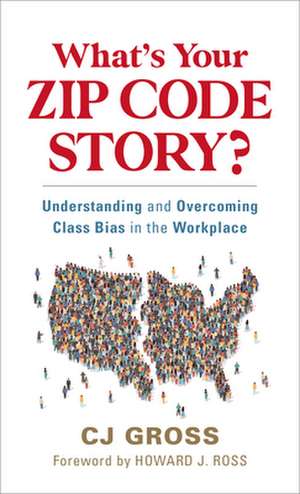
What's Your Zip Code Story?: Understanding and Overcoming Class Bias in the Workplace
Autor CJ Gross Cuvânt înainte de Howard J. Rossen Limba Engleză Hardback – 20 mai 2022
The renewed focus on class, race and equality in the workplace and beyond is making an indelible mark on society. This clarion call for change is sweeping inequality from every corner of the nation, including law enforcement, schools, and businesses. And within the past five years, diversity and inclusion, as well as unconscious bias, have been the main drivers of organizational training, politics, and community engagement.
What's Your Zip Code Story helps clarify the intersection of class bias and racial disparity in the workplace and arms organizations with the knowledge to not only have productive discussions, but also adopt effective solutions. Gross instructs class-migrants-whether college students, recent graduates, or overlooked employees-on how to climb the career lattice and transform themselves from undervalued employees to respected leaders. The book tackles challenges that class-migrants encounter when navigating the workplace and provides operative practices that can be utilized to hone new professional skills and drive positive change in workplace culture. It is a powerful tool that will inspire marginalized employees who are hungry for personal and professional growth, as well as give insight to business leaders seeking a new way to engage their teams. Through the lived experiences of the author and research-based strategies, readers will find insights on how to increase workplace engagement and business performance.
Preț: 180.99 lei
Preț vechi: 240.15 lei
-25%
Puncte Express: 271
Carte tipărită la comandă
Livrare economică 30 noiembrie-14 decembrie
Livrare prin curier în România Termenul estimat este afișat lângă disponibilitate.
Transport gratuit de la 400.00 lei Plată online sau ramburs, în funcție de opțiunile comenzii.
Retur gratuit în 14 zile Comandă securizată și suport în română.
Specificații
ISBN-13: 9781538160589
ISBN-10: 1538160587
Pagini: 224
Dimensiuni: 146 x 222 x 20 mm
Greutate: 0.43 kg
Editura: Bloomsbury Publishing
Colecția Rowman & Littlefield
Locul publicării:New York, United States
ISBN-10: 1538160587
Pagini: 224
Dimensiuni: 146 x 222 x 20 mm
Greutate: 0.43 kg
Editura: Bloomsbury Publishing
Colecția Rowman & Littlefield
Locul publicării:New York, United States
V-ar putea interesa
-
 The Race to the TopNazir AfzalPreț: 70.37 lei
 -
 The Person You Mean to BeDolly ChughPreț: 183.49 lei
 -
 -16%Preț: 214.63 lei257.02 lei
 -
 The ConversationRobert Livingston-17%Preț: 91.09 lei109.89 lei
 -
 Diversity DividendPaola Cecchi-Dimeglio-22%Preț: 152.55 lei195.13 lei
 -
 -32%Preț: 128.04 lei187.56 lei
 -
 Do the WorkRoxane Gay-18%Preț: 83.33 lei101.55 lei
 -
 Preț: 179.30 lei
 -
 Radical RespectKim Scott-33%Preț: 53.40 lei79.70 lei
 -
 UnbiasStacey A GordonPreț: 137.01 lei
 -
 The Elephant and the MouseLaura A LiswoodPreț: 135.93 lei
 -
 Can I Say That?Poornima LuthraPreț: 161.67 lei
 -
 -25%Preț: 109.31 lei145.79 lei
 -
 The Leader's Guide to Unconscious BiasPamela FullerPreț: 107.12 lei
 -
 -33%Preț: 54.05 lei80.09 lei
 -
 Bias InterruptedJoan C WilliamsPreț: 152.05 lei
 -
 -18%Preț: 65.03 lei79.50 leiRecomandat
 -
 Be Better Than Your BSRisha Grant-20%Preț: 71.67 lei89.57 lei
 -
 -25%Preț: 155.74 lei207.64 lei
 -
 Preț: 238.86 lei
Cuprins
Acknowledgments
Foreword: by Howard J Ross
Introduction
1 Why Does Social Class Matter?
2 My Zip Code Story
3 What's Your Zip Code Story?
4 Zip Code Bias
5 10 Things Managers and Class Migrants Need to Know
6 How Businesses can Incorporate Social Class into their Inclusion, Diversity, Equity and Accessibility Initiatives
7 The Power of Belonging
8 Mentorship the Bridge to Equity
Bibliography
Notes
Index
About the Author
Foreword: by Howard J Ross
Introduction
1 Why Does Social Class Matter?
2 My Zip Code Story
3 What's Your Zip Code Story?
4 Zip Code Bias
5 10 Things Managers and Class Migrants Need to Know
6 How Businesses can Incorporate Social Class into their Inclusion, Diversity, Equity and Accessibility Initiatives
7 The Power of Belonging
8 Mentorship the Bridge to Equity
Bibliography
Notes
Index
About the Author
Recenzii
If leaders aren't talking about social class at work, they're "missing a big piece of the puzzle," warns diversity and inclusion consultant Gross in this original.guide. Gross asks both employees and leaders to reflect on their "zip code stories," or the childhood experiences and cultural norms that reflect their class.. It's a much needed conversation starter about class in the workplace[.]
A TEDx speaker, consultant, and founder of a minority-owned consulting firm, Gross goes beyond class and society and takes a deep dive into zip-code stories- evidence that where you live influences your quality of life and the opportunities you'll have. He examines topics like racial disparity, workplace culture, and other boundaries that define who we are because of where we live. Chapters cover tips for managers and class migrants, the power of belonging, mentorship, and more. The book is punctuated with interviews from people across the U.S. to highlight such revelations as fewer than 60 percent of first-in-family college students complete their degree because of lack of support and understanding from family. Gross challenges readers to recognize their own zip-code stories and how they shape their views of others. Additionally, he encourages us all to talk to one another about our backgrounds and beliefs to develop empathy and relationships. Emigrants, workplace-diversity-and-inclusion leaders, college students, and those interested in social justice will be drawn to this book.
[H]is book engagingly addresses why social class matters in the workplace. Beginning with his own story, Gross provides numerous examples of how social class impacts every area of life and offers suggestions for class migrants to successfully move up the ladder. He also coaches managers on how to retain employees with different class backgrounds. Filled with stories, the book addresses topics such as workplace bias, the power of belonging, mentorship, and the integration of social class into diversity, equity, inclusion, and accessibility initiatives. Written in a simple, easy-to-read style, this book provides organizations and migrants with strategies for thinking about class and race in their places of work. Recommended. All readership levels.
This timely and important book by my colleague, CJ Gross, brings a fresh and innovative perspective to our nation's current discussion on issues of diversity, equity, accessibility, and inclusion in the workplace. Even with the growing national awareness of the critical need for greater diversity and inclusion in our nation's institutions, the oversized role that a mere zip code has played in a person's life is all too often omitted from this conversation. From the very beginning of our nation, a person's place of birth has had a profound impact on almost every aspect of their opportunities in life. Drawing on his own life experiences, as well as the experiences of others, CJ speaks to this critical reality. He does so by not only providing organizations with tools and strategies to help facilitate a more inclusive and equitable workplace, he does the same for his fellow "class-migrants" who are looking to climb the social and workplace ladder. For everyone who is a stakeholder in the diversity and inclusion discussion, this is a must-read book!
What's Your Zip Code Story? shows why it's important to include class in your diversity initiatives, not because class is more important than race but because you won't be able to effectively recruit and retain people of color without addressing class as well as race-and because first-generation professionals of all races are, in effect, migrating from one class culture to a different one. This book will help.
A TEDx speaker, consultant, and founder of a minority-owned consulting firm, Gross goes beyond class and society and takes a deep dive into zip-code stories- evidence that where you live influences your quality of life and the opportunities you'll have. He examines topics like racial disparity, workplace culture, and other boundaries that define who we are because of where we live. Chapters cover tips for managers and class migrants, the power of belonging, mentorship, and more. The book is punctuated with interviews from people across the U.S. to highlight such revelations as fewer than 60 percent of first-in-family college students complete their degree because of lack of support and understanding from family. Gross challenges readers to recognize their own zip-code stories and how they shape their views of others. Additionally, he encourages us all to talk to one another about our backgrounds and beliefs to develop empathy and relationships. Emigrants, workplace-diversity-and-inclusion leaders, college students, and those interested in social justice will be drawn to this book.
[H]is book engagingly addresses why social class matters in the workplace. Beginning with his own story, Gross provides numerous examples of how social class impacts every area of life and offers suggestions for class migrants to successfully move up the ladder. He also coaches managers on how to retain employees with different class backgrounds. Filled with stories, the book addresses topics such as workplace bias, the power of belonging, mentorship, and the integration of social class into diversity, equity, inclusion, and accessibility initiatives. Written in a simple, easy-to-read style, this book provides organizations and migrants with strategies for thinking about class and race in their places of work. Recommended. All readership levels.
This timely and important book by my colleague, CJ Gross, brings a fresh and innovative perspective to our nation's current discussion on issues of diversity, equity, accessibility, and inclusion in the workplace. Even with the growing national awareness of the critical need for greater diversity and inclusion in our nation's institutions, the oversized role that a mere zip code has played in a person's life is all too often omitted from this conversation. From the very beginning of our nation, a person's place of birth has had a profound impact on almost every aspect of their opportunities in life. Drawing on his own life experiences, as well as the experiences of others, CJ speaks to this critical reality. He does so by not only providing organizations with tools and strategies to help facilitate a more inclusive and equitable workplace, he does the same for his fellow "class-migrants" who are looking to climb the social and workplace ladder. For everyone who is a stakeholder in the diversity and inclusion discussion, this is a must-read book!
What's Your Zip Code Story? shows why it's important to include class in your diversity initiatives, not because class is more important than race but because you won't be able to effectively recruit and retain people of color without addressing class as well as race-and because first-generation professionals of all races are, in effect, migrating from one class culture to a different one. This book will help.