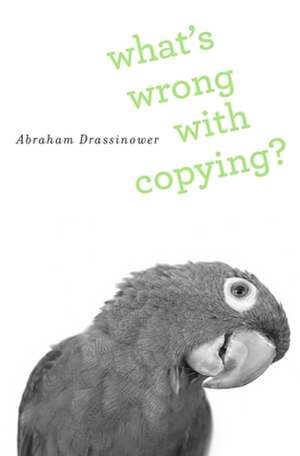
What's Wrong with Copying?
Autor Abraham Drassinoweren Limba Engleză Hardback – 9 apr 2015
În volumul What's Wrong with Copying?, Abraham Drassinower ne oferă instrumente analitice riguroase pentru a reevalua fundamentul juridic al proprietății intelectuale. Observăm o îndepărtare necesară de la viziunea convențională care tratează dreptul de autor ca pe un simplu echilibru între stimulente economice și accesul publicului. Autorul pune la dispoziția cititorului un cadru conceptual în care lucrarea este privită ca un „act de comunicare”, transformând analiza încălcării drepturilor de autor dintr-o dispută patrimonială într-o problemă de uzurpare a discursului celuilalt.
Subliniem abordarea practică a Abraham Drassinower, care oferă criterii specifice pentru a evalua când reproducerea unei opere este nu doar permisă, ci esențială pentru participarea la dialogul cultural. Această perspectivă permite o critică structurată a legislației actuale, oferind un șablon de gândire aplicabil în fața noilor provocări aduse de tehnologia digitală. Complementar volumului Copyright and Piracy de Lionel Bently, care analizează granița dintre imitație și inspirație din perspective multidisciplinare, lucrarea de față acoperă fundamentul filosofic și juridic al dreptului de autor ca drept la comunicare, o zonă pe care abordările pur economice tind să o ignore.
Recomandăm acest volum pentru rigoarea cu care demontează ideea dreptului absolut al autorului, înlocuind-o cu un model de participare dialogică. Stilul este dens și argumentat, specific publicațiilor Harvard University Press, fiind o resursă esențială pentru cei care doresc să înțeleagă nu doar ce este ilegal, ci de ce anumite forme de copiere sunt fundamentale pentru libertatea de exprimare.
Preț: 344.59 lei
Carte tipărită la comandă
Livrare economică 01-15 decembrie
Livrare express 24-30 octombrie pentru 58.83 lei
Specificații
ISBN-10: 0674743970
Pagini: 288
Dimensiuni: 164 x 243 x 30 mm
Greutate: 0.55 kg
Editura: Harvard University Press
V-ar putea interesa
-
 Free RideRobert Levine-19%Preț: 57.85 lei71.11 lei
 -
 A Practical Guide to Trade Mark LawAmanda Michaels-33%Preț: 951.56 lei1411.75 lei
 -
 Domain Names RewiredWolfePreț: 427.06 lei
 -
 Copyright Restoration & the Supreme Court's Golan v. Holder DecisionNicholas A Hernandez-26%Preț: 500.65 lei674.94 lei
 -
 International Approaches to Online Copyright EnforcementPatricia Wade-27%Preț: 1216.17 lei1658.64 lei
 -
 -27%Preț: 1385.49 lei1888.63 lei
 -
 Intellectual Property and EU Competition LawJonathan D.C. Turner-33%Preț: 1392.44 lei2071.67 lei
 -
 EU Intellectual Property LawTrevor Cook-32%Preț: 2477.93 lei3662.66 lei
De ce să citești această carte
Această carte se adresează juriștilor, academicienilor și profesioniștilor din industriile creative care caută o înțelegere profundă a dreptului de autor dincolo de cifre. Veți învăța să distingeți între copierea ca furt și copierea ca act necesar de comunicare, câștigând un cadru teoretic solid pentru a naviga dilemele etice și legale ale erei digitale. Este un argument puternic pentru o legislație mai echitabilă.