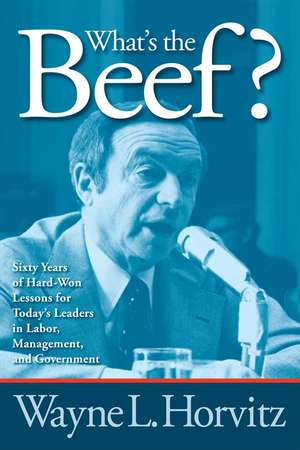
What's the Beef?: Sixty Years of Hard-Won Lessons for Today's Leaders in Labor, Management, and Government
Autor Wayne L. Horvitz Editat de Tansy Howard Blumeren Limba Engleză Paperback – 3 dec 2008
The story takes off on its own trajectory when Horvitz engages as a young management player in dramatic and sometimes bizarre plant disputes in Bayonne and Perth Amboy, N.J., and Rome, N.Y., and then dives into the enormous labor problems arising from the introduction of containerization on the West Coast waterfront where he meets some of the most colorful figures in labor history and provides snatches of conversation and hilarious stories of their interactions. Horvitz then transports us to the East Coast and a stint in the Carter Administration as the nation's top mediator only to find himself thrust into some of the longest longshore and coal strikes in recent history and a colorful but nonetheless near-disastrous dispute at the Metropolitan Opera. Ultimately, he finds himself up to the eyeballs in the deregulation and disruption of the airlines industry, airline mergers, and the convoluted problems caused by the outmoded cost structure of the nation's railroads.
A gifted storyteller, Horvitz gives us a front row seat throughout his lively saga, remembers the most delicious details, and tells only the best stories. While a long term member of the management fraternity, he nonetheless includes an impassioned and articulate argument for the revitalization and restructuring of the now-diminished art of collective bargaining in the global economy.
Preț: 401.91 lei
Preț vechi: 580.37 lei
-31%
Puncte Express: 603
Carte tipărită la comandă
Livrare economică 26 noiembrie-10 decembrie
Livrare prin curier în România Termenul estimat este afișat lângă disponibilitate.
Transport gratuit pentru acest produs Plată online sau ramburs, în funcție de opțiunile comenzii.
Retur gratuit în 14 zile Comandă securizată și suport în română.
Specificații
ISBN-13: 9780761844815
ISBN-10: 0761844813
Pagini: 368
Dimensiuni: 150 x 228 x 28 mm
Greutate: 0.57 kg
Ediția:New.
Editura: Bloomsbury Publishing
Colecția Hamilton Books
Locul publicării:New York, United States
ISBN-10: 0761844813
Pagini: 368
Dimensiuni: 150 x 228 x 28 mm
Greutate: 0.57 kg
Ediția:New.
Editura: Bloomsbury Publishing
Colecția Hamilton Books
Locul publicării:New York, United States
V-ar putea interesa
-
 No Country for Old Men: From Novel to FilmLynnea Chapman King-32%Preț: 343.22 lei507.83 lei
 -
 Buddhist Art Coloring, Book 1Robert Beer-38%Preț: 104.04 lei168.12 lei
Cuprins
Part 1 Aaron
Part 2 Going Corporate
Chapter 3 The Men and Machines Agreement
Chapter 4 Shipboard Unions
Chapter 5 The Free Speech Movement and Moving East
Part 6 The Joint Labor Management Committee of the Retail Food Industry
Chapter 7 Mediating in the Carter Administration
Part 8 Life After Public Office
Part 9 Airline Adventures
Part 10 After Planes, Trains
Part 11 Be Careful What You Wish For
Part 2 Going Corporate
Chapter 3 The Men and Machines Agreement
Chapter 4 Shipboard Unions
Chapter 5 The Free Speech Movement and Moving East
Part 6 The Joint Labor Management Committee of the Retail Food Industry
Chapter 7 Mediating in the Carter Administration
Part 8 Life After Public Office
Part 9 Airline Adventures
Part 10 After Planes, Trains
Part 11 Be Careful What You Wish For
Recenzii
Wayne Horvitz gives us three books for the price of one; all of them are easy on the eyes but together they sneak in an extremely valuable public policy discussion on collective bargaining. One is the personal memoir of a wise-very wise-talented, and witty man who selects carefully but forgets nothing. Next is the interplay of contending forces in labor relations-which reveals and teaches at the same time. And finally there is his spirited case for collective bargaining. When you finish reading this, you'll be far more alert than when you started.
Horvitz-a longtime labor relations executive in private industry and later a management consultant on labor issues does not sermonize in offering his lessons to the reader. Instead, he gives us stories in small doses and allows his message to emerge overthe long haul. The value we get as observers is an inside book at the reactions people have towards these issues and situations....
Wayne Horvitz's story is more than an entertaining life-long journey through the world of labor relations as it evolved over the course of the 20th century. It is that to be sure, an engaging personal account from one of the most highly respected leaders in our field. But it is also a story of the people, relationships, and mutual respect that made our labor relations system work well for so many years. We should all read this, reflect on what has been, what we are losing, and what we need to do to recreate a system that works in the 21st century.
Horvitz-a longtime labor relations executive in private industry and later a management consultant on labor issues does not sermonize in offering his lessons to the reader. Instead, he gives us stories in small doses and allows his message to emerge overthe long haul. The value we get as observers is an inside book at the reactions people have towards these issues and situations....
Wayne Horvitz's story is more than an entertaining life-long journey through the world of labor relations as it evolved over the course of the 20th century. It is that to be sure, an engaging personal account from one of the most highly respected leaders in our field. But it is also a story of the people, relationships, and mutual respect that made our labor relations system work well for so many years. We should all read this, reflect on what has been, what we are losing, and what we need to do to recreate a system that works in the 21st century.