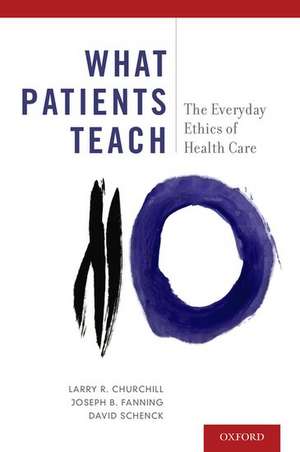
What Patients Teach: The Everyday Ethics of Health Care
Autor Larry R. Churchill, Joseph B. Fanning, David Schencken Limba Engleză Paperback – 8 dec 2016
Preț: 266.90 lei
Preț vechi: 360.08 lei
-26%
Puncte Express: 400
Carte tipărită la comandă
Livrare economică 04-09 decembrie
Livrare prin curier în România Termenul estimat este afișat lângă disponibilitate.
Transport gratuit de la 400.00 lei Plată online sau ramburs, în funcție de opțiunile comenzii.
Retur gratuit în 14 zile Comandă securizată și suport în română.
Specificații
ISBN-13: 9780190650582
ISBN-10: 0190650583
Pagini: 208
Dimensiuni: 137 x 208 x 15 mm
Greutate: 0.27 kg
Editura: Oxford University Press
Colecția OUP USA
Locul publicării:New York, United States
ISBN-10: 0190650583
Pagini: 208
Dimensiuni: 137 x 208 x 15 mm
Greutate: 0.27 kg
Editura: Oxford University Press
Colecția OUP USA
Locul publicării:New York, United States
V-ar putea interesa
-
 It's Probably NothingNaga Munchetty-5%Preț: 171.43 lei180.45 lei
 -
 Ethics for Health CareCatherine Berglund-5%Preț: 397.57 lei418.49 lei
 -
 Bioethics: Passing the Boards, Providing Patient Care, and BeyondJeffrey W. Bulger-24%Preț: 606.62 lei797.00 lei
 -
 Ethical Dimensions in the Health ProfessionsRegina F. Doherty-26%Preț: 416.82 lei566.66 lei
 -
 Kumar and Clark's Clinical MedicineDavid Randall-26%Preț: 487.97 lei658.70 leiRecomandat
 -
 -29%Preț: 223.05 lei315.67 lei
 -
 -31%Preț: 221.67 lei320.80 lei
 -
 Medical Ethics, Law and Communication at a GlancePatrick DaveyPreț: 331.38 lei
 -
 Medical Ethics and Law: A curriculum for the 21st CenturyDominic Wilkinson-33%Preț: 197.54 lei294.41 lei
 -
 Nursing & Healthcare EthicsSimon Robinson-31%Preț: 228.11 lei330.47 lei
 -
 Crash Course Medical Ethics and Sociology Updated Print + eBook editionAndrew Papanikitas-34%Preț: 178.20 lei268.74 lei
 -
 -5%Preț: 280.24 lei294.99 lei
 -
 -5%Preț: 631.56 lei664.80 lei
 -
 Spirituality in Patient Care: Why, How, When, and WhatHarold G Koenig-5%Preț: 223.96 lei235.75 lei
 -
 Values and Ethics for Care PracticeJan Quallington-5%Preț: 217.95 lei229.41 lei
 -
 -21%Preț: 361.90 lei459.32 lei
 -
 Improving Person-Centered Innovation of Nursing CareBarbara Sassen-5%Preț: 421.40 lei443.58 lei
 -
 Key Concepts and Issues in Nursing EthicsP. Anne Scott-5%Preț: 387.35 lei407.74 lei
 -
 Clinical Medical EthicsLaura Weiss Roberts-5%Preț: 544.57 lei573.23 lei
 -
 -23%Preț: 177.34 lei230.69 lei
Recenzii
This an outstanding contribution to the ethics literature
The near-universal complaint among disappointed patients is, 'My doctor doesn't listen.' Churchill, Schenck, and Fanning let the patients themselves tell us exactly what it means to listen within the context of a truly therapeutic relationship, thoughtfully describing the unglamorous, everyday world of solid medical practice. Along the way, they force us to rethink many of our assumptions about what most matters ethically in health care.
What Patients Teach, with its companion volume, Healers, gives health-care professionals the clearest, most practical, best researched guide to relationships with their patients. Few books offer as constructive a vision of what clinical care can be. The authors' concluding call for a reorientation of bioethics to focus on patients' vulnerability deserves to debated and, I hope, implemented. These books are essential reading for anyone concerned with the humane delivery of health care.
This is an essential book in medical ethics. Drawing on extensive interviews, the authors emphasize the patient's agency and the body's belonging to a community, and they see the trust that's central to the patient-physician relationship as a reciprocity of vulnerability and responsiveness. This "doubled agency" leads them to a reassessment of principlism; in their view ethical principles are the boundary conditions of that relationship, useful primarily when trust fails.
This is a good resource to highlight the patient perspective for clinicians. The authors allow patient stories to be told with little interruption, preserving an authentic patient voice, and still carry out an effective discussion and analysis of the contributions that these perspectives make to the ethics of healthcare.
The essential opinions about patients expressed by the physicians in Healers are ineluctably subjective; they are not measurable and cannot be made objective. To comprehend that is to realize also how imperative thoughtful subjectivity is not only to clinical medicine and bioethics but also to how persons live their lives generally. Understand that, and you will begin to be free of scientism outside of its rightful domain. I believe you will come away from these books with an increased appreciation of healing and a wider and more human view of ethics.
The near-universal complaint among disappointed patients is, 'My doctor doesn't listen.' Churchill, Schenck, and Fanning let the patients themselves tell us exactly what it means to listen within the context of a truly therapeutic relationship, thoughtfully describing the unglamorous, everyday world of solid medical practice. Along the way, they force us to rethink many of our assumptions about what most matters ethically in health care.
What Patients Teach, with its companion volume, Healers, gives health-care professionals the clearest, most practical, best researched guide to relationships with their patients. Few books offer as constructive a vision of what clinical care can be. The authors' concluding call for a reorientation of bioethics to focus on patients' vulnerability deserves to debated and, I hope, implemented. These books are essential reading for anyone concerned with the humane delivery of health care.
This is an essential book in medical ethics. Drawing on extensive interviews, the authors emphasize the patient's agency and the body's belonging to a community, and they see the trust that's central to the patient-physician relationship as a reciprocity of vulnerability and responsiveness. This "doubled agency" leads them to a reassessment of principlism; in their view ethical principles are the boundary conditions of that relationship, useful primarily when trust fails.
This is a good resource to highlight the patient perspective for clinicians. The authors allow patient stories to be told with little interruption, preserving an authentic patient voice, and still carry out an effective discussion and analysis of the contributions that these perspectives make to the ethics of healthcare.
The essential opinions about patients expressed by the physicians in Healers are ineluctably subjective; they are not measurable and cannot be made objective. To comprehend that is to realize also how imperative thoughtful subjectivity is not only to clinical medicine and bioethics but also to how persons live their lives generally. Understand that, and you will begin to be free of scientism outside of its rightful domain. I believe you will come away from these books with an increased appreciation of healing and a wider and more human view of ethics.
Notă biografică
Larry R. Churchill is the Anne Geddes Stahlman Professor of Medical Ethics, Professor of Medicine and Professor of Philosophy and Religion at Vanderbilt. His major works include a 1987 book Rationing Health Care in America (Univ. of Notre Dame Press), a 1994 book Self-Interest and Universal Health Care (Harvard Univ. Press, selected a Choice Magazine Outstanding Academic Book for 1995). With Marion Danis and Carolyn Clancy he edited Ethical Dimensions of Health Policy, (Oxford University Press) in 2002.Joseph B. Fanning is Assistant Professor of Medicine in the Center for Biomedical Ethics and Vanderbilt University Medical Center. He serves as the Director of the Clinical Ethics Consultations Service and works with patients, families and clinicians on ethical concerns that arise in patient care. His research focuses on the importance of communication in building therapeutic relationships. In 2009, Fanning co-edited with Ellen Wright Clayton a special issue of the American Journal of Medical Genetics that focused on spiritual and religious issues in medical genetics. He has also co-authored articles on the philosophy and practice of clinical ethics consultation. He is a lead investigator on a pilot project funded by the Baptist Healing Trust that seeks to understand how health care teams and families of incapacitated patients coordinate expectations about the future course of care.David Schenck is a Research Assistant Professor, Department of Medicine, of the Center for Biomedical Ethics and Society at the Vanderbilt University Medical Center. After twenty years as a professor of philosophy and religion, Schenck served as the founding executive director of a free medical clinic, and as a counselor and healthcare advocate for the homeless. He has volunteered and worked for many hospices over the last twenty years. Schenck has published articles in: Annals of Internal Medicine, Cambridge Quarterly of Healthcare Ethics, Social Medicine Reader, Society, Journal British Society Phenomenology, Phenomenology and Philosophical Research, Soundings, Journal of Religious Ethics, International Philosophical Quarterly, International Studies in Philosophy, Human Studies. He is the author, with Larry R. Churchill, of Healers: Extraordinary Clinicians at Work (Oxford University Press, 2011)