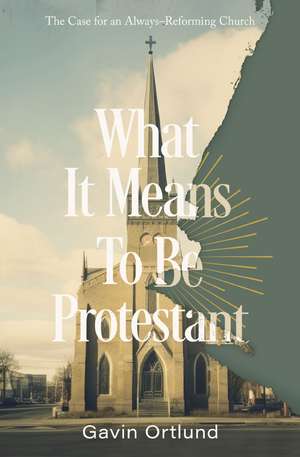
What It Means to Be Protestant: The Case for an Always-Reforming Church
Autor Gavin Ortlunden Limba Engleză Paperback – 20 aug 2024
These days many evangelicals are exploring the more sacramental, liturgical, and historically-conscious church traditions, including Roman Catholicism and Eastern Orthodoxy. This hunger for historical rootedness is a welcome phenomenon--but unfortunately, many assume that this need can only be met outside of Protestant contexts.??
In What it Means to Be Protestant, Gavin Ortlund draws from both his scholarly work in church history and his personal experience in ecumenical engagement to offer a powerful defense of the Protestant tradition. Retrieving classical Protestant texts and arguments, he exposes how many of the contemporary objections leveled against Protestants are rooted in caricature. Ultimately, he shows that historic Protestantism offers the best pathway to catholicity and historical rootedness for Christians today.??
In his characteristically charitable and irenic style, Ortlund demonstrates that the 16th century Reformation represented a genuine renewal of the gospel. This does not entail that Protestantism is without faults. But because it is built upon the principle of semper reformanda (always reforming), Protestantism is capable of reforming itself according to Scripture as the ultimate authority. This scholarly and yet accessible book breaks new ground in ecumenical theology and will be a staple text in the field for many years to come.
Preț: 88.27 lei
Preț vechi: 116.47 lei
-24%
15.61€ • 18.64$ • 13.52£
Carte disponibilă
Livrare economică 27 februarie-11 martie
Livrare express 10-14 februarie pentru 53.34 lei
Specificații
ISBN-10: 0310156327
Pagini: 288
Dimensiuni: 137 x 211 x 16 mm
Greutate: 0.34 kg
Editura: ZONDERVAN
Colecția Zondervan
Locul publicării:Grand Rapids, United States
Recenzii
'Gavin Ortlund presents a compelling case for mere Protestantism by showing how a Protestant faith is a recovery of the apostolic gospel and answers the abiding questions of church, authority, and tradition. It is a robust program to be both evangelical and ecumenical. An authentic church, Ortlund teaches us, should be constantly conforming itself closer to the gospel. This book provides a model for how Protestants should initiate conversations with other Christian traditions.'
'I find it hard to overstate the importance of this book for every pastor/minister, elder, and serious Bible student that I know. I am purchasing a copy for each elder and ministerial staff at my home church. This book automatically becomes my new go-to resource explaining Protestantism. It is fantastic, and I thank God for it....'
'In an age where theology is too often either angry and scornful, or mushy and hesitant, the directness, gentleness and humility of Gavin Ortlund's writing is a balm. Agree with him or not, this is as generous and wise a presentation of the case for historic Protestantism as I think you'll find.'
'In posing the question what it means to be Protestant, Gavin Ortlund launches the reader into a debate in which there is little consensus and which defies easy answers. Through a combination of robust arguments, theological and historical insight, and generosity towards other traditions, Ortlund admirably captures the restless, rebellious nature of a religious movement constantly striving for renewal. The author makes a case for Protestantism that will not find universal agreement, but which inspires response, reflection, and humility. An important read for all Christians.'
'Much of contemporary Protestantism, conservative to liberal, has little connection to the Reformation. But Ortlund reminds us why the 'Protestant' label is worth saving. He has a real gift for distilling complex issues into something that a struggling Christian can understand. This is a well-informed but also passionate defense. Before running to Rome or the East, please read this terrific book first!'
'Neither shying away from disagreements between Christian traditions nor triumphing in them, this book offers a wonderful introduction to the riches of the historic Protestant tradition. In conversation with other traditions, Ortlund's approach embodies a convicted civility, which is humble and irenic yet rooted. For anyone looking for an introduction to what it means to be Protestant that avoids common caricatures of Protestant, Catholic, and Eastern Orthodox positions, this is a great book!'
'With a heart aching for Protestants to understand their own heritage, Gavin Ortlund builds a strong, historically-grounded case for the advantages of their tradition. And he makes bold claims for the potential of mere Protestantism, as a renewal movement, to serve as the best cultivator of true catholicity. The result is a vigorous and engaging apologetic for a semper reformanda approach to theology and the Christian life.'
Descriere
These days many evangelicals are exploring the more sacramental, liturgical, and historically-conscious church traditions, including Roman Catholicism and Eastern Orthodoxy. This hunger for historical rootedness is a welcome phenomenon--but unfortunately, many assume that this need can only be met outside of Protestant contexts.??
In What it Means to Be Protestant, Gavin Ortlund draws from both his scholarly work in church history and his personal experience in ecumenical engagement to offer a powerful defense of the Protestant tradition. Retrieving classical Protestant texts and arguments, he exposes how many of the contemporary objections leveled against Protestants are rooted in caricature. Ultimately, he shows that historic Protestantism offers the best pathway to catholicity and historical rootedness for Christians today.??
In his characteristically charitable and irenic style, Ortlund demonstrates that the 16th century Reformation represented a genuine renewal of the gospel. This does not entail that Protestantism is without faults. But because it is built upon the principle of semper reformanda (always reforming), Protestantism is capable of reforming itself according to Scripture as the ultimate authority. This scholarly and yet accessible book breaks new ground in ecumenical theology and will be a staple text in the field for many years to come.