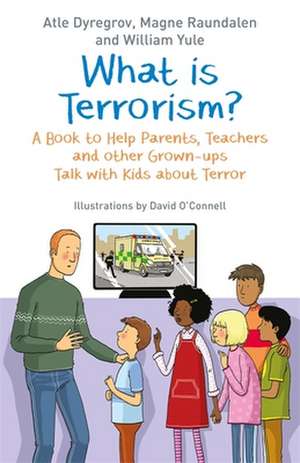
What is Terrorism?: A Book to Help Parents, Teachers and other Grown-ups Talk with Kids about Terror
Autor Atle Dyregrov, William Yule, Magne Raundalenen Limba Engleză Paperback – 21 sep 2018 – vârsta până la 14 ani
The authors, who are child psychologists, tackle a broad range of important but difficult questions with consideration, including: Why do some people and groups use terrorism? What are adults doing to prevent societies being hurt by terrorism? And what can we do when we feel worried and afraid?
An honest and helpful guide to talking about terrorism with children aged 7+, this reassuring book helps adults address children's questions and concerns, in a society where children are unfortunately increasingly aware to it.
Preț: 98.73 lei
Puncte Express: 148
Carte disponibilă
Livrare economică 12-26 noiembrie
Livrare express 28 octombrie-03 noiembrie pentru 14.60 lei
Livrare prin curier în România Termenul estimat este afișat lângă disponibilitate.
Transport gratuit de la 400.00 lei Plată online sau ramburs, în funcție de opțiunile comenzii.
Retur gratuit în 14 zile Comandă securizată și suport în română.
Specificații
ISBN-13: 9781785924736
ISBN-10: 1785924737
Pagini: 80
Dimensiuni: 169 x 216 x 7 mm
Greutate: 0.1 kg
Editura: JESSICA KINGSLEY PUBLISHERS
Colecția Jessica Kingsley Publishers
Locul publicării:London, United Kingdom
ISBN-10: 1785924737
Pagini: 80
Dimensiuni: 169 x 216 x 7 mm
Greutate: 0.1 kg
Editura: JESSICA KINGSLEY PUBLISHERS
Colecția Jessica Kingsley Publishers
Locul publicării:London, United Kingdom
Recenzii
How can parents talk with their children about unspeakable terrorist attacks? How can they help them make sense of actions that most of us find irrational? How can they comfort them despite the perception of ongoing threat? In 'What is terrorism?', world-renowned clinical psychologists have distilled wisdom from decades of work with children and families to answer these topical questions... 'What is Terrorism?' is a highly accessible book that empowers parents and carers to support children after terrorist attacks.
This book succeeds in doing a difficult and vital job: explaining a particularly frightening phenomenon to children in a way that's fair and in language that's understandable. Having read or listened to the book, children will feel clearer and less scared. Carers and professionals will, in turn, feel more confident about having the conversations that really matter.
The authors do an excellent job transforming scary concepts into clear and candid explanations so they are much less frightening to children. A section for children provides practical coping skills to manage worries of dramatic news. Another section equips teachers, parents and other adults to answer tough questions while providing
much needed reassurance.
This book succeeds in doing a difficult and vital job: explaining a particularly frightening phenomenon to children in a way that's fair and in language that's understandable. Having read or listened to the book, children will feel clearer and less scared. Carers and professionals will, in turn, feel more confident about having the conversations that really matter.
The authors do an excellent job transforming scary concepts into clear and candid explanations so they are much less frightening to children. A section for children provides practical coping skills to manage worries of dramatic news. Another section equips teachers, parents and other adults to answer tough questions while providing
much needed reassurance.
Cuprins
Foreword; PART 1: For Children; 1.What is terror and terrorism?; 2. What is new today?; 3. How can you better understand?; 4. The risk of being involved in a terrorist attack; 5. What can be done to reduce the risk of a terrorist attack?; 6. What can you do if you become worried or afraid?; 7. Do adults get afraid?; PART 2: For Parents; 8. Terror and children; 9. Why is it important to talk to children?; 10. Need to understand - providing pegs; 11. How to break news; 12. Need comforting and calming; 13. Calm parental behaviour produces calm children; 14. Approaching conversations; 15. Using your antennas; 16. Finding ways of explaining; 17. What can you say about terror, terrorism, and terrorists?; 18. About wrong thoughts and the mind's cleaning machine; 19. Age appropriate conversations; 20. Keep a tab on their media intake; 21. Admitting own worries; 22. Prepare them for action?; 23. Build on their compassion; 24. Summing up: Ten tips on talking to children