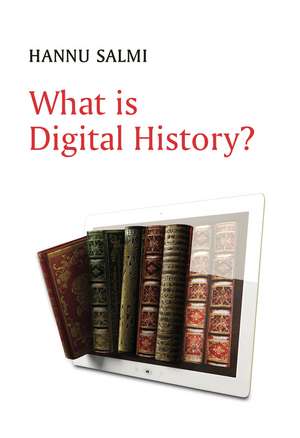
What is Digital History?
Autor Hannu Salmien Limba Engleză Paperback – 16 oct 2020
Hannu Salmi provides the most compelling introduction to digital history to date. Beginning with an examination of the origins of the digital study of history, he goes on to discuss the question of how history exists in a digitized form. He introduces basic concepts and ideas in digital history, including databases and archives, interdisciplinarity and public engagement. Outlining the problems and methods in the study of big data, both textual and visual, particular attention is paid to the born-digital era: the contemporary age that exists primarily in digital form.
What is Digital History? is essential reading for students of history and other humanities fields, as well as anyone interested in how digitization and digital cultures are transforming the study of history.
Preț: 137.54 lei
Puncte Express: 206
Carte disponibilă
Livrare economică 02-16 noiembrie
Livrare express 16-22 octombrie pentru 18.45 lei
Livrare prin curier în România Termenul estimat este afișat lângă disponibilitate.
Transport gratuit de la 400.00 lei Plată online sau ramburs, în funcție de opțiunile comenzii.
Retur gratuit în 14 zile Comandă securizată și suport în română.
Specificații
ISBN-13: 9781509537020
ISBN-10: 1509537023
Pagini: 156
Dimensiuni: 141 x 214 x 12 mm
Greutate: 0.18 kg
Editura: Polity Press
Locul publicării:Chichester, United Kingdom
ISBN-10: 1509537023
Pagini: 156
Dimensiuni: 141 x 214 x 12 mm
Greutate: 0.18 kg
Editura: Polity Press
Locul publicării:Chichester, United Kingdom
Notă biografică
Hannu Salmi is Professor of Cultural History at the University of Turku.
Cuprins
Introduction Notes
1 The Digital Past: Sources and Problems
Digitization of cultural heritage
Biases of the digital past
Born-digital era
Virality
Toward the epistemology of the born digital
Notes
2 Reading and Textuality in Digital History
Reading as a research method
Reading with machines
Distant reading
The challenge of big data
Texts for historical research
Distant reading techniques
Notes
3 Mapping and Viewing History
Maps as digital sources
Maps as historical interpretations
From visual evidence to distant viewing
Sound and vision
Visuality, textuality and metadata
Notes
4 Interdisciplinarity: Challenges for Research
Beyond disciplinarity
Trading across borders
Towards interdisciplinary practices
Notes
5 Presenting the Past in the Digital Age
Digital history for the public
Visualizing data
Presenting change over time
Augmented and mixed realities
Travelling in time
Notes
Conclusion
Notes
Further Reading
Index
1 The Digital Past: Sources and Problems
Digitization of cultural heritage
Biases of the digital past
Born-digital era
Virality
Toward the epistemology of the born digital
Notes
2 Reading and Textuality in Digital History
Reading as a research method
Reading with machines
Distant reading
The challenge of big data
Texts for historical research
Distant reading techniques
Notes
3 Mapping and Viewing History
Maps as digital sources
Maps as historical interpretations
From visual evidence to distant viewing
Sound and vision
Visuality, textuality and metadata
Notes
4 Interdisciplinarity: Challenges for Research
Beyond disciplinarity
Trading across borders
Towards interdisciplinary practices
Notes
5 Presenting the Past in the Digital Age
Digital history for the public
Visualizing data
Presenting change over time
Augmented and mixed realities
Travelling in time
Notes
Conclusion
Notes
Further Reading
Index