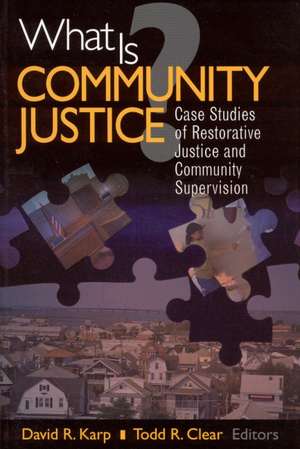
What Is Community Justice?
Editat de Todd R. Clear, David R. Karpen Limba Engleză Paperback – 2002
· The building of partnerships between community supervision agencies and the community
· Expanding the "client" definition to include the victim of crime, the family of the offender, and the community itself
· Focus on places: agencies must take into account important local differences in neighborhoods
· Preventing problems between the community and the client rather than reacting to them
· Adding value to community life
This book addresses the specific ways of achieving these goals by presenting six case studies of probation programs that represent a practical side of the community justice ideal. What emerges is a provocative and enlightening new approach to the problems of probation and parole.
Preț: 611.63 lei
Preț vechi: 719.57 lei
-15%
Puncte Express: 917
Carte tipărită la comandă
Livrare economică 16-30 noiembrie
Livrare prin curier în România Termenul estimat este afișat lângă disponibilitate.
Transport gratuit pentru acest produs Plată online sau ramburs, în funcție de opțiunile comenzii.
Retur gratuit în 14 zile Comandă securizată și suport în română.
Specificații
ISBN-13: 9780761987468
ISBN-10: 0761987460
Pagini: 192
Dimensiuni: 152 x 229 x 11 mm
Greutate: 0.29 kg
Ediția:New.
Editura: SAGE Publications
Locul publicării:Thousand Oaks, United States
ISBN-10: 0761987460
Pagini: 192
Dimensiuni: 152 x 229 x 11 mm
Greutate: 0.29 kg
Ediția:New.
Editura: SAGE Publications
Locul publicării:Thousand Oaks, United States
V-ar putea interesa
-
 Correctional Boot CampsDoris L. MacKenzie-18%Preț: 805.99 lei982.92 lei
 -
 Punishment and CivilizationJohn Pratt-18%Preț: 683.42 lei833.43 lei
 -
 Punishment and PrisonsJoe SimPreț: 466.70 lei
 -
 -18%Preț: 696.70 lei849.64 lei
 -
 Justice in the Risk SocietyBarbara Hudson-18%Preț: 696.70 lei849.64 lei
 -
 Smart SentencingJames M. Byrne-15%Preț: 623.11 lei733.07 lei
 -
 -15%Preț: 613.93 lei722.27 lei
 -
 Choosing Correctional Options That WorkAlan T. Harland-15%Preț: 616.78 lei725.63 lei
 -
 Crime and ModernityJohn Lea-15%Preț: 617.34 lei726.27 lei
 -
 Western European Penal SystemsVincenzo Ruggiero-18%Preț: 781.70 lei953.29 lei
 -
 Social Work CompetencesAnthony Andreas Vass-18%Preț: 692.26 lei844.22 lei
 -
 Coping with PrisonSteve GravettPreț: 378.34 lei
 -
 Correctional Mental HealthThomas J. Fagan-27%Preț: 929.28 lei1272.98 lei
 -
 Preț: 443.42 lei
 -
 Community-Based CorrectionsShannon M. Barton-Bellessa-27%Preț: 941.65 lei1289.92 lei
 -
 The Punishment ImperativeTodd R. ClearPreț: 264.67 lei
 -
 Researching Crime and Justice: Tales from the FieldLouise Westmarland-15%Preț: 418.85 lei492.76 lei
 -
 -18%Preț: 1115.65 lei1360.55 lei
 -
 Prisoners' Rights: Principles and PracticeSusan EastonPreț: 465.23 lei
 -
 The SAGE Handbook of Punishment and SocietyJonathan Simon-23%Preț: 1228.47 lei1595.41 lei
Cuprins
1. Preface
2. Ventura and the Theory of Community Justice - D.R. Karp, J. Lane, & S. Turner
3. Preface to Maricopa
4. Neighborhood Probation Offices in Maricopa County - T.R. Clear & J. Cannon
5. Preface to Vermont
6. The Offender/Community Encounter: Stakeholder Involvement in the Vermont Reparative - D.R. Karp
7. Preface to Tallahassee
8. Restorative Justice, Reparation, and the Southside Project - E. Zellerer & J. Cannon
9. Preface to Boston
10. Reinventing Probation and Reducing Youth Violence - R.P. Corbett Jr.
11. Preface to Deschutes
12. Deschutes County, Oregon: Community Justice in Action - T.K. Martin
13. Afterword: In the Shadows of Community Justice - S. Maruna
2. Ventura and the Theory of Community Justice - D.R. Karp, J. Lane, & S. Turner
3. Preface to Maricopa
4. Neighborhood Probation Offices in Maricopa County - T.R. Clear & J. Cannon
5. Preface to Vermont
6. The Offender/Community Encounter: Stakeholder Involvement in the Vermont Reparative - D.R. Karp
7. Preface to Tallahassee
8. Restorative Justice, Reparation, and the Southside Project - E. Zellerer & J. Cannon
9. Preface to Boston
10. Reinventing Probation and Reducing Youth Violence - R.P. Corbett Jr.
11. Preface to Deschutes
12. Deschutes County, Oregon: Community Justice in Action - T.K. Martin
13. Afterword: In the Shadows of Community Justice - S. Maruna
Notă biografică
David Karp, Ph.D., is Assistant Professor of Sociology at Skidmore College in Saratoga Springs, New York, where he teaches courses in criminology and criminal justice. He conducts research on community-based responses to crime and has given workshops on restorative justice and community justice nationally. Currently, he is engaged in a qualitative research study examining Vermont¿s community reparative probation boards and is a member of the New York State Community Justice Forum. He is the author of more that 30 academic articles and technical reports and two previous books¿Community Justice: An Emerging Field and The Community Justice Ideal: Preventing Crime and Achieving Justice (with Todd Clear).
Descriere
Past methods of probation and parole supervision have largely relied on caseworkers who monitor their "clients" as well as they can. But, as numbers of "clients" increase, studies indicate that this model is ineffectual. The time has come to significantly rethink the approaches to community supervision.
This book addresses the specific ways of achieving these goals by presenting six case studies of probation programs that represent a practical side of the community justice ideal. What emerges is a provocative and enlightening new approach to the problems of probation and parole.
This book addresses the specific ways of achieving these goals by presenting six case studies of probation programs that represent a practical side of the community justice ideal. What emerges is a provocative and enlightening new approach to the problems of probation and parole.