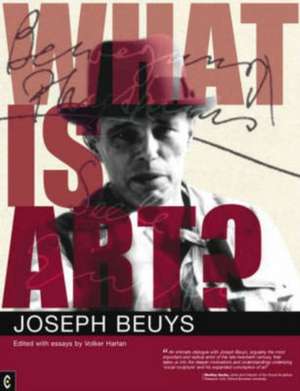
What Is Art?
Autor Joseph Beuys, Volker Harlanen Limba Engleză Paperback – 22 noi 2004
Publicat într-un context în care moștenirea teoretică a unuia dintre cei mai radicali artiști ai secolului XX este constant reevaluată, What is Art? nu este un simplu manual de estetică, ci o incursiune senzorială în mintea lui Joseph Beuys. Apreciem modul în care acest volum în format paperback reușește să capteze, prin dialogurile cu Volker Harlan, o intimitate intelectuală rară, transformând ideile abstracte despre „sculptura socială” în concepte palpabile. Simțim în aceste pagini rigoarea unui profesor de la Academia din Düsseldorf, dar și spiritul ludic al artistului care vedea poezia în cele mai umile materiale. Merită menționat că această lucrare se poziționează ca o piesă centrală în arhitectura gândirii lui Beuys, făcând trecerea de la performanța brută documentată în Beuys in America (2022) către o analiză structurală a rolului creatorului în lume. Dacă în What is Money? Beuys aplica această viziune asupra sistemelor economice, aici el revine la nucleul dur al existenței: actul de a crea ca responsabilitate socială. Complementar lucrării Everyone is an artist de Catherine Nichols, care documentează acțiunile sale prin imagini, volumul de față oferă fundamentul filosofic, înlocuind spectacolul vizual cu o claritate a cuvântului care provoacă cititorul să își redefinească propria capacitate creativă. Credem că această lectură este esențială pentru a înțelege cum arta poate deveni un instrument de reformă democratică, dincolo de pereții galeriilor.
Preț: 143.62 lei
Carte disponibilă
Livrare economică 06-20 noiembrie
Livrare express 22-28 octombrie pentru 27.41 lei
Specificații
ISBN-10: 1905570074
Pagini: 128
Ilustrații: 51 halftones
Dimensiuni: 191 x 246 x 10 mm
Greutate: 0.37 kg
Editura: CLAIRVIEW BOOKS
Locul publicării:United Kingdom
V-ar putea interesa
-
 Research Methods: Information, Systems, and ContextsKirsty Williamson-38%Preț: 529.87 lei853.99 lei
 -
 The Art of Creative Research: A Field Guide for WritersPhilip GerardPreț: 155.53 lei
 -
 The Human Condition: Second EditionHannah ArendtPreț: 157.01 lei
 -
 Research Methods and StatisticsIan Walker-12%Preț: 137.94 lei155.99 lei
 -
 Research Methods: The Key ConceptsMichael HammondPreț: 208.67 lei
 -
 Marketing Strategy for the Creative and Cultural IndustriesBonita M. KolbPreț: 458.04 lei
 -
 Arts Leadership in Contemporary ContextsJosephine CaustPreț: 432.83 lei
 -
 Preț: 423.78 lei
 -
 Preț: 158.39 lei
 -
 The Logic of Scientific DiscoveryKarl PopperPreț: 233.98 lei
 -
 The Research Project: How to Write It, Edition 5Ralph BerryPreț: 275.42 lei
 -
 On CreativityDavid BohmPreț: 171.83 lei
 -
 On DialogueDavid BohmPreț: 174.17 lei
 -
 -19%Preț: 430.25 lei531.17 lei
 -
 -15%Preț: 461.07 lei542.43 lei
 -
 Researching CulturePertti Alasuutari-27%Preț: 770.40 lei1055.34 lei
 -
 Research Methods for PostgraduatesTony GreenfieldPreț: 448.94 lei
 -
 Research MethodsNicholas WallimanPreț: 157.82 lei
 -
 The Routledge Companion to DramaturgyMagda RomanskaPreț: 378.98 lei
 -
 Research MethodsBob Matthews-13%Preț: 492.88 lei566.53 lei
 -
 Research DesignStephen GorardPreț: 405.97 lei
 -
 Being and EventAlain Badiou-18%Preț: 177.81 lei215.80 lei
 -
 -16%Preț: 287.83 lei342.21 lei
 -
 Meditation as Contemplative InquiryArthur ZajoncPreț: 122.32 lei
 -
 The Event in Science, History, Philosophy & ArtYeshayahu Ben-AharonPreț: 225.29 lei
 -
 Research Methods for ManagersJohn Gill-11%Preț: 499.86 lei561.64 lei
De ce să citești această carte
Recomandăm această carte oricui dorește să înțeleagă de ce Joseph Beuys a rămas o figură legendară. Cititorul câștigă acces direct la filosofia din spatele conceptului de „sculptură socială”, învățând să privească arta nu ca pe un obiect de consum, ci ca pe un proces de transformare a societății. Este un instrument de lucru prețios pentru artiști, pedagogi și studenți care caută să depășească limitele tradiționale ale creativității.
Despre autor
Artistul german Joseph Beuys (1921–1986) a fost o figură plurivalentă: pictor, sculptor, performer și profesor influent la Academia de Artă din Düsseldorf. Considerat unul dintre cei mai importanți artiști postbelici, el a revoluționat limbajul vizual prin utilizarea materialelor neconvenționale și prin promovarea ideii că procesele sociale pot fi considerate opere de artă. Beuys s-a autostilizat ca un „șaman” al artei contemporane, militând pentru o democrație directă și pentru o educație bazată pe libertatea creativă universală, lăsând în urmă o operă ce îmbină politicul cu spiritualul.
Descriere scurtă
"I know that from him [Rudolf Steiner] that a mission was given to me to gradually remove people's alienation and mistrust toward the supersensible through my means. In political thinking--the field I have to be working on daily--it is a matter of realizing the Threefold Social Order as quickly as possible." Joseph Beuys's work continues to influence and inspire artists and thinkers around the world--in areas from organizational learning, direct democracy, and new forms of money, to new methods of art education and the practice of "ecological art."
Volker Harlan (a close colleague of Beuys), whose own work also explores substance and sacrament, talked in a conversation with Joseph Beuys about the deeper motivations and insights behind "social sculpture" and his expanded view of art. These profound reflections are complemented by Harlan's thoughtful essays and give a sense of the interconnected nature of all life forms, offering a basis for a path toward a future that is ecologically sustainable.
The book features more than forty illustrations.