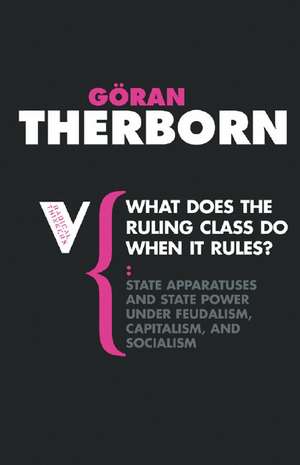
What Does the Ruling Class Do When It Rules?
Autor Goran Therbornen Limba Engleză Paperback – 17 ian 2008
Preț: 115.73 lei
Carte disponibilă
Livrare economică 09-23 noiembrie
Specificații
ISBN-10: 1844672107
Pagini: 288
Ilustrații: black & white illustrations
Dimensiuni: 129 x 197 x 23 mm
Greutate: 0.32 kg
Editura: VERSO
V-ar putea interesa
-
 ConsumedHarry WallopPreț: 114.87 lei
 -
 IncompletenessRebecca Newberger GoldsteinPreț: 128.45 lei
 -
 Between Sex and Power: Family in the World 1900-2000Göran Therborn-15%Preț: 483.89 lei569.29 lei
 -
 -35%Preț: 744.19 lei1150.00 lei
 -
 Letters on LifeRainer Maria RilkePreț: 118.18 lei
 -
 Classes in Contemporary CapitalismNicos PoulantzasPreț: 169.87 lei
 -
 Philadelphia Gentlemen: The Making of a National Upper ClassRoger L. GeigerPreț: 481.56 lei
 -
 Can the Welfare State Compete?Ian Gough-15%Preț: 666.13 lei783.68 lei
 -
 Farewell to the Leftist Working ClassPeter AchterbergPreț: 467.94 lei
 -
 Rich, Free, and Miserable: The Failure of Success in AmericaJohn Brueggemann-31%Preț: 348.72 lei508.65 lei
 -
 Social Things: An Introduction to the Sociological LifeCharles Lemert-22%Preț: 292.75 lei377.06 lei
 -
 Betrayal of the American DreamDonald L. BarlettPreț: 128.12 lei
 -
 Critique of Everyday LifeHenri LefebvrePreț: 228.33 lei
 -
 Minima Moralia (English Edition)Theodor AdornoPreț: 78.59 lei
 -
 The Ideology of Power and the Power of IdeologyGoran TherbornPreț: 110.38 lei
Notă biografică
Recenzii
“An extremely thought-provoking, wide-ranging book.”—Comment
"Excellent ... With a dispassionate and erudite command of wide-ranging historical and comparative sources, this book is essential reading."--"Choice""An extremely thought-provoking, wide-ranging book."--"Comment"
Descriere
In his new book, Göran Therborn – author of the now standard comparative work on classical sociology and historical materialism, Science, Class and Society – looks at successive state structures in an arrestingly fresh perspective. Therborn uses the formal categories of modern system analysis – input mechanisms, processes of transformation, output flows – to advance a substantive Marxist analysis of state power and state apparatuses. His account of these is comparative in the most far-reaching historical sense: its object is nothing less than the construction of systematic typology of the differences between the feudal state, the capitalist state and the socialist state. Therborn ranges from the monarchies of mediaeval Europe through the bourgeois democracies of the west in the 20th century to the contemporary regimes in Russia, Eastern Europe and China. The book ends with a major analytic survey of the strategies of working class parties for socialism, from the Second International to the Comintern to Eurocommunism, that applies the structural findings of Therborn’s enquiry in the ‘Future as History’. Written with lucidity and economy, What Does the Ruling Class Do when it Rules? represents a remarkable sociological and political synthesis.