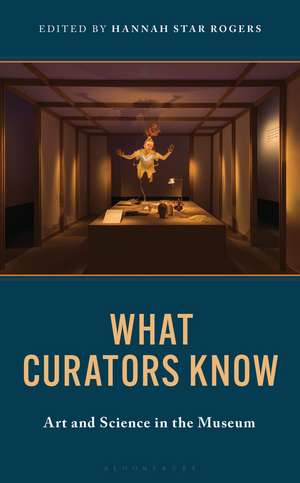
What Curators Know: Art and Science in the Museum
Editat de Hannah Star Rogersen Limba Engleză Hardback – 6 aug 2026
Nowhere are these challenges more visible than in art-science exhibitions. This volume explores how curators draw on Science and Technology Studies (STS) to synthesize subjects ranging from health complexity to nuclear energy, from communication technologies and computing histories to meat and eternal life. In doing so, they reveal the dynamic role of curatorship in shaping how we think, feel, and know.
Preț: 636.85 lei
Preț vechi: 931.70 lei
-32% Nou
Puncte Express: 955
Carte disponibilă
Livrare economică 18 noiembrie-02 decembrie
Livrare prin curier în România Termenul estimat este afișat lângă disponibilitate.
Transport gratuit pentru acest produs Plată online sau ramburs, în funcție de opțiunile comenzii.
Retur gratuit în 14 zile Comandă securizată și suport în română.
Specificații
ISBN-13: 9798765162088
Pagini: 448
Ilustrații: 33 bw illustrations; 2 tables
Dimensiuni: 158 x 232 x 38 mm
Greutate: 0.88 kg
Editura: Bloomsbury Publishing
Colecția Bloomsbury Academic
Locul publicării:New York, United States
Pagini: 448
Ilustrații: 33 bw illustrations; 2 tables
Dimensiuni: 158 x 232 x 38 mm
Greutate: 0.88 kg
Editura: Bloomsbury Publishing
Colecția Bloomsbury Academic
Locul publicării:New York, United States
Cuprins
Preface
Foreword: Eating Vegan Ortolan with Bruno Latour
Michael John Gorman
Acknowledgements
Introduction: What Do Curators Know?
Hannah Star Rogers
Chapter 1: Actor-Network-Theory as Curatorial Method: An STS Framework for Trans-Disciplinary Curation
Kristin D. Hussey
Chapter 2: Engaged Curatorial Practice as STS-Oriented Mode of Inquiry
Bilge Hasdemir
Chapter 3: Beyond the Display: Why Minor Gestures Matter in Curating Research Exhibitions Anne Julie Arnfred
Chapter 4: Boundaries and Imaginaries: STS and Curating Technoscientific Arts
Rodrigo Guzman-Serrano
Chapter 5: Curating Media as Scientific Objects
Geoffrey Belknap and Georgina Grant
Chapter 6: STS in Practice at the Computer History Museum
Hansen Hsu
Chapter 7: The Missing Museum: Curating the PostNatural Blindspot
Rich Pell and Gil Olivera
Chapter 8: Curating Hinterland: Reassembling Invisible Work in Art / Science Practices
Morten Søndergaard
Chapter 9: Curating Health Complexity at Medical Museion: The Exhibition as Medium and Process for Sharing an STS Sensibility
Louise Whiteley and Adam Bencard
Chapter 10: Curating "from an STS Perspective": Co-Creator, Counter-Expert, and Collider
Makoto Takahashi
Chapter 11: Curating for Controversy: Crearation, Overidentification, Objektinstruments and Pop Sloganeering as Art-Based Strategies for Critical Controversy Studies
Sophia Efstathiou and Alexandra Murray-Leslie
Chapter 12: Life Eternal: A Case of the Importance of Trusting Museum Visitors
Clara Åhlvik
Chapter 13: "Curating AI" or How to Exhibit a Controversy
Chris Salter
Index
About the Editor
About the Authors
Foreword: Eating Vegan Ortolan with Bruno Latour
Michael John Gorman
Acknowledgements
Introduction: What Do Curators Know?
Hannah Star Rogers
Chapter 1: Actor-Network-Theory as Curatorial Method: An STS Framework for Trans-Disciplinary Curation
Kristin D. Hussey
Chapter 2: Engaged Curatorial Practice as STS-Oriented Mode of Inquiry
Bilge Hasdemir
Chapter 3: Beyond the Display: Why Minor Gestures Matter in Curating Research Exhibitions Anne Julie Arnfred
Chapter 4: Boundaries and Imaginaries: STS and Curating Technoscientific Arts
Rodrigo Guzman-Serrano
Chapter 5: Curating Media as Scientific Objects
Geoffrey Belknap and Georgina Grant
Chapter 6: STS in Practice at the Computer History Museum
Hansen Hsu
Chapter 7: The Missing Museum: Curating the PostNatural Blindspot
Rich Pell and Gil Olivera
Chapter 8: Curating Hinterland: Reassembling Invisible Work in Art / Science Practices
Morten Søndergaard
Chapter 9: Curating Health Complexity at Medical Museion: The Exhibition as Medium and Process for Sharing an STS Sensibility
Louise Whiteley and Adam Bencard
Chapter 10: Curating "from an STS Perspective": Co-Creator, Counter-Expert, and Collider
Makoto Takahashi
Chapter 11: Curating for Controversy: Crearation, Overidentification, Objektinstruments and Pop Sloganeering as Art-Based Strategies for Critical Controversy Studies
Sophia Efstathiou and Alexandra Murray-Leslie
Chapter 12: Life Eternal: A Case of the Importance of Trusting Museum Visitors
Clara Åhlvik
Chapter 13: "Curating AI" or How to Exhibit a Controversy
Chris Salter
Index
About the Editor
About the Authors
Recenzii
Hannah Star Rogers is the most important voice in theorising Art, Science and Technology Studies today, and in this volume, she has brought together a range of voices that explore the complex relationships between curators, artists, and scientists and their collective claims to knowledge on the exhibition floor.
What Curators Know is on the forefront of mapping out how curatorial work can be understood as an intrinsic method within Science and Technology Studies... You'll be all the wiser for reading these reports from a diverse range of international curator/theorists whose work addresses everything from nuclear culture to GM to AI.
The cultural and intellectual role of curation is rising exponentially: we curate everything these days. But what knowledge is created? And what know-how do curators apply? At the forefront of interdisciplinary curation, Rogers' important volume establishes a landmark that raises, and begins answering, these fascinating questions.
What Curators Know is on the forefront of mapping out how curatorial work can be understood as an intrinsic method within Science and Technology Studies... You'll be all the wiser for reading these reports from a diverse range of international curator/theorists whose work addresses everything from nuclear culture to GM to AI.
The cultural and intellectual role of curation is rising exponentially: we curate everything these days. But what knowledge is created? And what know-how do curators apply? At the forefront of interdisciplinary curation, Rogers' important volume establishes a landmark that raises, and begins answering, these fascinating questions.