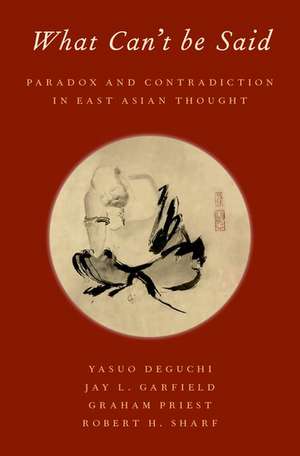
What Can't be Said: Paradox and Contradiction in East Asian Thought
Autor Yasuo Deguchi, Jay L. Garfield, Graham Priest, Robert H. Sharfen Limba Engleză Hardback – 21 apr 2021
Observăm în What Can't be Said o provocare directă adresată unuia dintre pilonii fundamentali ai logicii occidentale: principiul non-contradicției. Dacă în tradiția europeană prezența paradoxului semnalează eșecul unui sistem, autorii acestei lucrări argumentează că, pentru gânditorii est-asiatici, acesta reprezintă o poartă către o înțelegere mai profundă a realității. Analiza debutează cu textele fundamentale Daodejing și Zhuangzi, demonstrând cum contradicția nu este un accident retoric, ci o metodă deliberată de a surprinde natura lumii.
Remarcăm modul în care autorii urmăresc această traiectorie intelectuală prin ramurile budismului Sanlun, Tiantai și Zen, culminând cu perspectivele moderne ale Școlii de la Kyoto. Structura cărții permite o tranziție fluidă de la textele antice la filosofia contemporană, oferind dovezi textuale riguroase pentru susținerea ideii că realitatea este inerent paradoxală. Lucrarea extinde cadrul propus de Beyond the Limits of Thought cu date noi din spațiul est-asiatic, demonstrând că limitele gândirii pot fi nu doar identificate, ci și locuite productiv.
În contextul operei autorilor, volumul continuă programul de cercetare început în The Moon Points Back, rafinând dialogul dintre filosofia budistă și cea occidentală. Spre deosebire de Asian Philosophies and the Idea of Religion, care explorează intersecția dintre spiritualitate și filosofie, What Can't be Said se concentrează strict pe validitatea logică și ontologică a paradoxului. Stilul este precis, academic, evitând misticismul în favoarea unei analize riguroase a inerentului contradictoriu.
Preț: 504.77 lei
Preț vechi: 728.74 lei
-31%
Carte disponibilă
Livrare economică 15-26 mai
Specificații
ISBN-10: 0197526187
Pagini: 204
Dimensiuni: 211 x 142 x 23 mm
Greutate: 0.61 kg
Editura: Oxford University Press
Colecția OUP USA
Locul publicării:New York, United States
De ce să citești această carte
Această lucrare este esențială pentru cercetătorii și studenții la filosofie care doresc să depășească prejudecățile logicii formale occidentale. Cititorul câștigă o perspectivă tehnică asupra modului în care marii gânditori ai Orientului au utilizat paradoxul ca instrument de cunoaștere, nu ca eroare de raționament. Este un ghid riguros pentru înțelegerea structurii profunde a budismului și taoismului prin ochii unor logicieni contemporani de renume.
Despre autor
Volumul reunește patru voci de referință în filosofia comparată. Graham Priest este cunoscut pentru lucrările sale despre logica paraconsistentă și limitele gândirii, în timp ce Jay L. Garfield este un specialist recunoscut în filosofia budistă și hermeneutică. Yasuo Deguchi aduce expertiza asupra Școlii de la Kyoto, iar Robert H. Sharf contribuie cu o viziune istorică și critică asupra tradițiilor Chan și Zen. Împreună, aceștia au transformat studiul filosofiei est-asiatice, integrând-o în dezbaterile analitice globale contemporane.
Descriere
Recenzii
an invaluable book of reference
The use of paradoxes across East Asian philosophies is well known, but this book is rare in taking those paradoxes seriously, both as claims that reality is indeed contradictory and as philosophical positions that are reasonable and even true. It is a valuable contribution to the growing field of world philosophy.
This is a unique work that takes the issue of 'paradox,' a topic that has thus far been rather scamped in the study of East Asian philosophy, seriously. The authors challenge the assumption that the presence of paradox in premodern texts was due to muddled thinking, and instead consider its significance as intentional and systematic. The chapters are pellucidly clear, focused, and present difficult concepts and translated passages in a coherent way that will be accessible to a wide readership.
Reality is inherently paradoxical, some profound contradictions are true, and East Asian philosophers have understood these matters better than anyone else. That's the thesis of this brilliant collaboration. A must-read for global philosophers and anyone who wants to know what can be said about what can't be said.
This work is a welcome continuation, now applied to East Asian philosophy, of the authors' previous efforts to challenge the tyrannical hegemony of the Principle of Non-Contradiction. The possible implications of this endeavor for everything else we think and do remains one of the most engaging points of contention in current philosophical enquiry. The classical East Asian Daoist and Buddhist thinkers, those great adepts in the arts of ineluctable paradox, are especially relevant for grappling with these questions in a thoroughgoing way, and it is encouraging to see their thought examined in this fine study.
As an interpretative work, I think this book is a valuable contribution to the literature on East Asian philosophy. It's particularly nice to see such a collaborative work in the humanities and it's a treat to see several of the leading scholars on the topic work together.