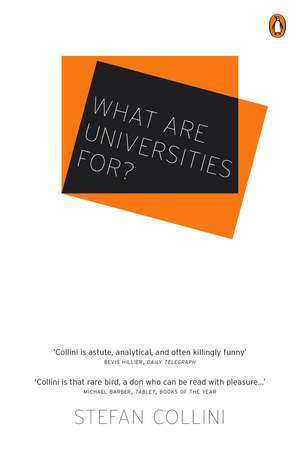
What are Universities For?
Autor Stefan Collinien Limba Engleză Paperback – 23 feb 2012
Stefan Collini challenges the common claim that universities need to show that they help to make money in order to justify getting more money. Instead, he argues that we must reflect on the different types of institution and the distinctive roles they play. In particular we must recognize that attempting to extend human understanding, which is at the heart of disciplined intellectual enquiry, can never be wholly harnessed to immediate social purposes - particularly in the case of the humanities, which both attract and puzzle many people and are therefore the most difficult subjects to justify.
At a time when the future of higher education lies in the balance, What Are Universities For? offers all of us a better, deeper and more enlightened understanding of why universities matter, to everyone.
Preț: 91.11 lei
Puncte Express: 137
Carte disponibilă
Livrare economică 18 septembrie-02 octombrie
Livrare express 03-09 septembrie pentru 18.46 lei
Livrare prin curier în România Termenul estimat este afișat lângă disponibilitate.
Transport gratuit de la 400.00 lei Plată online sau ramburs, în funcție de opțiunile comenzii.
Retur gratuit în 14 zile Comandă securizată și suport în română.
Specificații
ISBN-13: 9781846144820
ISBN-10: 1846144825
Pagini: 240
Dimensiuni: 131 x 204 x 18 mm
Greutate: 0.18 kg
Editura: Penguin Books
Locul publicării:London, United Kingdom
ISBN-10: 1846144825
Pagini: 240
Dimensiuni: 131 x 204 x 18 mm
Greutate: 0.18 kg
Editura: Penguin Books
Locul publicării:London, United Kingdom
V-ar putea interesa
-
 Dynamic Analysis in the Social SciencesEmilio J. Castilla-19%Preț: 683.75 lei844.13 lei
 -
 Data Warehousing in the Age of Big DataKrish Krishnan-29%Preț: 210.20 lei297.24 lei
 -
 CivilizationNiall FergusonPreț: 111.23 lei
 -
 -20%Preț: 55.78 lei69.87 lei
 -
 Quantitative Research Methods in the Social SciencesPaul S. Maxim-27%Preț: 1299.44 lei1780.06 lei
 -
 Design History – An AnthologyDennis P DoordanPreț: 246.62 lei
 -
 A History of Economic ThoughtWilliam J. BarberPreț: 165.75 lei
 -
 Excel Dashboards and ReportsMichael Alexander-20%Preț: 199.12 lei248.91 lei
 -
 Preț: 343.72 lei
 -
 Handbook of Research on Trends in European Higher Education ConvergenceAlina Mihaela Dima-23%Preț: 1684.20 lei2187.28 lei
 -
 -23%Preț: 1053.26 lei1367.86 lei
 -
 -23%Preț: 911.72 lei1184.06 lei
 -
 Business Models for Renewable Energy InitiativesAdrian Tantau-23%Preț: 885.82 lei1150.42 lei
 -
 Helping Children SucceedPaul Tough-42%Preț: 50.86 lei87.27 lei
 -
 Unternehmen Deutsch 1. LehrbuchNorbert Becker (jezikoslovec.)Preț: 183.37 lei
 -
 Lokales Denken, globales HandelnGeert HofstedePreț: 146.71 lei
 -
 -8%Preț: 528.54 lei574.49 lei
 -
 LeadershipJohn C. MaxwellPreț: 91.36 lei
 -
 Richtig entscheidenElisabeth GöbelPreț: 263.36 lei
 -
 Preț: 207.23 lei
 -
 Actividades para el Marco ComunLidia LozanoPreț: 232.93 lei
Notă biografică
Stefan Collini has become one of the most respected voices in public debates about universities and their place in modern society.He is a Professor of Intellectual History and English Literature at Cambridge University and Fellow of the British Academy, who frequently contributes to The Guardian,The London Review of Books,The Times Literary Supplement and The Nation.Reviewers of the recent, Common Reading: Critics, Historians,Publics (2008), described him as 'one of Britain's finest essaysists and writers.'Other works include Absent Minds: Intellectuals in Britain (2006),Public Moralists (1991),Matthew Arnold: a Critical Portrait (1994) and English Pasts: Essays in History and Culture (1999).
Recenzii
An eloquent and impassioned book
Collini is astute, analytical, and often killingly funny
Collini is that rare bird, a don who can be read with pleasure
One of Britain's finest essayists and writers
[A] timely lecture for the coalition of dunces ... this is a closely argued defence
The book is a bit like some university courses. It is erudite, well argued, carefully researched, a fine addition to the debate about the purpose of university education
[Collini is] stern and splendid in his brief history of the hot debate on useful versus useless knowledge
It is extremely well written: Collini's prose is lively, well-reasoned and persuasive. The book is a refreshing example of a faculty member engaging with the wider issues of higher education rather than perceiving them through the narrow prism of his own discipline ... a valuable, timely contribution to the discourse
A critique both pointed and witty
Collini writes beautifully
Collini puts his finger on the nub of the problem facing universities. Collini's book is a must-read
Collini is astute, analytical, and often killingly funny
Collini is that rare bird, a don who can be read with pleasure
One of Britain's finest essayists and writers
[A] timely lecture for the coalition of dunces ... this is a closely argued defence
The book is a bit like some university courses. It is erudite, well argued, carefully researched, a fine addition to the debate about the purpose of university education
[Collini is] stern and splendid in his brief history of the hot debate on useful versus useless knowledge
It is extremely well written: Collini's prose is lively, well-reasoned and persuasive. The book is a refreshing example of a faculty member engaging with the wider issues of higher education rather than perceiving them through the narrow prism of his own discipline ... a valuable, timely contribution to the discourse
A critique both pointed and witty
Collini writes beautifully
Collini puts his finger on the nub of the problem facing universities. Collini's book is a must-read