Cantitate/Preț
Produs

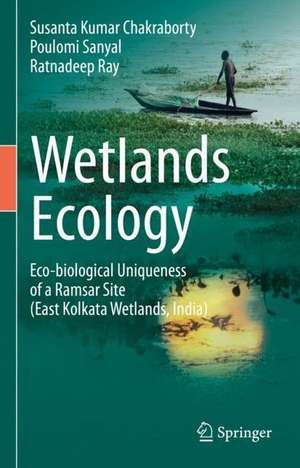
Wetlands Ecology: Eco-biological uniqueness of a Ramsar site (East Kolkata Wetlands, India)

Autor Susanta Kumar Chakraborty, Poulomi Sanyal, Ratnadeep Ray
en Limba Engleză Hardback – 12 mar 2023

Recomandăm această lucrare ca o referință de nivel master și doctorat, fiind un studiu de caz exhaustiv asupra unuia dintre cele mai complexe ecosisteme antropice din lume. Wetlands Ecology investighează unicitatea eco-biologică a zonei East Kolkata Wetlands, un sit Ramsar recunoscut pentru capacitatea sa fenomenală de reciclare naturală a deșeurilor. Subliniem rigoarea cu care autorii, Susanta Kumar Chakraborty, Poulomi Sanyal și Ratnadeep Ray, integrează tehnologia modernă — GIS și teledetecția — în analiza degradării habitatelor, oferind o metodologie replicabilă pentru monitorizarea zonelor umede aflate sub presiune industrială.

Textul este organizat logic în 11 capitole, pornind de la perspective istorice și geomorfologice (capitolul 2) către principiile ecologice fundamentale și dinamica sezonieră a parametrilor fizico-chimici (capitolul 7). Reținem importanța acordată secțiunilor de biomonitorizare și bioremediere, care transformă volumul dintr-o simplă descriere biologică într-un instrument practic pentru inginerii de mediu. Comparabil cu Wetlands Conservation de Sanjeev Sharma în ceea ce privește prezentarea amenințărilor la adresa biodiversității, volumul de față se distinge prin focalizarea pe soluții tehnice specifice de reciclare a apelor uzate și prin analiza detaliată a unui singur sit de importanță globală.

Spre deosebire de abordarea generalistă din Ramsar Wetlands de Peter Gell, care analizează succesul convenției la nivel global, lucrarea publicată de Springer oferă date granulare despre impactul schimbărilor climatice asupra biotei bentice și pelagice dintr-un ecosistem specific. Este o resursă esențială pentru cercetătorii care studiază sustenabilitatea și serviciile ecosistemice în contextul urbanizării accelerate.

Citește tot Restrânge

Preț: 99171 lei

Preț vechi: 120940 lei
-18%

Puncte Express: 1488

Carte disponibilă

Livrare economică 16-30 mai


Specificații

ISBN-13: 9783031092527
ISBN-10: 303109252X
Pagini: 709
Ilustrații: XXXV, 709 p. 125 illus., 122 illus. in color.
Dimensiuni: 155 x 235 mm
Greutate: 1.36 kg
Ediția:2023
Editura: Springer International Publishing
Colecția Springer
Locul publicării:Cham, Switzerland

De ce să citești această carte

Această monografie este indispensabilă cercetătorilor în ecologie acvatică și planificatorilor de mediu care caută soluții concrete pentru managementul zonelor umede. Cititorul câștigă o înțelegere profundă a modului în care tehnologia GIS poate fi utilizată pentru a combate poluarea și bioinvazia. Este un exemplu rar de documentare tehnică ce îmbină biologia cu ingineria sustenabilă, oferind strategii de conservare pentru cel mai mare sistem natural de reciclare a deșeurilor din lume.


Despre autor

Autorii acestui volum sunt experți recunoscuți în ecologia zonelor umede și sustenabilitate. Susanta Kumar Chakraborty are o experiență vastă în studiul biodiversității acvatice, fiind secondat de Poulomi Sanyal și Ratnadeep Ray, specialiști în aplicarea tehnicilor de teledetecție și analiză fizico-chimică a mediului. Împreună, echipa de cercetători de la Springer a reușit să sintetizeze date complexe de teren și laborator, oferind o perspectivă multidisciplinară asupra managementului siturilor Ramsar, esențială pentru literatura academică actuală din domeniul științelor naturii și planificării resurselor.


Descriere scurtă

This book discusses current knowledge and challenges with the ecological management and conservation of wetlands, with a focus on the East Kolkata Wetlands of India. This area is referred to as a Ramsar Site, a designation given to areas with special protection statuses, since it is the largest natural waste recycling system in the world. The site faces many threats to its biodiversity and ecosystem functioning due to anthropogenic activity in the region, and therefore an assessment of the ecosystem services, bio-ecological uniqueness, and issues stemming from climate change and human impacts is needed to develop protection strategies for the future ecological functioning and sustainability of the wetlands. The authors use GIS and remote sensing techniques to assess and monitor harmful industrial and environmental impacts on the wetlands, and to inform mitigation and conservation strategies in the face of ongoing threats such as pollution, habitat destruction and bioinvasion. Thebook also highlights various social and economic aspects tied to the functioning and management of the wetlands, along with ecological, biological, and physio-chemical considerations. The study will be of use to students and researchers in aquatic ecology, biodiversity, and environmental sustainability and conservation, as well as to environmental planners, engineers, and policymakers. 

Cuprins

Chapter 1-Introduction.- Chapter 2-Historical perspectives of the wetlands with special reference to geomorphic evolution of East Kolkata Wetlands.- Chapter 3-Underlying ecological principles  for the functioning of  Wetland Ecosystems.- Chapter 4-Basics of Remote Sensing Techniques applicable in the aquatic freshwater  system: Classificatory Approaches of East Kolkata Wetlands.- Chapter 5-Biodiversity of East Kolkata wetlands: Concept of biodiversity.- Chapter 6-Ecosystem services and values of Wetlands (East Kolkata Wetlands). Chapter 7-Seasonal Dynamics of Physico-Chemical Parameters of Soil and Water.- Chapter 8-Threats and pollution of wetlands: Special reference to East Kolkata Wetland (E.K.W).- Chapter 9-Biomonitoring and Bioremediation.- Chapter 10-Sustainable conservation strategy (Waste Water Recycling).- Chapter 11-Conclusion.

Notă biografică

Dr. Susanta Kumar Chakraborty is Professor of Zoology at Vidyasagar University and he received his M.Phil. in Environmental Science and Ph.D. in Marine Science from Calcutta University. His research centers on Coastal Ecology, Mangrove and Fresh Water Wetlands, Rivers and Estuaries, emphasising biodiversity and ecosystem dynamics. He has also worked on the integration of rural bio-technologies for environmental management, eco-restoration, and livelihood generation. He has received a number of awards in recognition of his research commitments. Dr. Chakraborty has taught for over three decades, mostly in the postgraduate level, covering different aspects of Zoology in general and Ecology/Environmental Science in particular, and has successfully supervised thirty Ph.D. students, published around 150 research papers, written books, and has completed more than a dozen research projects including consultancy work on environmental impact assessment in several countries. Dr. Chakraborty has also served at other universities as a member of selection committees and academic bodies, as well as an expert member in several government departments like U.G.C. and I.C.A.R., and he is a life member of a number of scientific bodies in India and serves on the editorial board of a number of journals. 

Dr. Poulami Sanyal is a Research Scientist at West Bengal Pollution Control Board, India.

Dr. Ratnadeep Ray is an Assistant Professor of remote sensing and GIS in Earth Sciences at JIS University, kolkata, India.