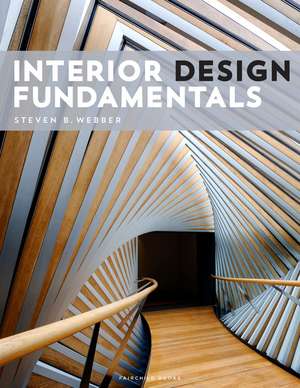
Webber, S: Interior Design Fundamentals
en Limba Engleză Paperback – 28 noi 2019
În volumul Webber, S: Interior Design Fundamentals, narațiunea vizuală și conceptuală este construită riguros, ghidând cititorul de la abstracția ideii la pragmatismul execuției. Suntem de părere că forța acestui manual rezidă în modul în care Steven Webber ordonează elementele fundamentale: nu ca pe o listă de reguli estetice, ci ca pe un proces viu de „design thinking”. Experiența parcurgerii cărții începe cu așezarea bazelor teoretice — elementele și principiile designului — pentru ca apoi să evolueze natural spre complexitatea spațiului construit. Structura este segmentată în douăsprezece capitole care oferă o acoperire enciclopedică, pornind de la rădăcinile istorice ale arhitecturii și ajungând la detalii tehnice precum finisajele, corpurile de iluminat sau sistemele de suport ale mediului. Observăm o progresie logică ce pune accent pe „spatial well-being”, integrând factorii psihologici alături de cei tehnici. Calitatea editorială a celor de la Bloomsbury Publishing se reflectă în prezența studiilor de caz care ancorează teoria în realități sociale dure, cum ar fi reutilizarea adaptivă a clădirilor sau impactul designului asupra comunităților vulnerabile. Tonul este unul didactic, dar imersiv, transformând fiecare capitol într-o etapă de explorare a rolului de designer profesionist. Cititorul experimentează o trecere fluidă de la teoria culorii la planificarea spațială, totul fiind susținut de un aparat critic bogat, menit să fixeze terminologia esențială și să încurajeze aplicarea practică prin exerciții dedicate.
Preț: 454.32 lei
Preț vechi: 608.28 lei
-25%
Carte disponibilă
Livrare economică 13-18 noiembrie
Specificații
ISBN-10: 1501327089
Ilustrații: 377 color illus
Dimensiuni: 216 x 280 x 22 mm
Greutate: 1.22 kg
Editura: Bloomsbury Publishing
Locul publicării:New York, United States
V-ar putea interesa
-
 Digital Drawing for Designers: A Visual Guide to AutoCAD® 2017Douglas R. Seidler-30%Preț: 559.55 lei801.28 lei
 -
 -26%Preț: 480.00 lei648.67 lei
 -
 -35%Preț: 605.14 lei935.02 lei
 -
 Designing the Brand Identity in Retail SpacesMartin M. Pegler-31%Preț: 486.18 lei702.32 lei
 -
 -31%Preț: 451.31 lei655.51 lei
 -
 -31%Preț: 532.08 lei766.41 lei
 -
 Portfolio Design for InteriorsHarold Linton-25%Preț: 502.75 lei674.78 lei
 -
 Know Your Home FurnishingsVirginia Hencken Elsasser-35%Preț: 527.47 lei807.19 lei
 -
 Revit Architecture 2016 for DesignersDouglas R. Seidler-22%Preț: 452.96 lei583.59 lei
 -
 Shintō-Bibliography in Western LanguagesArcadio Schwade-14%Preț: 846.08 lei983.80 lei
 -
 The State in Indian TraditionHartmut Scharfe-14%Preț: 1222.61 lei1421.63 lei
De ce să citești această carte
Această resursă este esențială pentru studenții aflați la început de drum și pentru profesioniștii care doresc să își fundamenteze procesul creativ prin „design thinking”. Cititorul câștigă o viziune de ansamblu asupra profesiei, învățând să echilibreze estetica cu funcționalitatea și responsabilitatea socială. Este un ghid practic ce transformă intuiția în metodologie riguroasă, oferind instrumentele necesare pentru a naviga complexitatea designului de interior contemporan.
Descriere
Learn the basics of interior design thinking and the design process. Envision yourself in the role of professional designer as you learn about design theory, such as the phases of design, spatial well-being, color theory, history, professional practices, and design practicalities such as finishes, furnishings, lighting, environmental systems, and more. Learning how to think like a designer, and developing a process to do so, will be a valuable skill as you move forward in your studies and career.
Features
-Provides techniques for developing awareness of conditions related to urban and rural issues, building architecture, and societal and organizational cultures
-Case Studies showing how designers address important topics like homelessness and adaptive reuse, as well as use color, furniture, materials, lighting, and environmental support systems to reflect the client's message
-Learning objectives and outcomes, definitions of key terms, review questions, chapter summaries, and exercises reinforce the learning experience
Instructor's Resources
-Instructor's Guide provides suggestions for planning the course and using the text in the classroom, supplemental assignments, and lecture notes
-Test Bank includes sample questions for each chapter
-PowerPoint® presentations include images from the book and provide a framework for lecture and discussion
Within the STUDIO, students will be able to
-Study smarter with self-quizzes featuring scored results and personalized study tips
-Review concepts with flashcards of essential vocabulary
Cuprins
Introduction: What is Interior Design?
Chapter 1: The Foundation of Design: Design Thinking and the Elements and Principles of Design
Chapter 2: History of Architecture and Design
Chapter 3: The Design Process
Chapter 4: Spatial Well-Being
Chapter 5: Color Theory
Chapter 6: Professional Practice of Interior Design
Chapter 7: Contextual Factors of the Built Environment
Chapter 8: Planning
Chapter 9: Finishes
Chapter 10: Furnishings: Millwork, Furniture, Fixtures, and Equipment
Chapter 11: Lighting
Chapter 12: Built Environment Support Systems
Recenzii
I think the distinguishing factor of this book is the way it addresses design thinking and places it first and foremost in the book. This makes the book unique.
The book is well organized and introduces topics that can later be covered in-depth in other courses. The design thinking approach is definitely a strength and the main reason to adopt this textbook.