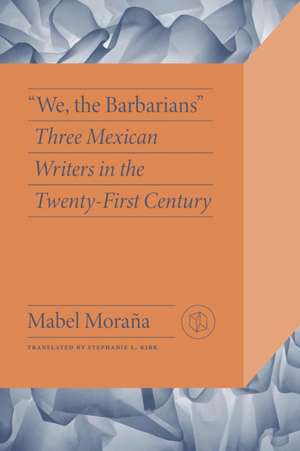
"We, the Barbarians": Three Mexican Writers in the Twenty-First Century: Critical Mexican Studies
Autor Mabel Moraña Traducere de Stephanie Kirken Limba Engleză Paperback – 20 mai 2024
Descoperim în ["We, the Barbarians"] (book) o analiză critică riguroasă ce se distinge prin interdisciplinaritate, situându-se la intersecția dintre istoria literară, sociologia violenței și studiile culturale. Mabel Moraña investighează modul în care literatura mexicană a secolului XXI răspunde descompunerii miturilor naționale și fragmentării societății civile, oferind o perspectivă teoretică asupra modului în care esteticul interacționează cu politicul. Notăm cu interes cum autoarea nu se limitează la un comentariu de text, ci construiește un cadru pentru înțelegerea 'barbariei' ca formă de enunțare în fața precarității extreme.
Structura volumului este segmentată în trei secțiuni diacronice, facilitând o urmărire precisă a evoluției stilistice pentru Yuri Herrera, Fernanda Melchor și Valeria Luiselli. De la micro-lecturile asupra universului lui Herrera — unde sunt analizate 'virtuozitatea testimonială' și funcția mitului — până la reinterpretarea afectului și a spațiului social, progresia cuprinsului indică o acoperire exhaustivă a producției lor literare. Credem că această abordare completează perspectiva oferită de Writing Juárez, adăugând o dimensiune teoretică mai largă asupra relației globale dintre viață și reprezentare simbolică, dincolo de spațiul strict al graniței.
În contextul operei sale anterioare, ["We, the Barbarians"] (book) continuă preocuparea lui Mabel Moraña pentru 'giro afectivo' (turnura afectivă) explorată în El lenguaje de las emociones și pentru structurile de putere analizate în Coloniality at Large. Dacă în lucrările precedente se concentra pe dimensiunea istorică a rasei sau a postcolonialismului, aici autoarea aplică aceste instrumente critice pe fenomenul contemporan al devalorizării vieții, transformând critica literară într-un instrument de diagnoză socială pentru Mexicul actual.




Preț: 319.96 lei
Carte disponibilă
Livrare economică 12-26 noiembrie
Livrare express 28 octombrie-03 noiembrie pentru 43.31 lei
Specificații
ISBN-10: 0826506690
Pagini: 408
Dimensiuni: 152 x 229 x 21 mm
Greutate: 0.57 kg
Editura: Vanderbilt University Press
Colecția Vanderbilt University Press
Seria Critical Mexican Studies
De ce să citești această carte
Această lucrare este esențială pentru cercetătorii și studenții interesați de literatura latino-americană contemporană. Cititorul câștigă o înțelegere profundă a modului în care scriitori precum Yuri Herrera sau Fernanda Melchor transformă violența sistemică în artă. Este o resursă academică de prim rang care explică de ce acești autori au devenit vocile centrale ale noii valuri de proză mexicană, oferind chei de lectură indispensabile pentru decodarea realităților politice actuale prin prisma esteticii.
Despre autor
Mabel Moraña este o figură proeminentă în studiile culturale latino-americane, recunoscută pentru capacitatea sa de a îmbina teoria critică cu analiza literară de finețe. Opera sa vastă, care include titluri de referință precum Coloniality at Large și Poetics of Race in Latin America, demonstrează un interes constant pentru mecanismele de putere, identitate și reprezentare în spațiul hispanic. În prezentul volum, ea își folosește expertiza pentru a cartografia peisajul literar mexican al secolului XXI, consolidându-și reputația de critic capabil să extragă semnificații politice profunde din textul beletristic.
Descriere scurtă
Characterized by the fragmentation of civil society and the decomposition of the myths that accompanied the consolidation of the modern nation, Mexican visual and literary arts have explored a myriad of representational avenues to approach the phenomena of violence, institutional decay, and political instability. The critical and theoretical approaches in “We, the Barbarians” explore a variety of alternative symbolic representations of topics such as nationalism, community, and affect in times impacted by systemic violence, precariousness, and radical inequality. Moraña perceives the negotiations between regional/local imaginaries and global scenarios characterized by the devaluation and resignification of life, both at individual and collective levels. Though it uses three authors as its focus, this book seeks to more broadly theorize the question of the relationship between literature and the social in the twenty-first century.
Recenzii
—Pedro Ángel Palou, author of Mestizo Failure(s): Race, Film, and Literature in Twentieth-Century Mexico
Notă biografică
Stephanie Kirk is a translator and professor of Hispanic studies at Washington University in St. Louis, working on Latin American literature and translation studies.
Cuprins
Chapter 1 | Yuri Herrera: A Distilled and Elliptical Art
Children’s Stories: Preparing Readers
Talud and Other Stories: Telling the Tale
Diez planetas: The Science of Fiction
Testimonial Virtuosity in El Incendio de la mina El Bordo
Microcosms
Human Bodies versus Legal Bodies
Trabajos del Reino: First as Tragedy, then as Farce
Tragedy, Myth, Fable, and Farce
Axes and Paradigms
What’s in a Name?
The Word, a Glimmer
The Corrido as Social Text
Courtly Theater: Dialogic Scenes
Seales que Precederán al Fin del Mundo: A Voyage into Silence
Journey as Paradigm
Word, Language, Time, Writing: Symbolic Displacements
Becomings
Tradition/Modernity and the Function of Myth
“We, the Barbarians”: From Enunciated to Enunciation
La Transmigración de los Cuerpos: “Symbolic Exchange and Death”
Mediation and Mandate
El Alfaqueque and “The Accursed Share”
Social Space and the Place of Death
Body as Commodity
Community/Immunity
Chapter 2 | Fernanda Melchor: Necro-Aesthetics and the “Truth of the Body”
(Thankfully) This Is Not Miami
Chronicle, Border Narrative, and the Villa Rica of la Vera Cruz
Regional Identities: Heterogeneity and Consistency
Lights, Fire, and Shadows
“Youth, Divine Treasure” in Falsa Liebre
The Devastation of Society
Mapping Subjectivity
Perversion, Excess, and Gender
Temporada de Huracanes or the Whirlwind of Language
The Problem with Truth
The Black Hole of a Bruja
Patriarchy and Witchcraft
Between Private and Public Life: Secrets and Gossip
(Anti)Modernity and Community in La Matosa
Chapter 3 | Valeria Luiselli: The Unbearable Lightness of Being
Displacements, Dispositifs, and Gestures
Papeles Falsos: The Exoskeleton and the Seeing Eye
The Map and the Hole
Liminality and Name Dropping
Los Ingrávidos: Owen and I (or Vice Versa?)
The Metaphysics of Presence and the Absence of the Self
Mobility and Fixity
Fabricating the Model: Translation and Simulacrum
The Irritating Historia de mis Dientes
Collectionism and the Aura of the Object
The Auction House as Negotiation of Meaning
Los Niños Perdidos (Un Ensayo en Cuarenta Preguntas)
The Migrant’s Via Crucis and the Theater of Belonging
Microhistory and Literature
Lost Children Archive
Word and Silence; Body and Specter
Experience, Archive, and Narration
Border Semiotics and Autofiction
Luiselli’s Use of Children
Elegiac Discourse
Notes