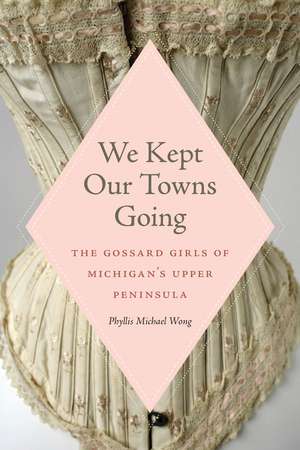
We Kept Our Towns Going: The Gossard Girls of Michigan's Upper Peninsula
Autor Phyllis Michael Wongen Limba Engleză Paperback – mar 2022
Preț: 104.81 lei
Puncte Express: 157
Preț estimativ în valută:
18.55€ • 21.67$ • 16.10£
18.55€ • 21.67$ • 16.10£
Carte disponibilă
Livrare economică 04-18 februarie
Preluare comenzi: 021 569.72.76
Specificații
ISBN-13: 9781611864205
ISBN-10: 1611864208
Pagini: 196
Ilustrații: 20
Dimensiuni: 152 x 229 x 15 mm
Greutate: 0.32 kg
Editura: Michigan State University Press
Colecția Michigan State University Press
ISBN-10: 1611864208
Pagini: 196
Ilustrații: 20
Dimensiuni: 152 x 229 x 15 mm
Greutate: 0.32 kg
Editura: Michigan State University Press
Colecția Michigan State University Press
Notă biografică
PHYLLIS MICHAEL WONG has held roles as a historian, an educator, and thirty-year member of the university level academic world, including as First Lady at Northern Michigan University (2004–12) and San Francisco State University (2012–19).
Cuprins
Contents
Foreword, by Lisa Fine
Preface
Introduction
Chapter 1. The Beginnings of the H. W. Gossard Company
Cecilia Kangas, Gossard Girl
Chapter 2. The Factory
Rose Collick, Gossard Girl
Claude Tripp, Gossard Manager
Chapter 3. A Decade of Expansion
Madeleine DelBello, Gossard Girl
Laila Poutanen, Gossard Girl
Lucy Tousignant, Gossard Girl
Chapter 4. Considering Unionization
Elaine Peterson, Gossard Girl
Helmi Talbacka, Gossard Girl
Denise Anderson, Gossard Girl
Chapter 5. Transforming Fashions
Marjorie Ketola, Gossard Girl
Rita Corradina, Gossard Girl
Chapter 6. Changes Force Gwinn Closure
Paulette Nardi, Gossard Girl
Anita Lehtinen, Gossard Girl
G. Mae Kari, Gossard Girl
Chapter 7. Signs of the Time
Joyce and Dennis Evans, Gossard Couple
Nancy Finnila, Gossard Girl
Remigia Davey, Gossard Girl
Chapter 8. Remembering the Gossard
Gerald Harju, Son of Lydia Harju
Judy Charbonneau, Daughter of Anita Lehtinen
Joan Luoma, Daughter of Clifford and Edith Perry
Barbara Gauthier, Daughter of Viola Medlyn
Michael Morissette, Son of Henry and Alice Morissette
Chris Wiik, Gossard Girl
Chapter 9. Reemergence
Ruth Craine, Gossard Girl and Union Organizer
Geraldine Gordon Defant, ILGWU Union Organizer
Dorothy Windsand, Gossard Girl
Acknowledgments
Appendix. People Interviewed for the Book
Glossary
Sources
Index
Recenzii
Phyllis Michael Wong’s new book We Kept Our Towns Going: The Gossard Girls of Michigan’s Upper Peninsula renders visible the voices of the subaltern. One of the myths of US history is that white women didn’t begin working outside of the home until the early 1970s. This myth has been perpetuated by the lack of storytelling about white women working outside the home. Wong’s pioneering book offers a rare glimpse into this invisible world. This is an astonishing book that will challenge and transform your understanding of what we as Americans think about working women.—Angela J. Hattery, professor of women and gender studies and co-director of the Center for the Study and Prevention of Gender-Based Violence, University of Delaware
In my years of study of Upper Peninsula history I often wondered when the story of the Gossard girls would be told. Now, through Phyllis Michael Wong’s diligent and thorough efforts, the story has arrived—a major milestone in the history of women in the UP.—Russell M. Magnaghi, professor of history emeritus, Northern Michigan University, and author of Upper Peninsula of Michigan: A History
This is a brilliant presentation about the cultural and economic history of women in the garment industry in the UP of Michigan. These are important and moving stories, very well researched.—Douglas B. Roberts, former chair, board of trustees, Northern Michigan University; former director, Institute for Public Policy and Social Research, Michigan State University; and former State Treasurer of Michigan
Relentlessly researched, beautifully written, and chock-full of intimate life stories from some of America’s most impactful glass-ceiling breakers, We Kept Our Towns Going is an engaging yet poignant reminder that our nation’s battle for gender equity, immigrant rights, and labor unions is replete with unsung heroes. Unsung no longer, the Gossard Girls profiled in these pages are worthy of study and celebration as our nation aims to finally and fully eradicate the inequities they so courageously faced.—Framroze M. Virjee, president, California State University, Fullerton
In my years of study of Upper Peninsula history I often wondered when the story of the Gossard girls would be told. Now, through Phyllis Michael Wong’s diligent and thorough efforts, the story has arrived—a major milestone in the history of women in the UP.—Russell M. Magnaghi, professor of history emeritus, Northern Michigan University, and author of Upper Peninsula of Michigan: A History
This is a brilliant presentation about the cultural and economic history of women in the garment industry in the UP of Michigan. These are important and moving stories, very well researched.—Douglas B. Roberts, former chair, board of trustees, Northern Michigan University; former director, Institute for Public Policy and Social Research, Michigan State University; and former State Treasurer of Michigan
Relentlessly researched, beautifully written, and chock-full of intimate life stories from some of America’s most impactful glass-ceiling breakers, We Kept Our Towns Going is an engaging yet poignant reminder that our nation’s battle for gender equity, immigrant rights, and labor unions is replete with unsung heroes. Unsung no longer, the Gossard Girls profiled in these pages are worthy of study and celebration as our nation aims to finally and fully eradicate the inequities they so courageously faced.—Framroze M. Virjee, president, California State University, Fullerton
Descriere
Phyllis Michael Wong tells the stories of the Gossard Girls, women who sewed corsets and bras at factories in Ishpeming and Gwinn from the early twentieth century to the 1970s. As the Upper Peninsula’s mines became increasingly exhausted and its stands of timber further depleted, the Gossard Girls’ income sustained both their families and the local economy.