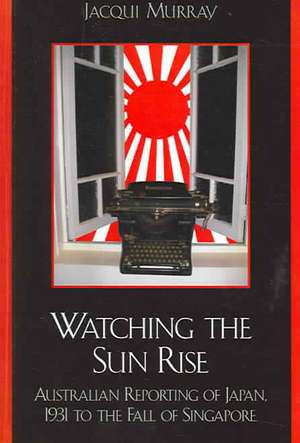
Watching the Sun Rise: Australian Reporting of Japan, 1931 to the Fall of Singapore
Autor Jacqui Murrayen Limba Engleză Hardback – 9 noi 2004
Preț: 665.16 lei
Preț vechi: 1021.60 lei
-35%
Puncte Express: 998
Carte tipărită la comandă
Livrare economică 08-22 iunie
Specificații
ISBN-13: 9780739107829
ISBN-10: 0739107828
Pagini: 296
Dimensiuni: 154 x 232 x 24 mm
Greutate: 0.6 kg
Ediția:New.
Editura: Bloomsbury Publishing
Colecția Lexington Books
Locul publicării:New York, United States
ISBN-10: 0739107828
Pagini: 296
Dimensiuni: 154 x 232 x 24 mm
Greutate: 0.6 kg
Ediția:New.
Editura: Bloomsbury Publishing
Colecția Lexington Books
Locul publicării:New York, United States
Cuprins
Chapter 1 Incident at Mukden
Chapter 2 In News Just to Hand
Chapter 3 The Big Hookup
Chapter 4 Agency Wars, Australian Woes
Chapter 5 Flattery and Facts
Chapter 6 Radio Wars
Chapter 7 Broadcasting for Peace
Chapter 8 Trading Propaganda
Chapter 9 Lies and Spies
Chapter 10 In Service to the Master
Chapter 11 Eastern Adventures
Chapter 2 In News Just to Hand
Chapter 3 The Big Hookup
Chapter 4 Agency Wars, Australian Woes
Chapter 5 Flattery and Facts
Chapter 6 Radio Wars
Chapter 7 Broadcasting for Peace
Chapter 8 Trading Propaganda
Chapter 9 Lies and Spies
Chapter 10 In Service to the Master
Chapter 11 Eastern Adventures
Recenzii
Jacqui Murray brings to life the world of international reporting in the 1930s: tough, often dangerous, and with a somewhat romantic aura. Her subject is Japan's aggression in Manchuria and the looming war in Asia, as seen by the Australian media. She tells of both press and radio, timid, complacent, and beset by propaganda, censorship, and disinformation from all sides. It is, unexpectedly, a story of war, espionage, collaboration, conspiracy, and treason-an exciting revelation of an era we have largely forgotten.
Spin doctors and the manipulation of news stories are nothing new. In this highly readable and compelling account Jacqui Murray draws on experience as journalist and historian to show how Australian perceptions of East Asia in the 1930s were distorted in the media. Interference by an Australian government nervous of dissent and controversy worked on news stories already gathered from inadequate sources. The result was that Australia entered the Pacific War under-prepared and under-informed. Jacqui Murray's story has resonances reaching beyond Australia, and carries lessons for the present day.
Jacqui Murray's <Watching the Sun> weaves fine strains of detail into a fascinating tapestry that presents much more than its prosaic subtitle suggests? Murray has produced a work that challenges conceptions of the media's role in Australian history? Thematerial presented amply demonstrates the limits of professionalism in the thoroughly politicized field of media....
Murray?s superbly critical hard-hitting analysis of pre-World War Two Australian journalism is a solid piece of historical analysis derived from a review of public and private primary sources, many now available for the first time as official papers from the era of World War Two are declassified.
The thesis is a triumph both of research and analysis. It produces new and compelling insights into many aspects of Australian media regarding Japan in the lead-up to the Pacific War. It also effectively demolishes some strands in the history of Australian foreign policy, which suggested much more prescience and fear of the coming Japanese threat, than is justified by the evidence.
Spin doctors and the manipulation of news stories are nothing new. In this highly readable and compelling account Jacqui Murray draws on experience as journalist and historian to show how Australian perceptions of East Asia in the 1930s were distorted in the media. Interference by an Australian government nervous of dissent and controversy worked on news stories already gathered from inadequate sources. The result was that Australia entered the Pacific War under-prepared and under-informed. Jacqui Murray's story has resonances reaching beyond Australia, and carries lessons for the present day.
Jacqui Murray's <Watching the Sun> weaves fine strains of detail into a fascinating tapestry that presents much more than its prosaic subtitle suggests? Murray has produced a work that challenges conceptions of the media's role in Australian history? Thematerial presented amply demonstrates the limits of professionalism in the thoroughly politicized field of media....
Murray?s superbly critical hard-hitting analysis of pre-World War Two Australian journalism is a solid piece of historical analysis derived from a review of public and private primary sources, many now available for the first time as official papers from the era of World War Two are declassified.
The thesis is a triumph both of research and analysis. It produces new and compelling insights into many aspects of Australian media regarding Japan in the lead-up to the Pacific War. It also effectively demolishes some strands in the history of Australian foreign policy, which suggested much more prescience and fear of the coming Japanese threat, than is justified by the evidence.