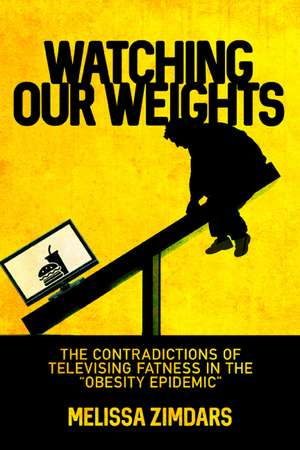
Watching Our Weights: The Contradictions of Televising Fatness in the “Obesity Epidemic”
Autor Melissa Zimdarsen Limba Engleză Hardback – 7 feb 2019
Winner of the 2020 Gourmand Awards, Food Writing Section, USA
Watching Our Weights explores the competing and contradictory fat representations on television that are related to weight-loss and health, medicalization and disease, and body positivity and fat acceptance. While television—especially reality television—is typically understood to promote individual self-discipline and expert interventions as necessary for transforming fat bodies into thin bodies, fat representations and narratives on television also create space for alternative as well as resistant discourses of the body. Melissa Zimdars thus examines the resistance inherent within TV representations and narratives of fatness as a global health issue, the inherent and overt resistance found across stories of medicalized fatness, and programs that actively avoid dieting narratives in favor of less oppressive ways of thinking about the fat body. Watching Our Weights weaves together analyses of media industry lore and decisions, communication and health policies, medical research, activist projects, popular culture, and media texts to establish both how television shapes our knowledge of fatness and how fatness helps us better understand contemporary television.
Watching Our Weights explores the competing and contradictory fat representations on television that are related to weight-loss and health, medicalization and disease, and body positivity and fat acceptance. While television—especially reality television—is typically understood to promote individual self-discipline and expert interventions as necessary for transforming fat bodies into thin bodies, fat representations and narratives on television also create space for alternative as well as resistant discourses of the body. Melissa Zimdars thus examines the resistance inherent within TV representations and narratives of fatness as a global health issue, the inherent and overt resistance found across stories of medicalized fatness, and programs that actively avoid dieting narratives in favor of less oppressive ways of thinking about the fat body. Watching Our Weights weaves together analyses of media industry lore and decisions, communication and health policies, medical research, activist projects, popular culture, and media texts to establish both how television shapes our knowledge of fatness and how fatness helps us better understand contemporary television.
Preț: 848.91 lei
Preț vechi: 1102.47 lei
-23%
Puncte Express: 1273
Preț estimativ în valută:
150.24€ • 175.58$ • 130.44£
150.24€ • 175.58$ • 130.44£
Carte disponibilă
Livrare economică 30 ianuarie-13 februarie
Livrare express 15-21 ianuarie pentru 877.75 lei
Preluare comenzi: 021 569.72.76
Specificații
ISBN-13: 9780813593555
ISBN-10: 0813593557
Pagini: 200
Ilustrații: 15 b-w images
Dimensiuni: 152 x 229 x 20 mm
Greutate: 0.4 kg
Ediția:None
Editura: Rutgers University Press
Colecția Rutgers University Press
ISBN-10: 0813593557
Pagini: 200
Ilustrații: 15 b-w images
Dimensiuni: 152 x 229 x 20 mm
Greutate: 0.4 kg
Ediția:None
Editura: Rutgers University Press
Colecția Rutgers University Press
Notă biografică
MELISSA ZIMDARS is an assistant professor of communication and media at Merrimack College in North Andover, Massachusetts.
Recenzii
"Well-written and enjoyable to read, Watching Our Weights evaluates the various ways that fatness is portrayed on television. It will make an important contribution to popular culture studies in general and television studies specifically."
"Zimdars offers a gripping analysis of fat TV as a site for contesting meanings of health, fatness, and embodiment. Her examination of global trends in televising fatness is meticulously researched."
Descriere
Watching Our Weights explores the competing and contradictory fat representations on television that are related to weight-loss and health, medicalization and disease, and body positivity and fat acceptance. Melissa Zimdars establishes how television shapes our knowledge of fatness and how fatness helps us better understand contemporary television.