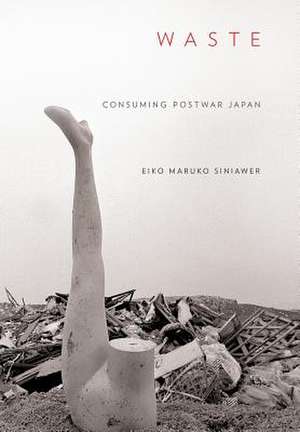
Waste – Consuming Postwar Japan
Autor Eiko Maruko Siniaweren Limba Engleză Hardback – 14 oct 2018
Over the course of the long postwar, Japanese society understood waste variously as backward and retrogressive, an impediment to progress, a pervasive outgrowth of mass consumption, incontrovertible proof of societal excess, the embodiment of resources squandered, and a hazard to the environment. Siniawer also shows how an encouragement of waste consciousness served as a civilizing and modernizing imperative, a moral good, an instrument for advancement, a path to self-satisfaction, an environmental commitment, an expression of identity, and more. From the late 1950s onward, a defining element of Japan's postwar experience emerged: the tension between the desire for the privileges of middle-class lifestyles made possible by affluence and dissatisfaction with the logics, costs, and consequences of that very prosperity. This tension complicated the persistent search for what might be called well-being, a good life, or a life well lived. Waste is an elegant history of how people lived--how they made sense of, gave meaning to, and found value in the acts of the everyday.
Preț: 776.97 lei
Preț vechi: 1064.33 lei
-27%
Puncte Express: 1165
Carte tipărită la comandă
Livrare economică 18 noiembrie-02 decembrie
Livrare prin curier în România Termenul estimat este afișat lângă disponibilitate.
Transport gratuit pentru acest produs Plată online sau ramburs, în funcție de opțiunile comenzii.
Retur gratuit în 14 zile Comandă securizată și suport în română.
Specificații
ISBN-13: 9781501725845
ISBN-10: 150172584X
Pagini: 414
Ilustrații: 18 Halftones, black and white
Dimensiuni: 168 x 234 x 35 mm
Greutate: 0.76 kg
Editura: MB – Cornell University Press
ISBN-10: 150172584X
Pagini: 414
Ilustrații: 18 Halftones, black and white
Dimensiuni: 168 x 234 x 35 mm
Greutate: 0.76 kg
Editura: MB – Cornell University Press
Descriere
In Waste, Eiko Maruko Siniawer innovatively explores the many ways in which the Japanese have thought about waste-in terms of time, stuff, money, possessions, and resources-from the immediate aftermath of World War II to the present. She shows how questions about waste were deeply embedded in the decisions of everyday life, reflecting the...