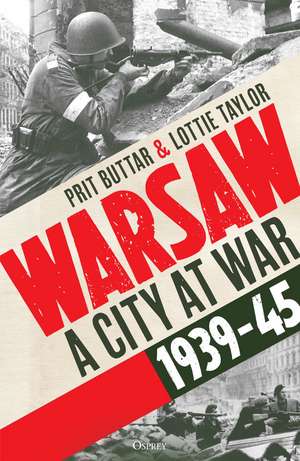
Warsaw: A City at War, 1939–45
Autor Prit Buttar, Lottie Tayloren Limba Engleză Hardback – 10 sep 2026
In Warsaw: A City at War 1939-45, historians Prit Buttar and Lottie Taylor bring to light the unparalleled experience of a city caught between two invading powers, Nazi Germany and the Soviet Union, and the resilience of its citizens.
This fascinating history illuminates how Warsaw's centuries-old fight for identity shaped the course of its wartime experience. For a mere 21 years, Warsaw thrived as the proud capital of an independent Poland, only to be betrayed when Nazi Germany invaded in 1939. Yet the heart of the city - its people - refused to surrender. From the tragic Ghetto Uprising to the heroic city-wide revolt, Warsaw's resistance was fierce as it faced the systematic attempt to erase it from the map. The story does not end with the conclusion of the war, as Warsaw found itself trapped behind the Iron Curtain.
This compelling narrative is not just about battles - it's about a city and its inhabitants, whose unwavering spirit defined them in the darkest of times. Drawing from rare archival material including countless first-hand accounts, Warsaw's wartime years are majestically brought to life.
Preț: 170.11 lei
Preț vechi: 230.82 lei
-26% Nou
Puncte Express: 255
Carte disponibilă
Livrare economică 07-21 noiembrie
Livrare express 27-31 octombrie pentru 103.52 lei
Livrare prin curier în România Termenul estimat este afișat lângă disponibilitate.
Transport gratuit de la 400.00 lei Plată online sau ramburs, în funcție de opțiunile comenzii.
Retur gratuit în 14 zile Comandă securizată și suport în română.
Specificații
ISBN-13: 9781472873514
ISBN-10: 1472873513
Pagini: 432
Ilustrații: 1 x 8pp plate section of black-and-white images
Dimensiuni: 160 x 236 x 40 mm
Greutate: 0.66 kg
Editura: Bloomsbury Publishing
Colecția Osprey Publishing
Locul publicării:London, United Kingdom
ISBN-10: 1472873513
Pagini: 432
Ilustrații: 1 x 8pp plate section of black-and-white images
Dimensiuni: 160 x 236 x 40 mm
Greutate: 0.66 kg
Editura: Bloomsbury Publishing
Colecția Osprey Publishing
Locul publicării:London, United Kingdom
Cuprins
List of Illustrations
List of Maps
Dramatis Personae
Introduction
Chapter 1: The Rebirth of a Nation
Chapter 2: Lebensraum
Chapter 3: Fall Weiss
Chapter 4: A New Partition
Chapter 5: Intelligenzaktion
Chapter 6: Oppression and Defiance
Chapter 7: The Warsaw Ghetto
Chapter 8: Endlösung and The Ghetto Uprising
Chapter 9: Resistance
Chapter 10: Burza
Chapter 11: Tragedy
Chapter 12: The Devastated City
Glossary
Notes
Bibliography
Index
List of Maps
Dramatis Personae
Introduction
Chapter 1: The Rebirth of a Nation
Chapter 2: Lebensraum
Chapter 3: Fall Weiss
Chapter 4: A New Partition
Chapter 5: Intelligenzaktion
Chapter 6: Oppression and Defiance
Chapter 7: The Warsaw Ghetto
Chapter 8: Endlösung and The Ghetto Uprising
Chapter 9: Resistance
Chapter 10: Burza
Chapter 11: Tragedy
Chapter 12: The Devastated City
Glossary
Notes
Bibliography
Index
Recenzii
An excellent book. a beautifully presented and well researched account of an exceptional city at war.