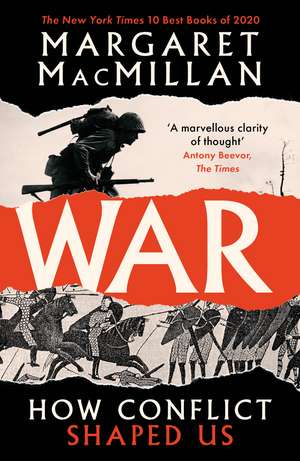
War: How Conflict Shaped Us
Autor Professor Margaret MacMillanen Limba Engleză Paperback – 7 oct 2021
Recomandăm acest volum studenților la istorie, sociologie și științe politice, precum și cercetătorilor interesați de dinamica puterii, oferindu-le un cadru analitic riguros pentru a înțelege de ce conflictul rămâne o constantă umană. În War, Professor Margaret MacMillan demonstrează că, în ciuda „lungii păci” post-1945 teoretizate de Steven Pinker, războiul a modelat fundamental structurile noastre politice, economice și culturale. Descoperim aici o perspectivă nuanțată: războiul nu este doar un distrugător, ci și un catalizator pentru inovații precum penicilina, radarul sau chiar schimbări majore în drepturile civile. Remarcăm stilul clar, care transformă o erudiție vastă într-o lectură accesibilă, susținută vizual de o secțiune de 16 pagini cu planșe. Ca alternativă la War: What is it good for? de Ian Morris pentru cursurile de istorie universală, lucrarea lui MacMillan oferă avantajul unei abordări mai centrate pe factorul uman și pe modul în care instituțiile sociale reflectă natura conflictului, spre deosebire de accentul pus de Morris pe evoluția pe termen lung. Cartea continuă direcția începută în The War that Ended Peace, unde autoarea analiza eșecul diplomației, însă aici extinde aria de investigație de la zorii umanității până în prezent, transformând studiul militar într-o analiză sociologică profundă.
Preț: 77.03 lei
Preț vechi: 94.07 lei
-18%
Carte disponibilă
Livrare economică 12-26 noiembrie
Livrare express 28 octombrie-03 noiembrie pentru 41.17 lei
Specificații
ISBN-10: 1788162579
Pagini: 336
Ilustrații: 16 page plate section
Dimensiuni: 128 x 196 x 24 mm
Greutate: 0.3 kg
Ediția:Main
Editura: Profile
Colecția Profile Books
Locul publicării:London, United Kingdom
De ce să citești această carte
Cititorul câștigă o înțelegere critică a modului în care instituțiile moderne, de la state la sistemele medicale, sunt rezultatul secolelor de conflicte. Este o lectură esențială pentru a demonta mitul că pacea este starea naturală a societății, oferind în schimb o perspectivă realistă asupra modului în care progresul și violența s-au împletit istoric. Un motiv concret pentru a alege această ediție este sinteza magistrală între istoria militară și evoluția culturală.
Despre autor
Professor Margaret MacMillan este o istorică de renume mondial, specializată în relații internaționale și istoria conflictelor. Fostă profesoară la Universitatea Oxford și la Universitatea din Toronto, ea s-a remarcat prin lucrări care analizează momentele de cotitură ale secolului XX, precum The War that Ended Peace sau Peacemakers. Opera sa se concentrează pe rolul deciziilor individuale în istorie, temă explorată și în History's People, și pe modul în care memoria trecutului influențează politica prezentului, subiect central în The Uses and Abuses of History.
Notă biografică
Descriere scurtă
Recenzii
This important book teaches us to realize the impressive way in which war invades every aspect of our society. Read and learn.
War is awful but somehow alluring, dreaded but, too often, welcomed. On these pages, with her vast gifts as an historian and story teller, Margaret MacMillan explains why.
Readable and convincing ... yet another tour de force from Margaret MacMillan
MacMillan's book ranges briskly and fluently across the entire history of human warfare ... she is a bracingly unsentimental observer with an admirable eye for detail.
a lively piece of non-academic writing that brings a sense of urgency to the study of war and society. It reads, though, as if spoken. History-telling, above all the history of battle, is an oral tradition, and MacMillan is its master. The book is full of the kind of detail designed not only to make a point, but also to keep the listener alert. She might just as well have been telling these stories and their curiosities across a campfire before battle ... excellent historical exposé
Elegant ... War is not a historical aberration best forgotten but a clear and ever-present danger for humanity. It merits continuing historical inquiry and political discussion. War is as good a place as any from which to start
brilliant and stimulating
The writing about war in history is sometimes formidable but forbidding (Homer), sometimes rambling but romantic (Churchill), sometimes searching but searing (Erich Maria Remarque). It seldom is energetic and engaging. This book is.
[A] richly eclectic discussion of how culture and society have been molded by warfare throughout history ... MacMillan writes with enormous ease, and practically every page of this book is interesting, even entertaining.
MacMillan cogently explains via colourful historical anecdotes how understanding war means we can also understand our emotions, our ideas and our capacity for good - as well as for cruelty.
delightfully readable. The author wears the immense scholarship underpinning the book lightly. Her writing style is crisp and there is an enviable clarity of thought. This should come as no surprise. MacMillan's previous books, notably Peacemakers, her magisterial account of the 1919 Versailles conference, are critically acclaimed and have won several important awards. War is another fine achievement, and should be widely read by those wishing to understand how armed conflict has shaped, and continues to shape, the world in which we live today.