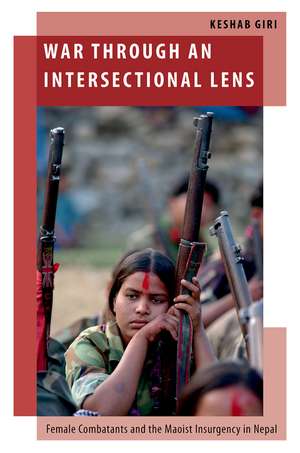
War through an Intersectional Lens: Female Combatants and the Maoist Insurgency in Nepal: Oxford Studies in Gender and International Relations
Autor Keshab Girien Limba Engleză Hardback – 21 mai 2025
Din seria Oxford Studies in Gender and International Relations
- 29%
 Preț: 470.16 lei
 - 24%
 Preț: 181.75 lei
 - 29%
 Preț: 473.71 lei
 - 29%
 Preț: 539.07 lei
 - 29%
 Preț: 471.56 lei
 - 30%
 Preț: 516.34 lei
 - 22%
 Preț: 430.35 lei
 - 29%
 Preț: 443.40 lei
 - 22%
 Preț: 212.70 lei
 - 20%
 Preț: 147.80 lei
 - 24%
 Preț: 150.75 lei
 - 30%
 Preț: 433.29 lei
 - 19%
 Preț: 258.93 lei
 - 18%
 Preț: 347.46 lei
 - 31%
 Preț: 595.44 lei
 - 5%
 Preț: 572.03 lei
 - 10%
 Preț: 354.53 lei
 - 11%
 Preț: 368.33 lei
 - 13%
 Preț: 251.46 lei
 - 23%
 Preț: 256.21 lei
 - 17%
 Preț: 212.70 lei
 - 16%
 Preț: 336.76 lei
 - 23%
 Preț: 222.39 lei
 - 30%
 Preț: 419.59 lei
 - 34%
 Preț: 881.35 lei
 - 18%
 Preț: 259.41 lei
 - 10%
 Preț: 332.28 lei
 - 30%
 Preț: 718.96 lei
 - 22%
 Preț: 195.08 lei
 - 30%
 Preț: 615.02 lei
 - 19%
 Preț: 281.71 lei
 - 14%
 Preț: 593.83 lei
 - 15%
 Preț: 150.41 lei
 - 30%
 Preț: 749.12 lei
 - 11%
 Preț: 486.40 lei
 - 19%
 Preț: 282.47 lei
 - 31%
 Preț: 609.97 lei
 - 30%
 Preț: 617.75 lei
 - 25%
 Preț: 193.45 lei
Preț: 394.64 lei
Preț vechi: 559.63 lei
-29%
Puncte Express: 592
Carte disponibilă
Livrare economică 13-18 noiembrie
Livrare prin curier în România Termenul estimat este afișat lângă disponibilitate.
Transport gratuit de la 400.00 lei Plată online sau ramburs, în funcție de opțiunile comenzii.
Retur gratuit în 14 zile Comandă securizată și suport în română.
Specificații
ISBN-13: 9780197758106
ISBN-10: 019775810X
Pagini: 168
Dimensiuni: 165 x 240 x 20 mm
Greutate: 0.39 kg
Editura: Oxford University Press
Colecția OUP USA
Seria Oxford Studies in Gender and International Relations
Locul publicării:New York, United States
ISBN-10: 019775810X
Pagini: 168
Dimensiuni: 165 x 240 x 20 mm
Greutate: 0.39 kg
Editura: Oxford University Press
Colecția OUP USA
Seria Oxford Studies in Gender and International Relations
Locul publicării:New York, United States
Recenzii
“Treating the experiences of his interlocutors with deep sensitivity and care, Keshab Giri presents a nuanced and complex analysis of women's agency in conflict and post-conflict reconstruction in Nepal. Giri pays particular attention to the non-coercive governance of marriage and sexuality, demonstrating how the 'private sphere' of intimate relations is imbricated and implicated in the lives of female combatants. This book expertly deploys an intersectional approach to the dynamics of wars and their endings and will be of interest to anyone studying gender, agency, and violent conflict.” -Laura J. Shepherd, The University of Sydney
“Keshab Giri has written an exciting and rich feminist analysis that connects the political and private lives of female rebels and pushes discussions of female rebel group activity beyond tired binary notions of 'victim' and 'agents.' Using thoughtful and reflexive methodologies, this book does not just use the rhetoric of intersectionality, but truly illustrates how class, race, and caste shape female rebels' motivations, wartime contributions, and lives post-war.” -Megan H. MacKenzie, Simon Fraser University
“Groundbreaking in every sense. War through an Intersectional Lens demonstrates a robust understanding of the lives of female combatants and how they transition from war to peace. He sensitively draws out the complexity of the experiences of women combatants and how they navigate, resist and accommodate the labels assigned to them as women which are always defined by class, caste, ethnicity, social status, educational status, and geographical location. This book makes an important contribution to the feminist IR literature, feminist security studies, reconciliation literature and has significant policy implications, particularly concerning reintegration, demobilisation and demilitarization of female combatants in places of conflict. This book challenges the 'politics of silences' surrounding the everyday experiences of women combatants in war.” -Azrini Wahidin, The University of Sydney
“Keshab Giri has written an exciting and rich feminist analysis that connects the political and private lives of female rebels and pushes discussions of female rebel group activity beyond tired binary notions of 'victim' and 'agents.' Using thoughtful and reflexive methodologies, this book does not just use the rhetoric of intersectionality, but truly illustrates how class, race, and caste shape female rebels' motivations, wartime contributions, and lives post-war.” -Megan H. MacKenzie, Simon Fraser University
“Groundbreaking in every sense. War through an Intersectional Lens demonstrates a robust understanding of the lives of female combatants and how they transition from war to peace. He sensitively draws out the complexity of the experiences of women combatants and how they navigate, resist and accommodate the labels assigned to them as women which are always defined by class, caste, ethnicity, social status, educational status, and geographical location. This book makes an important contribution to the feminist IR literature, feminist security studies, reconciliation literature and has significant policy implications, particularly concerning reintegration, demobilisation and demilitarization of female combatants in places of conflict. This book challenges the 'politics of silences' surrounding the everyday experiences of women combatants in war.” -Azrini Wahidin, The University of Sydney
Notă biografică
Keshab Giri is a Lecturer in International Relations at The University of St Andrews. He is also a research fellowat the Women and Public Policy Program, Harvard Kennedy School (2023-24). Dr Giri's research has been published in journals like International Studies Quarterly,International Studies Review, Studies in Conflict and Terrorism, and Global Studies Quarterly. His PhD thesis titled, “Experiences of Female Ex-Combatants in the Maoist Insurgency in Nepal: Endless Battles andResistance” received the 2022 Thelma Hunter Gender and Politics PhD Prize from the Australian Political Studies Association (APSA). His research interests include women combatants, intersectionality, gender and war, violentextremism, leftist insurgencies, feminist International Relations, feminist research methodology, rebel governance, and governance of intimacy in rebel groups.
Cuprins
- 1. Introduction
- 2. Women and War: The Turn to the Everyday
- 3. Male Researcher Doing Feminist Fieldwork in the Global South
- 4. Why Women Rebelled in Nepal? Narratives of Mobilization
- 5. Intersectionality and the Temporality of Violence: Female Combatants During and After the War
- 6. The Politicization of the Private Sphere: The Governance of Marriage and Sexuality During and After the War
- 7. Conclusion
- Bibliography