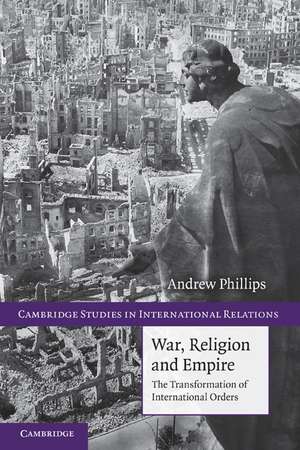
War, Religion and Empire
Autor Andrew Phillipsen Limba Engleză Paperback – 11 sep 2017
În cadrul programelor de studii avansate în Relații Internaționale, analiza stabilității sistemelor politice globale reprezintă un pilon fundamental. Găsim în lucrarea War, Religion and Empire, semnată de Andrew Phillips, o examinare riguroasă a mecanismelor care duc la transformarea sau prăbușirea ordinilor internaționale. Publicat în prestigioasa serie Cambridge Studies in International Relations, volumul propune o abordare hibridă, realist-constructivistă, argumentând că ordinea nu depinde doar de raporturile de forță, ci și de viziuni împărtășite asupra binelui comun și de practici acceptate ale violenței organizate. Descoperim aici o structură narativă și analitică ce pleacă de la definirea conceptului de ordine internațională (capitolele 1-2) și avansează către studii de caz profunde. Autorul analizează minuțios decăderea creștinătății latine și a sinosferei, evidențiind modul în care crizele de legitimitate și inovațiile militare disruptive pot demantela structuri politice milenare. Această lucrare completează perspectiva oferită de Empire and International Order de Noel Parker, adăugând o dimensiune constructivistă esențială: rolul „imaginarului social” în menținerea coeziunii imperiale, element care în textul lui Parker este secundar analizei structurilor de putere. Poziționată în continuarea preocupărilor sale din How the East Was Won și Outsourcing Empire, noua carte a lui Andrew Phillips rafinează interesul său pentru evoluția sistemului global de state. Dacă în lucrările anterioare se concentra pe ascensiunea imperiilor și a companiilor comerciale, aici autorul face pasul spre o teorie generală a declinului, investigând cum „marea dezordine” a dus la nașterea sistemului suveran în Asia de Est și ce lecții putem extrage pentru supraviețuirea ordinii liberale contemporane în fața amenințărilor asimetrice.
Preț: 287.42 lei
Carte tipărită la comandă
Livrare economică 05-19 decembrie
Specificații
ISBN-10: 0521122090
Pagini: 384
Ilustrații: 5 tables
Dimensiuni: 152 x 229 x 21 mm
Greutate: 0.56 kg
Editura: Cambridge University Press
Locul publicării:Cambridge, United Kingdom
V-ar putea interesa
-
 Preț: 400.33 lei
 -
 Realism, Idealism and International PoliticsMartin GriffithsPreț: 397.14 lei
 -
 Symbolic InteractionismHerbert BlumerPreț: 183.24 lei
 -
 Deadlocks in Multilateral NegotiationsAmrita NarlikarPreț: 290.80 lei
 -
 Social Theory of International PoliticsAlexander WendtPreț: 398.31 lei
 -
 The Retreat of the StateSusan StrangePreț: 210.73 lei
 -
 The Right War?Gary RosenPreț: 231.81 lei
 -
 America AloneStefan HalperPreț: 290.15 lei
 -
 Understanding Foreign Policy Decision MakingAlex MintzPreț: 347.63 lei
 -
 From War to DemocracyAnna K. JarstadPreț: 289.29 lei
 -
 After BushTimothy J. LynchPreț: 333.26 lei
 -
 Empire in Denial: The Politics of State-BuildingDavid ChandlerPreț: 231.18 lei
 -
 Development, Security and Unending WarMark DuffieldPreț: 220.77 lei
 -
 -15%Preț: 212.47 lei250.53 lei
 -
 American Foreign Policy and Its ThinkersPerry AndersonPreț: 205.06 lei
 -
 Old Europe, New Europe, Core EuropeDaniel LevyPreț: 167.08 lei
 -
 Incoherent EmpireMichael MannPreț: 186.29 lei
De ce să citești această carte
Recomandăm această carte cercetătorilor și studenților la științe politice care doresc să înțeleagă dincolo de evenimentele curente. Cititorul câștigă un cadru analitic solid pentru a descifra crizele de legitimitate globală. Este o lectură esențială deoarece oferă o perspectivă istorică comparativă rară între Europa și Asia, explicând de ce anumite ordini politice supraviețuiesc secolelor, în timp ce altele se prăbușesc sub presiunea ideologiilor radicale și a noilor tehnologii militare.
Despre autor
Andrew Phillips este cercetător în cadrul Departamentului de Relații Internaționale de la Australian National University. Interesele sale de cercetare sunt concentrate pe evoluția sistemului global de state și pe provocările pe care noile amenințări de securitate le ridică la adresa ordinii mondiale contemporane. Expertiza sa în istoria comparată a sistemelor politice din Asia și Europa este reflectată în lucrări de referință precum How the East Was Won, unde explorează paralelele dintre Imperiul Mughal, Dinastia Qing și Raj-ul Britanic. Contribuția sa la seria Cambridge Studies in International Relations consolidează profilul său de teoretician al ordinii internaționale.
Descriere scurtă
Cuprins
Recenzii
'A rich and novel constructivist analysis of the transformation of international order in both early modern Europe and China. Phillips shows empirically that violence is as much a part of constitutive order as norms.' Henry R. Nau, George Washington University
'War, Religion and Empire is an impressively wide-ranging study that should provoke discussion and debate about the relationship between realism and constructivism, and about how a synthesis of the two can contribute to the historical sociology of international relations. It is a tribute to its breadth that it will challenge many readers to reflect on the conceptual frameworks that can be used to explain the collapse of earlier international orders.' Andrew Linklater, Global Change, Peace and Security
'One of the virtues of the book is that the author gives a primary role to war (realism) and religion (constructivism).' Christopher Coker, International Affairs
'Phillips provides us with an invaluable analytical framework for thinking about the origin, operation, decay and ultimate demise of international orders. War, Religion and Empire is a welcome addition to the constructivist IR literature and we highly recommend it to scholars interested in IR theory, constructivism, comparative historical approaches to IR and the jihadist challenge to the contemporary international order. We also recommend it to faculty teaching undergraduate IR courses.' Andrew A. Latham and Jake Waxman, Cambridge Review of International Affairs