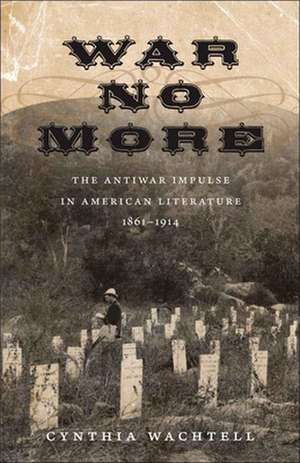
War No More
Autor Cynthia Wachtellen Limba Engleză Paperback – apr 2012
Structura volumului War No More este concepută ca o rectificare istoriografică necesară, organizată cronologic pentru a evidenția ascensiunea inexorabilă a sentimentului anti-război în literele americane. Metodologia autoarei Cynthia Wachtell se bazează pe o cercetare exhaustivă a arhivelor, integrând nu doar opere canonice, ci și documente personale, cum sunt jurnalele ofițerilor sau corespondența privată. Considerăm că forța acestui studiu rezidă în capacitatea de a demonstra că pacifismul literar nu a fost un produs spontan al traumelor din 1914, ci un curent care s-a consolidat pe parcursul a jumătate de secol. Analiza pornește de la interpretări contrastante ale bătăliei de la Chickamauga și evoluează spre examinarea modului în care scriitori precum Nathaniel Hawthorne sau Herman Melville au început să chestioneze moralitatea conflictului armat încă din timpul Războiului Civil. Putem afirma că lucrarea oferă o perspectivă critică asupra tranziției de la reprezentările eroice la cele care subliniază teroarea mecanizării luptei, vizibilă în scrierile lui Mark Twain sau Stephen Crane. Cititorii familiarizați cu We Who Dared to Say No to War de Murray Polner vor aprecia modul în care Cynthia Wachtell aduce un aparat critic academic și o rigoare documentară sporită, concentrându-se specific pe evoluția estetică și etică a textelor, nu doar pe discursul politic. În timp ce The Civil War Era de James H. Meredith explorează miturile generale ale epocii, acest volum izolează și analizează chirurgical impulsul anti-război ca fenomen literar distinct. Ediția de față, publicată de Louisiana State University Press, reușește să sintetizeze 150 de ani de istorie literară, oferind un fundament solid pentru înțelegerea rădăcinilor criticii sociale americane contemporane.
Preț: 220.60 lei
Carte tipărită la comandă
Livrare economică 08-22 decembrie
Specificații
ISBN-10: 0807145637
Pagini: 248
Dimensiuni: 140 x 216 x 14 mm
Greutate: 0.32 kg
Editura: Louisiana State University Press
V-ar putea interesa
-
 The End of the Age of InnocenceA. PricePreț: 342.05 lei
 -
 Northern Irish Literature, 1956-1975M. Parker-18%Preț: 898.90 lei1096.22 lei
 -
 Linguistic Conflict and Language LawsP. LarrivéePreț: 400.87 lei
 -
 The Heyday of Sir Walter ScottDonald DaviePreț: 193.76 lei
 -
 -8%Preț: 524.08 lei569.65 lei
 -
 Alternative Shakespeares Vol 2Terence HawkesPreț: 469.66 lei
 -
 Re-Reading EnglishPeter WiddowsonPreț: 464.99 lei
 -
 Shakespeare's Dramatic StructuresAnthony Brennan-15%Preț: 450.25 lei529.70 lei
 -
 H.G. WellsPatrick ParrinderPreț: 473.93 lei
 -
 Thomas Carlyle: The Critical HeritageJules Paul SiegelPreț: 523.04 lei
 -
 Inventing PolemicJesse M. Lander-14%Preț: 739.84 lei860.27 lei
 -
 Preț: 297.04 lei
 -
 Hemingway Short StoryRobert Paul LambPreț: 259.34 lei
 -
 Australian PatriographyStephen Mansfield-19%Preț: 684.95 lei845.62 lei
 -
 Handbook for Literary Analysis Book IJames P. StobaughPreț: 265.66 lei
 -
 AYN RAND NATIONGary WeissPreț: 134.59 lei
 -
 Diplomacy and Early Modern CultureR. AdamsPreț: 369.20 lei
 -
 Transgressive FictionR. MookerjeePreț: 371.15 lei
 -
 Preț: 372.13 lei
 -
 Twenty-First Century FictionS. AdiseshiahPreț: 370.95 lei
 -
 Preț: 369.35 lei
 -
 The Female Figure in Eiléan Ní Chuilleanáin's PoetryPatricia Boyle HaberstrohPreț: 325.46 lei
 -
 La BolaEmilio RabasaPreț: 156.60 lei
De ce să citești această carte
Această lucrare este esențială pentru studenții și cercetătorii interesați de istoria literară a SUA și de studiile despre pace. Cititorul câștigă o perspectivă nouă asupra modului în care literatura a modelat opinia publică împotriva conflictelor armate cu mult înainte de Hemingway. Este o resursă academică riguroasă care demonstrează că opoziția față de război are rădăcini adânci în cultura americană, fiind documentată prin surse primare fascinante.
Textul de pe ultima copertă
"An astute and eminently readable study that sheds much-needed light on the American antiwar literature produced in the five decades between the Civil War and the Great War." -- American Literature
"War No More upends the standard chronology of American antiwar literature, showing that American writers routinely questioned the morality and sanity of warfare decades earlier than most scholars have imagined." -- Register of the Historical Kentucky Society
Until now, scholars have portrayed America's antiwar literature as an outgrowth of World War I, manifested in the writings of Ernest Hemingway and John Dos Passos. But in War No More, Cynthia Wachtell traces the steady rise of antiwar writing in American literature from the Civil War to the eve of World War I. The authors examined include Herman Melville, Walt Whitman, John William De Forest, Nathaniel Hawthorne, Ambrose Bierce, Stephen Crane, Mark Twain, William Dean Howells, William James, Theodore Roosevelt, and others. War No More concludes by charting the development of antiwar literature from World War I to the present, thus offering the first comprehensive overview of one hundred and fifty years of American antiwar writing.
Descriere scurtă
Beginning with an examination of three very different renderings of the chaotic Battle of Chickamauga -- a diary entry by a northern infantry officer, a poem romanticizing war authored by a young southerner a few months later, and a gruesome story penned by the veteran Ambrose Bierce -- Wachtell traces the gradual shift in the late nineteenth century away from highly idealized depictions of the Civil War. Even as the war was under way, she shows, certain writers -- including Herman Melville, Walt Whitman, John William De Forest, and Nathaniel Hawthorne -- quietly questioned the meaning and morality of the conflict.
As Wachtell demonstrates, antiwar writing made steady gains in public acceptance and popularity in the final years of the nineteenth century and the opening years of the twentieth, especially during the Spanish-American War and the war in the Philippines. While much of the era's war writing continued the long tradition of glorifying battle, works by Bierce, Stephen Crane, Mark Twain, William Dean Howells, William James, and others increasingly presented war as immoral and the modernization and mechanization of combat as something to be deeply feared. Wachtell also explores, through the works of Theodore Roosevelt and others, the resistance that the antiwar impulse met.
Drawing upon a wide range of published and unpublished sources, including letters, diaries, essays, poems, short stories, novels, memoirs, speeches, magazine and newspaper articles, and religious tracts, Wachtell makes strikingly clear that pacifism had never been more popular than in the years preceding World War I. War No More concludes by charting the development of antiwar literature from World War I to the present, thus offering the first comprehensive overview of one hundred and fifty years of American antiwar writing.