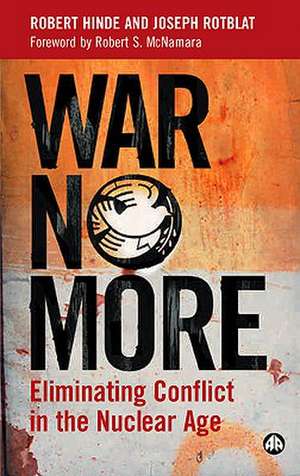
War No More: Eliminating Conflict in the Nuclear Age
Autor Robert Hinde, Joseph Rotblaten Limba Engleză Paperback – 20 oct 2003
Written by Nobel Peace prize winner and former nuclear physicist Joseph Rotblat, who was involved in the creation of the first atom bomb, and biologist/ psychologist Robert Hinde, War No More provides expert insight into the nature of modern warfare - including weapons of mass destruction. Examining the key factors that contribute to conflict, the authors explain how best to approach a peaceful future.
If war is ever to be eliminated, we must address key issues such as the gap between rich and poor; have fully effective arms controls, and above all we must have better education. The authors emphasise the United Nations - as well as NGOs, religious groups, and grassroots movements - also have important parts to play.
Preț: 168.15 lei
Puncte Express: 252
Preț estimativ în valută:
29.73€ • 34.80$ • 25.96£
29.73€ • 34.80$ • 25.96£
Carte disponibilă
Livrare economică 13-27 februarie
Livrare express 29 ianuarie-04 februarie pentru 26.34 lei
Preluare comenzi: 021 569.72.76
Specificații
ISBN-13: 9780745321912
ISBN-10: 0745321917
Pagini: 240
Ilustrații: Illustrations
Dimensiuni: 135 x 215 x 15 mm
Greutate: 0.37 kg
Editura: PLUTO PRESS
Colecția Pluto Press
ISBN-10: 0745321917
Pagini: 240
Ilustrații: Illustrations
Dimensiuni: 135 x 215 x 15 mm
Greutate: 0.37 kg
Editura: PLUTO PRESS
Colecția Pluto Press
Notă biografică
Robert Hinde was Emeritus Royal Society Research Professor in the Department of Zoology at the University of Cambridge, and a Fellow and former Master of St John's College. He trained as an RAF pilot in WW2 and wrote extensively on the causes of wars. He was the co-author of War No More (Pluto, 2003) and held the Hitchcock Professorship at the University of California, Berkeley, and was an honorary Foreign Associate of the National Academy of Sciences.
Cuprins
Acknowledgements
Foreword
Introduction
Of War And Its Weapons
1. The Diversity of Wars
2. The Nuclear Peril
3. Other Weapons Of Mass Destruction
4. 'Conventional' Weapons
What Makes War More Likely?
5. Causes of War and the Role of Weapons
6. The Political System and its Leaders
7. Culture and Tradition
8. Resources: Territory and the Environment
9. Economic Factors: Globalisation and Poverty
10. War and Human Nature
What Should Be Done To Eliminate War?
11. What Stops Countries from Going to War?
12. Preventing War: Arms Control
13. Preventing War: Promotion of International Well-Being and Peace Education
14. Organisations Involved in Prevention, Intervention and Conflict Resolution
15. Intervention and Conflict Resolution
16. Epilogue: Ending Conflict in the Nuclear Age
Abbreviations and Acronyms
Further Reading
Index
Foreword
Introduction
Of War And Its Weapons
1. The Diversity of Wars
2. The Nuclear Peril
3. Other Weapons Of Mass Destruction
4. 'Conventional' Weapons
What Makes War More Likely?
5. Causes of War and the Role of Weapons
6. The Political System and its Leaders
7. Culture and Tradition
8. Resources: Territory and the Environment
9. Economic Factors: Globalisation and Poverty
10. War and Human Nature
What Should Be Done To Eliminate War?
11. What Stops Countries from Going to War?
12. Preventing War: Arms Control
13. Preventing War: Promotion of International Well-Being and Peace Education
14. Organisations Involved in Prevention, Intervention and Conflict Resolution
15. Intervention and Conflict Resolution
16. Epilogue: Ending Conflict in the Nuclear Age
Abbreviations and Acronyms
Further Reading
Index
Descriere
Eliminating the barriers to peace