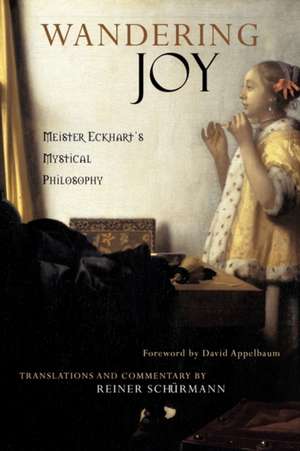
Wandering Joy
Autor Meister Eckharten Limba Engleză Paperback – iun 1997
Schürmann shows us that Eckhart is our contemporary. He describes the threefold movement of detachment, release, and "dehiscence" (splitting open), which leads to the experience of "living without a why," in which all things are in God and sheer joy. Going beyond that, he describes the transformational force of approaching the Godhead, the God beyond God:
"A man who has experienced the same no longer has a place to establish himself. He has settled on the road, and for those who have learned how to listen, his existence becomes a call. This errant one dwells in joy. Through his wanderings the origin beckons."
Preț: 109.97 lei
Puncte Express: 165
Carte disponibilă
Livrare economică 06-20 noiembrie
Livrare express 23-29 octombrie pentru 31.42 lei
Livrare prin curier în România Termenul estimat este afișat lângă disponibilitate.
Transport gratuit de la 400.00 lei Plată online sau ramburs, în funcție de opțiunile comenzii.
Retur gratuit în 14 zile Comandă securizată și suport în română.
Specificații
ISBN-13: 9780970109712
ISBN-10: 0970109717
Pagini: 304
Dimensiuni: 153 x 234 x 19 mm
Greutate: 0.46 kg
Editura: Lindisfarne Books
Locul publicării:United Kingdom
ISBN-10: 0970109717
Pagini: 304
Dimensiuni: 153 x 234 x 19 mm
Greutate: 0.46 kg
Editura: Lindisfarne Books
Locul publicării:United Kingdom
V-ar putea interesa
-
 Hildegard of Bingen: The Woman of Her AgeFiona MaddocksPreț: 107.43 lei
 -
 The Wounding and Healing of DesireWendy FarleyPreț: 182.69 lei
 -
 Dorothee Soelle - Mystic and RebelMartin H RumscheidtPreț: 199.32 lei
 -
 The Way of the Practical MysticHenry Thomas HamblinPreț: 137.30 lei
 -
 Predigten, Traktate, SprucheMeister EckhartPreț: 61.32 lei
 -
 Prayer of the Heart in Christian and Sufi MysticismLlewellyn Vaughan-LeePreț: 71.26 lei
 -
 The Suburbs of Heaven: The Diary of Murdoch CampbellMurdoch CampbellPreț: 146.75 lei
 -
 The Interior Castle, or The Mansions (Aziloth Books)St Teresa De AvilaPreț: 87.43 lei
 -
 A Companion to John of RuusbroecJohn Arblaster-23%Preț: 1476.31 lei1917.29 lei
 -
 The Devotion and Promotion of Stigmatics in Europe, C. 1800-1950Tine Van Osselaer-23%Preț: 1520.57 lei1974.77 lei
Notă biografică
Meister Eckhart (Eckhart von Hochheim O.P., c.1260-c.1328) was a German theologian, philosopher, and mystic born near Gotha, in the Landgraviate of Thuringia in the Holy Roman Empire. Eckhart came to prominence during the Avignon papacy, a time of increased tensions among monastic orders, diocesan clergy, the Franciscan Order, and Eckhart's Dominican Order of Preachers. In later life, Eckhart was accused of heresy, brought before the local Franciscan-led Inquisition, and tried as a heretic by Pope John XXII, but it seems he died before his verdict was received. He was well known for his work with pious lay groups such as the Friends of God and was succeeded by his more circumspect disciples John Tauler and Henry Suso. Since the nineteenth century, he has received renewed attention. He has acquired a status as a great mystic within contemporary popular spirituality, as well as considerable interest from scholars situating him within the medieval scholastic and philosophical tradition.