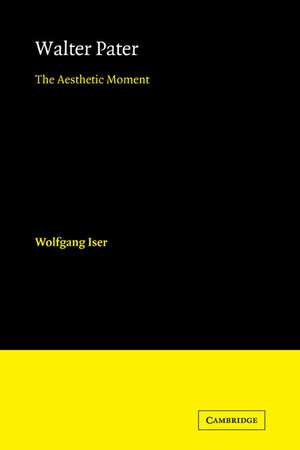
Walter Pater
Autor Wolfgang Iser, Iseren Limba Engleză Paperback – 6 dec 2010
Preț: 321.73 lei
Puncte Express: 483
Carte tipărită la comandă
Livrare economică 27 noiembrie-11 decembrie
Livrare prin curier în România Termenul estimat este afișat lângă disponibilitate.
Transport gratuit de la 400.00 lei Plată online sau ramburs, în funcție de opțiunile comenzii.
Retur gratuit în 14 zile Comandă securizată și suport în română.
Specificații
ISBN-13: 9780521179287
ISBN-10: 0521179289
Pagini: 226
Dimensiuni: 152 x 229 x 13 mm
Greutate: 0.34 kg
Editura: Cambridge University Press
Locul publicării:Cambridge, United Kingdom
ISBN-10: 0521179289
Pagini: 226
Dimensiuni: 152 x 229 x 13 mm
Greutate: 0.34 kg
Editura: Cambridge University Press
Locul publicării:Cambridge, United Kingdom
V-ar putea interesa
-
 The Portable Edgar Allan PoeEdgar Allan Poe-22%Preț: 102.06 lei130.79 lei
 -
 Ethics, Evil, and FictionColin McGinn-20%Preț: 348.72 lei434.29 lei
 -
 The Cambridge Companion to Crime FictionMartin PriestmanPreț: 283.65 lei
 -
 Witness Against the BeastE. P. ThompsonPreț: 169.75 lei
 -
 The Cambridge Companion to Oscar WildePeter RabyPreț: 216.77 lei
 -
 Preț: 222.11 lei
 -
 The Cambridge Introduction to W.B. YeatsDavid HoldemanPreț: 245.77 lei
 -
 The Cambridge Introduction to Harriet Beecher StoweSarah RobbinsPreț: 251.13 lei
 -
 The Cambridge Companion to the Spanish NovelHarriet TurnerPreț: 278.92 lei
 -
 Preț: 61.67 lei
 -
 -18%Preț: 1297.00 lei1581.71 lei
 -
 George Eliot: A Critic's BiographyProfessor Barbara Hardy-23%Preț: 175.47 lei227.62 lei
 -
 Charles DickensDr Donald Hawes-17%Preț: 176.16 lei213.02 lei
 -
 -25%Preț: 275.00 lei367.91 lei
 -
 Emily Dickinson and PhilosophyJed Deppman-14%Preț: 704.65 lei819.36 lei
 -
 Preț: 60.83 lei
Cuprins
Foreword; Part I. Introduction; Section 1. Pater Criticism; Section 2. Historical Preliminaries: 1. Art as creation; 2. Art as mimesis; Part II. Autonomous Art; Section 3. The Starting Point: 1. Scepticism; 2. The essay; 3. Defining human existence; 4. Expression; Section 4. Defining Art: 1. 'Art for art's sake'; 2. Impressionism; 3. Style; Section 5. The Problem of Orientation: 1. Beauty; 2. 'Postscript'; Part III. Art and History; Section 6. What Is History?: 1. Hegelian schematism; 2. Historicity; 3. 'House Beautiful'; Section 7. The Limits of Historical Legitimation: 1. Plato and Platonism; 2. Glaston de Latour; Part IV. Art and Myth; Section 8. The Ancient Gods: 1. Cult and ritual; 2. 'The myth of Demeter and Persephone'; 3. 'A study of Dionysis'; Section 9. The Limits of Mythical Legitimation: 1. 'Apollo in Picardy'; 2. Pater and Nietzche; Part V. The Aesthetic Existence; Section 10. Marius the Epicurean: 1. The form; 2. The problem; Section 11. Imaginary Portraits: 1. The form; 2. 'A Prince of Court Painters'; 3. Denys l'Auxerrois'; 4. 'Sebastian van Storck'; 5. 'Duke Carl of Rosenmold'; Conclusion; Notes; Bibliography; Biographical addendum; Index of names; Index of subjects.
Descriere
Within this text, first published in German in 1960, the influential German literary scholar Wolfgang Iser writes engagingly of Pater's aesthetic.