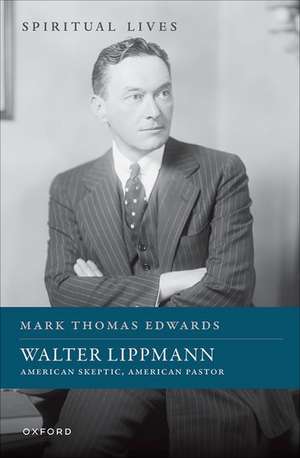
Walter Lippmann: American Skeptic, American Pastor: Spiritual Lives
Autor Mark Thomas Edwardsen Limba Engleză Hardback – 9 iun 2023
În acest nou volum din seria Spiritual Lives, Mark Thomas Edwards propune o reevaluare provocatoare a celui mai influent jurnalist politic al secolului XX. Observăm cum Walter Lippmann nu este prezentat aici doar ca arhitectul opiniei publice moderne, ci ca un „pastor american” neconvențional, a cărui gândire a fost profund marcată de pierderea unei moralități comune într-o eră post-creștină. Spre deosebire de abordările biografice clasice, această ediție se concentrează pe dimensiunea spirituală și teologică ascunsă a operei sale, investigând cum un sceptic declarat a ajuns să fie vocea care avertiza asupra pericolelor și, totodată, necesității unei religii civile.
Descoperim o analiză metodică a modului în care Lippmann a navigat între identitatea sa evreiască, pe care a marginalizat-o, și atracția față de valorile creștine occidentale. Remarcăm efortul autorului de a scoate la lumină „punctele oarbe” ale liberalismului lui Lippmann, în special în zonele sensibile ale rasei și clasei sociale. Cartea este comparabilă cu Walter Lippmann and the American Century de Ronald Steel în rigurozitate documentară, dar este actualizată pentru a răspunde preocupărilor contemporane privind criza de consens ideologic și rolul credinței în spațiul public. Dacă în lucrările sale anterioare, precum The Right of the Protestant Left sau Faith and Foreign Affairs in the American Century, Mark Thomas Edwards a explorat intersecția dintre protestantismul liberal și politica externă, aici el restrânge cadrul asupra individului ca simbol al unei națiuni aflate în căutarea sensului. Este o lectură esențială pentru a înțelege cum conceptele de „stereotip” sau „Război Rece” au apărut dintr-o minte care vedea ordinea mondială ca pe o luptă tragică și perpetuă între necesitate și limitare.
Din seria Spiritual Lives
- 12%
 Preț: 373.48 lei
 - 12%
 Preț: 294.22 lei
 - 13%
 Preț: 290.23 lei
 - 11%
 Preț: 344.38 lei
 - 12%
 Preț: 256.83 lei
 - 11%
 Preț: 248.72 lei
 - 17%
 Preț: 170.91 lei
 - 12%
 Preț: 358.72 lei
 - 28%
 Preț: 365.08 lei
 - 28%
 Preț: 352.20 lei
 - 14%
 Preț: 284.24 lei
 - 13%
 Preț: 288.17 lei
 - 12%
 Preț: 294.29 lei
 -
 Preț: 359.22 lei
 - 11%
 Preț: 248.68 lei
 - 16%
 Preț: 145.07 lei
 - nou
 Preț: 228.27 lei
Preț: 344.63 lei
Preț vechi: 386.78 lei
-11%
Carte disponibilă
Livrare economică 06-17 noiembrie
Livrare express 24-30 octombrie pentru 73.42 lei
Specificații
ISBN-10: 0192895168
Pagini: 240
Dimensiuni: 137 x 203 x 18 mm
Greutate: 0.36 kg
Editura: OUP OXFORD
Colecția OUP Oxford
Seria Spiritual Lives
Locul publicării:Oxford, United Kingdom
De ce să citești această carte
Această biografie intelectuală se adresează cititorilor interesați de istoria ideilor politice și de rolul religiei în democrație. Prin parcurgerea lucrării, veți înțelege nu doar mecanismele comunicării de masă teoretizate de Lippmann, ci și fundamentele morale ale liberalismului american. Este o resursă valoroasă pentru cei care doresc să descopere cum îndoiala și scepticismul pot deveni instrumente constructive în definirea unei societăți libere, dincolo de etichetele politice simpliste.
Despre autor
Mark Thomas Edwards este un istoric specializat în intersecția dintre religie, politică și relații internaționale în contextul american. Opera sa se concentrează frecvent pe analiza mișcărilor religioase de stânga și pe influența acestora asupra politicii externe a Statelor Unite. În volume precum The Right of the Protestant Left, el a explorat tensiunile interne ale protestantismului ecumenic, o temă care fundamentează și analiza sa actuală asupra lui Walter Lippmann. Prin această contribuție la seria Spiritual Lives, Edwards își confirmă poziția de cercetător atent la nuanțele teologice care modelează marii gânditori laici ai modernității.
Descriere
Recenzii
Mark Edwards' exhaustively documented, analytically ambitious study of Walter Lippmann's career argues that the notorious contradictions, conceits, and blind spots in Lippmann's writings are largely explained by a quasi religious quest for a national community that is at once post Judaic, post Catholic, and post Protestant. By ascribing to Lippmann's secularism a sense of religious mission grounded in a decidedly Judeo-Christian matrix, Edwards brings a fresh perspective to one of the most studied of American intellectuals. Against the many observers who have emphasized the "integrity" and "wisdom" of Lippmann's performance as a public moralist, Edwards insists that Lippmann was a "chameleon," whose brilliance functioned as a vehicle for a virtual infinity of American virtues and vices.
Mark Edwards smartly situates Walter Lippmann smack dab in the thicket of American exceptionalism and its religious facets. As such, Edwards' book is a welcome reminder of a public intellectual whose insights were arguably wiser than Reinhold Niebuhr's. Edwards' Lippmann could well turn out to be the better guide to the spiritual dilemmas of the United States' global dominance in the twentieth century than any voice the nationâs churches produced.
This slim but fruitful volume is the rare book that reconceptualizes the thought of a well-researched thinker in a way that illuminates rather than distracts...Highly recommended. Undergraduates through faculty.
This stimulating and thought-provoking book appears in a series entitled "Spiritual Lives," which offers "biographies of prominent men and women whose eminence is not primarily based on a specifically religious contribution." Walter Lippmann was the great interpreter, analyst, and critic of twentieth century America's self-understanding. Verbally gifted, he either invented or popularized the key concepts that Americans used to understand the world they were shaping, including globalism, stereotypes, and the Cold War. Mark Thomas Edwards presents a fascinating interpretation of a man whose analyses were constantly changing, yet seemed founded on a moral certainty.
In our present context, Edwards provides an important study of Lippmann's criticism of easy consensus built upon ideological stasis.