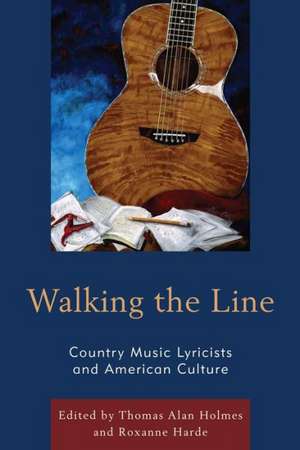
Walking the Line: Country Music Lyricists and American Culture
Editat de Thomas Alan Holmes, Roxanne Harde Contribuţii de Pete Falconer, Howard Steve Goodson, Taylor Hagood, Douglas Harrison, Michael MacDonald, Clay Motley, Laura Pattillo, Blase Scarnati, June Skinner Sawyers, James Zborowski, Samantha Christensenen Limba Engleză Paperback – 9 oct 2013
Preț: 345.92 lei
Preț vechi: 484.18 lei
-29%
Puncte Express: 519
Carte tipărită la comandă
Livrare economică 27 noiembrie-11 decembrie
Livrare prin curier în România Termenul estimat este afișat lângă disponibilitate.
Transport gratuit de la 400.00 lei Plată online sau ramburs, în funcție de opțiunile comenzii.
Retur gratuit în 14 zile Comandă securizată și suport în română.
Specificații
ISBN-13: 9780739169674
ISBN-10: 073916967X
Pagini: 247
Dimensiuni: 154 x 231 x 23 mm
Greutate: 0.44 kg
Editura: Bloomsbury Publishing
Colecția Lexington Books
Locul publicării:New York, United States
ISBN-10: 073916967X
Pagini: 247
Dimensiuni: 154 x 231 x 23 mm
Greutate: 0.44 kg
Editura: Bloomsbury Publishing
Colecția Lexington Books
Locul publicării:New York, United States
Cuprins
Table of Contents
Acknowledgments
Credits
Introduction
Walking the Line: The Dixie Chicks and the Making of Country Lyricists
Thomas Alan Holmes
Roxanne Harde
Chapter 1
"Nobody knows but me": Jimmie Rodgers and the Body Politic
Taylor Hagood
Chapter 2
Cindy Walker, Lyle Lovett, and the West
Thomas Alan Holmes
Chapter 3
"Help your brother along the way": Hank Williams and the Humane Tradition
Howard Steve Goodson
Chapter 4
JC: Johnny Cash and Faith
Thomas Alan Holmes
Chapter 5
Religious Doctrine in the mid-1970s to 1980s Country Music Concept Albums of Willie Nelson
Blase S. Scarnati
Chapter 6
Grace to Catch a Falling Soul: Country, Gospel, and Evangelical Populism in the Music of Dottie Rambo
Douglas Harrison
Chapter 7
"Here's the story of my life; listen and I'll tell it twice": The Appalachian Autobiography of Loretta Lynn
Laura Grace Pattillo
Chapter 8
"Branded" Man: Merle Haggard's Romance of the Outlier
Thomas Alan Holmes
Chapter 9
Townes van Zandt: "Now here's what this story's told."
Pete Falconer and James Zborowski
Chapter 10
Wildness, Eschatology, and Enclosure in the Songs of Townes Van Zandt
Michael B. MacDonald
Chapter 11
"Where it counts I'm real": The Complexities of Dolly Parton's Feminist Voice
Samantha Christensen
Chapter 12
"Sin City": Gram Parsons and the "Christ-Haunted South"
Clay Motley
Chapter 13
Weeping Willows and Long Black Veils: The Country Roots of Rosanne Cash, from Scotland to Tennessee
June Skinner Sawyers
Chapter 14
"They draft the white trash first 'round here anyway": Steve Earle's American Boys
Roxanne Harde
Index
About the Contributors
Acknowledgments
Credits
Introduction
Walking the Line: The Dixie Chicks and the Making of Country Lyricists
Thomas Alan Holmes
Roxanne Harde
Chapter 1
"Nobody knows but me": Jimmie Rodgers and the Body Politic
Taylor Hagood
Chapter 2
Cindy Walker, Lyle Lovett, and the West
Thomas Alan Holmes
Chapter 3
"Help your brother along the way": Hank Williams and the Humane Tradition
Howard Steve Goodson
Chapter 4
JC: Johnny Cash and Faith
Thomas Alan Holmes
Chapter 5
Religious Doctrine in the mid-1970s to 1980s Country Music Concept Albums of Willie Nelson
Blase S. Scarnati
Chapter 6
Grace to Catch a Falling Soul: Country, Gospel, and Evangelical Populism in the Music of Dottie Rambo
Douglas Harrison
Chapter 7
"Here's the story of my life; listen and I'll tell it twice": The Appalachian Autobiography of Loretta Lynn
Laura Grace Pattillo
Chapter 8
"Branded" Man: Merle Haggard's Romance of the Outlier
Thomas Alan Holmes
Chapter 9
Townes van Zandt: "Now here's what this story's told."
Pete Falconer and James Zborowski
Chapter 10
Wildness, Eschatology, and Enclosure in the Songs of Townes Van Zandt
Michael B. MacDonald
Chapter 11
"Where it counts I'm real": The Complexities of Dolly Parton's Feminist Voice
Samantha Christensen
Chapter 12
"Sin City": Gram Parsons and the "Christ-Haunted South"
Clay Motley
Chapter 13
Weeping Willows and Long Black Veils: The Country Roots of Rosanne Cash, from Scotland to Tennessee
June Skinner Sawyers
Chapter 14
"They draft the white trash first 'round here anyway": Steve Earle's American Boys
Roxanne Harde
Index
About the Contributors
Recenzii
This book presents 14 essays, by a variety contributors, about 15 country-music lyricists. The order is roughly chronological, starting with Jimmie Rodgers and ending with Steve Earle. Though excerpts from the subjects' lyrics are quoted, complete lyrics are not provided. Instead, the contributors discuss the lyricists' works in their cultural context. It is common for country artists to perform songs that others wrote for them, but, interestingly, most of these essays concern lyrics that well-known artists such as Hank Williams, Merle Haggard, Loretta Lynn, and Willie Nelson wrote, performed, and popularized themselves. The exception is Cindy Walker, who was extremely successful as a lyricist but little known as a performer. Most of the essayists, including Holmes and Harde, are professors of or specialists in English and history rather than music. It is thus understandable that their discussions focus on topics such as the dominant culture, regional history, and religious views that shaped the lyricists, without delving into matters of musical style. This book is suitable for for anyone interested in American popular music and popular culture. Summing Up: Recommended. Upper-division undergraduates through faculty.
Songs are the children of songwriters and, though each song carries the songwriter's gene, each song-like each child-is an individual all its own. In this remarkable collection of essays, a group of writers examine songwriters and their songs; how they are born, nurtured and grow from a child to an independent adult. Walking the Line profiles songwriters and their offspring in a way that is intelligent, thoughtful, instructive, heart-felt, deep and long-lasting-just like a great song.
Like Dolly Parton's 'Coat of Many Colors', these diverse essays are carefully stitched together by Holmes and Harde to form a many-hued portrait of the lyrics and cultural meaning in country music song writing. As the collection clearly demonstrates, the best songwriters, many times social outsiders themselves, are more likely to color outside the cultural lines of their collective audience than to acquiesce to traditional themes and beliefs. An important addition to the collective knowledge of cultural creation and easily the best such collection since Tichi's Reading Country Music.
Songs are the children of songwriters and, though each song carries the songwriter's gene, each song-like each child-is an individual all its own. In this remarkable collection of essays, a group of writers examine songwriters and their songs; how they are born, nurtured and grow from a child to an independent adult. Walking the Line profiles songwriters and their offspring in a way that is intelligent, thoughtful, instructive, heart-felt, deep and long-lasting-just like a great song.
Like Dolly Parton's 'Coat of Many Colors', these diverse essays are carefully stitched together by Holmes and Harde to form a many-hued portrait of the lyrics and cultural meaning in country music song writing. As the collection clearly demonstrates, the best songwriters, many times social outsiders themselves, are more likely to color outside the cultural lines of their collective audience than to acquiesce to traditional themes and beliefs. An important addition to the collective knowledge of cultural creation and easily the best such collection since Tichi's Reading Country Music.